

West Virginia's Ascend program: Economic development one worker at a time
Since 2021, West Virginia has paid remote workers $12,000 to move there with a job already in hand. By the program's count, 827 workers and their families, 1,641 people, have come. Here is how that compares with JobsOhio's big bets, like Intel.

Over the last two days we followed the money on JobsOhio. We first built a public tool to track its grants, understand who gets the money, and what happened to it. We then followed this up by studying where the money went.
One of the main takeaways is that JobsOhio has given out a boatload of grants, but when you look at the dollars, the program has given a disproportionate amount of money to large corporations who are promising to create loads of jobs in one shot.
There is a term for this strategy in sales.
It’s called whale hunting.
You go after the “whales” hoping to harpoon one that can bring in a bunch of revenue, or in this case, jobs. But, as we learned earlier this week, an economic development strategy that is based on whale hunting is a risky sport. It can end in grantees issuing mass layoffs, closing the funded site, going bankrupt, subject to lawsuits for nonperformance, or just never building the facility they signed up to build. In short, it’s a strategy rife with concentration risk.
For example, Ohio has made one huge bet on Intel, a package reported at about $2.1 billion. Ohio has already paid out at least $839.4 million of it, $125.4 million of that from JobsOhio. It turns out that whether this bet pays off or not rests on whether Intel can land “a significant external customer” for its new 14A chipmaking process. If it can't, Intel says, in its own words, it “may pause or discontinue” 14A, and if it does, it “would likely discontinue the new leading-edge fabrication facilities we are building in Ohio.” In its latest quarterly report, from October 2026, Intel says it has committed to finishing development of 14A, but that how much and how fast it builds will depend on committed customer demand. The project is not off to a good start. It has already been delayed from 2025 to 2030 or 2031, and now we are left to wait and see whether Intel can find customers for its 14A process in a fast-changing chip market where, by Intel's own account, AI spending is driving demand.
Anyway, that’s one way to do it.
But there is an entire spectrum of other ways to approach economic development. Today’s post is about one of the most interesting ones we have come across, which just happens to be going on right next door to Ohio. It’s called the Ascend program, and we are focusing on it today because West Virginia's approach to economic development is about as different from JobsOhio as a program could be. Instead of trying to hunt whales, Ascend is going after individual workers. It provides an incentive directly to a worker to relocate to West Virginia, and bring their very healthy income to the community to which they move. It’s the other economic development bookend sitting on the opposite side of the bookshelf. The yin to Ohio’s yang. That alone made it fascinating to us, and set us off on our exploration of the program. Here is what we found.
What Ascend is, in its own words
Ascend WV opened applications on April 12, 2021. It is run by West Virginia University's Brad and Alys Smith Outdoor Economic Development Collaborative, and it pays remote workers to move to one of six parts of the state. The offer is $12,000 in cash, paid monthly over two years, plus free outdoor gear and recreation. The program values the full package at "more than $20,000." Ascend and the Collaborative that runs it were started with a $25 million gift to WVU from Brad and Alys Smith's Wing 2 Wing Foundation, with support from the West Virginia Department of Tourism.
To join, a person must work remotely full time or be self-employed. Before they are accepted, applicants must "provide evidence of employment and income," such as a recent paystub or tax documents, and an employer must confirm the job.
The program started in the Morgantown area in April 2021. It has since added the Eastern Panhandle (June 2022), Greenbrier Valley (September 2022), Greater Elkins (November 2022), New River Gorge (June 2023) and Charleston (September 2025). In September 2021, it said it would bring more than 1,000 remote workers to the state within five years.
Here is where the program stands by its own count. As of September 30, 2026, WVU reports:
- 827 members, the remote workers themselves, or 82.7% of that goal
- 1,641 new West Virginians, counting family members and 25 babies born during the program
- 184 members who have finished the two-year program
- a 96% retention rate, which WVU defines as members who stayed after at least four months in the program
- more than 94,400 applications
The program has released counts like these every few months since its first class. The chart below shows each one on the date it came out.
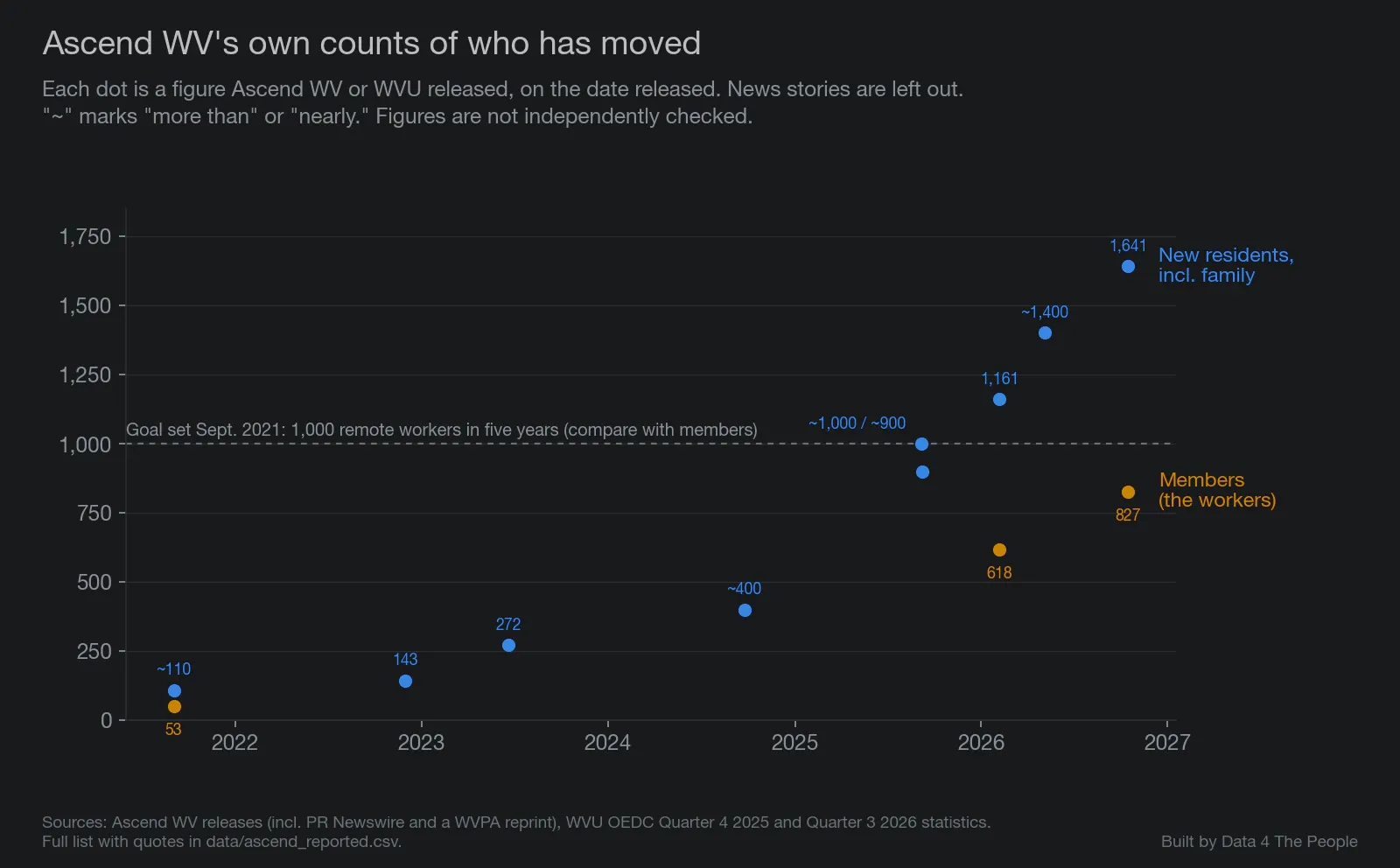
Source: Ascend WV and WVU releases and statistics. WVU shared its Q3 2026 statistics with Data 4 The People.
Ascend also publishes the average salary of its members in each community. As of September 2026, the averages ranged from $82,122 in the Charleston area to $110,020 in the Eastern Panhandle.
West Virginia started gaining people from other states around the time Ascend launched
We were curious if we could measure the impact that Ascend had on migration into West Virginia since the program's inception. So, we consulted the census data. It turns out that since COVID, West Virginia has been a huge beneficiary of net in-migration. The turnaround in migration is astounding. In the five years from July 2014 to July 2019, the state lost 39,847 people this way, on net. That turned around in the year ending July 2021. West Virginia has gained people from other states every year since, a total of 17,349 through July 2025. The chart below shows this net domestic migration for each year.
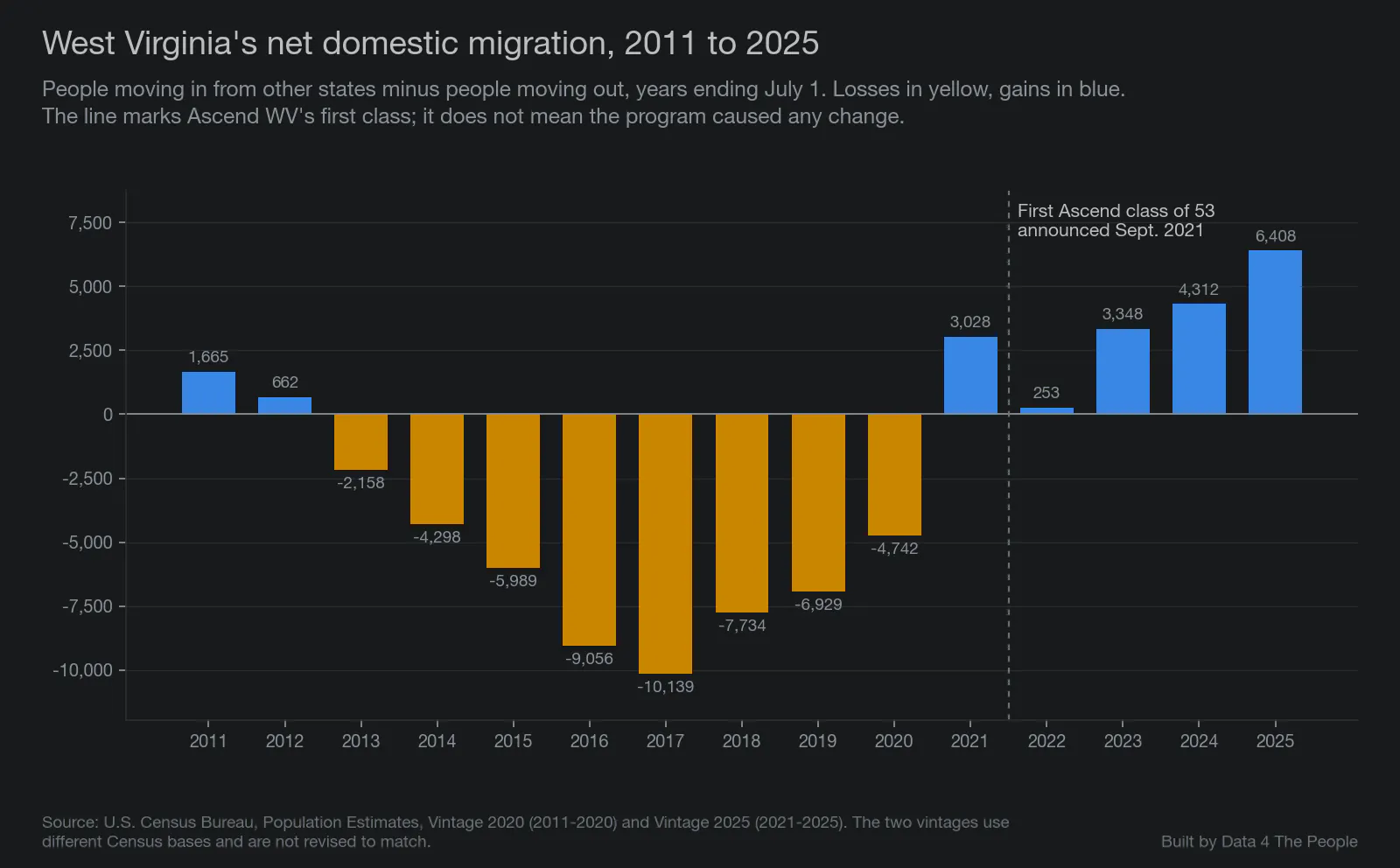
Source: U.S. Census Bureau, Population Estimates, Vintage 2020 and Vintage 2025.
That turn dramatically outperformed all five of West Virginia's neighbors. Per resident, West Virginia went from losing people to other states faster than any of them in 2015-2019 to gaining people faster than any of them in 2021-2025. Its change, 6.34 more people per 1,000 residents a year, ranks third among the 50 states and D.C. The closest neighbor, Kentucky, ranks 22nd at 1.87. Ohio ranks 31st. The next chart shows the 10 states with the largest change, plus the five states that border West Virginia, in blue.
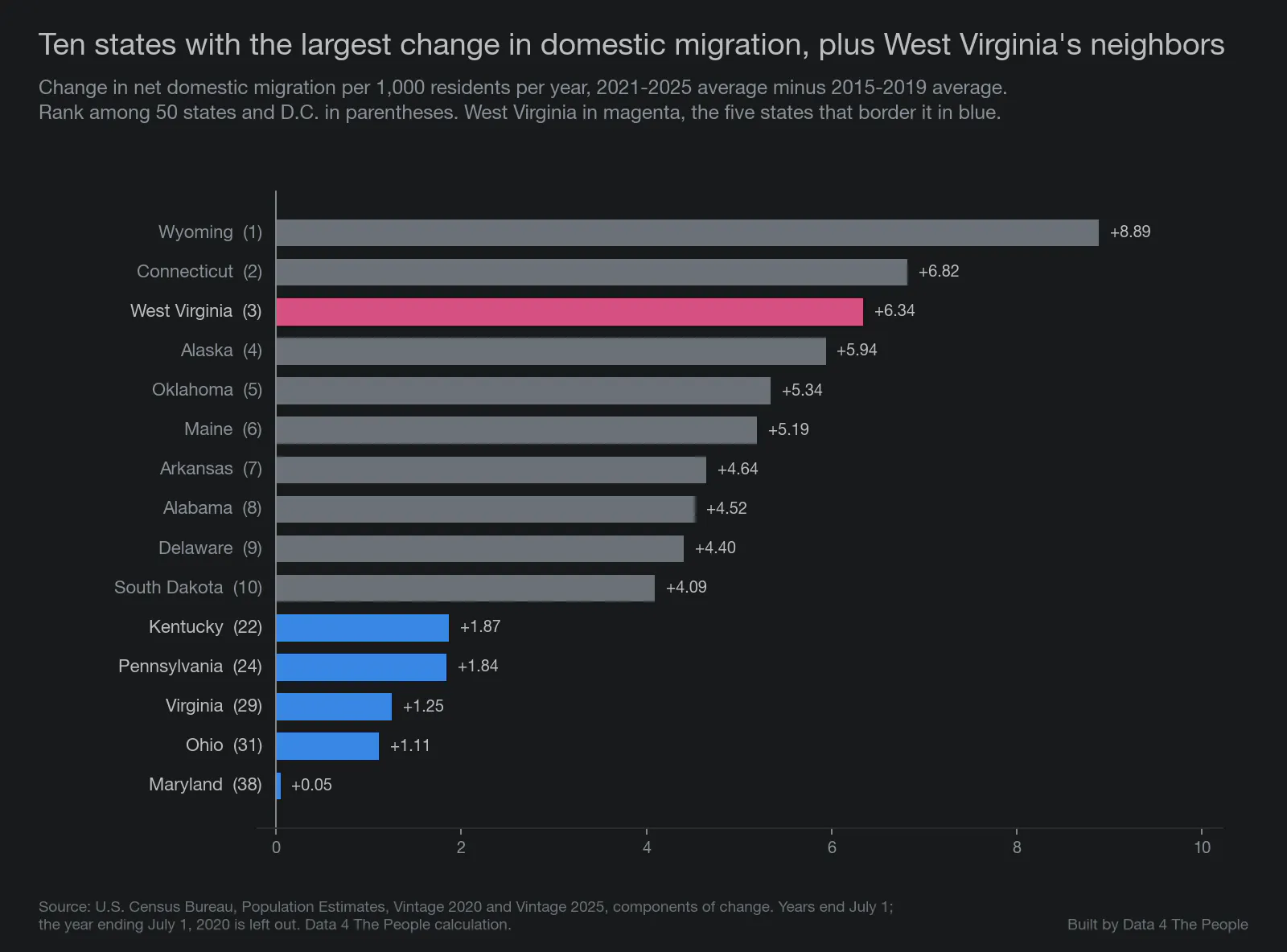
Source: U.S. Census Bureau, Population Estimates, Vintage 2020 and Vintage 2025. Data 4 The People calculation.
Most of West Virginia's post-COVID gain went to one corner of the state. The three Eastern Panhandle counties, Jefferson, Berkeley and Morgan, gained 21,680 people through moves from 2021 to 2025, more than the state's total of 17,349.
The Panhandle was already gaining people before Ascend arrived. The next chart compares it with the other Ascend areas and the rest of the state, per 1,000 residents a year.
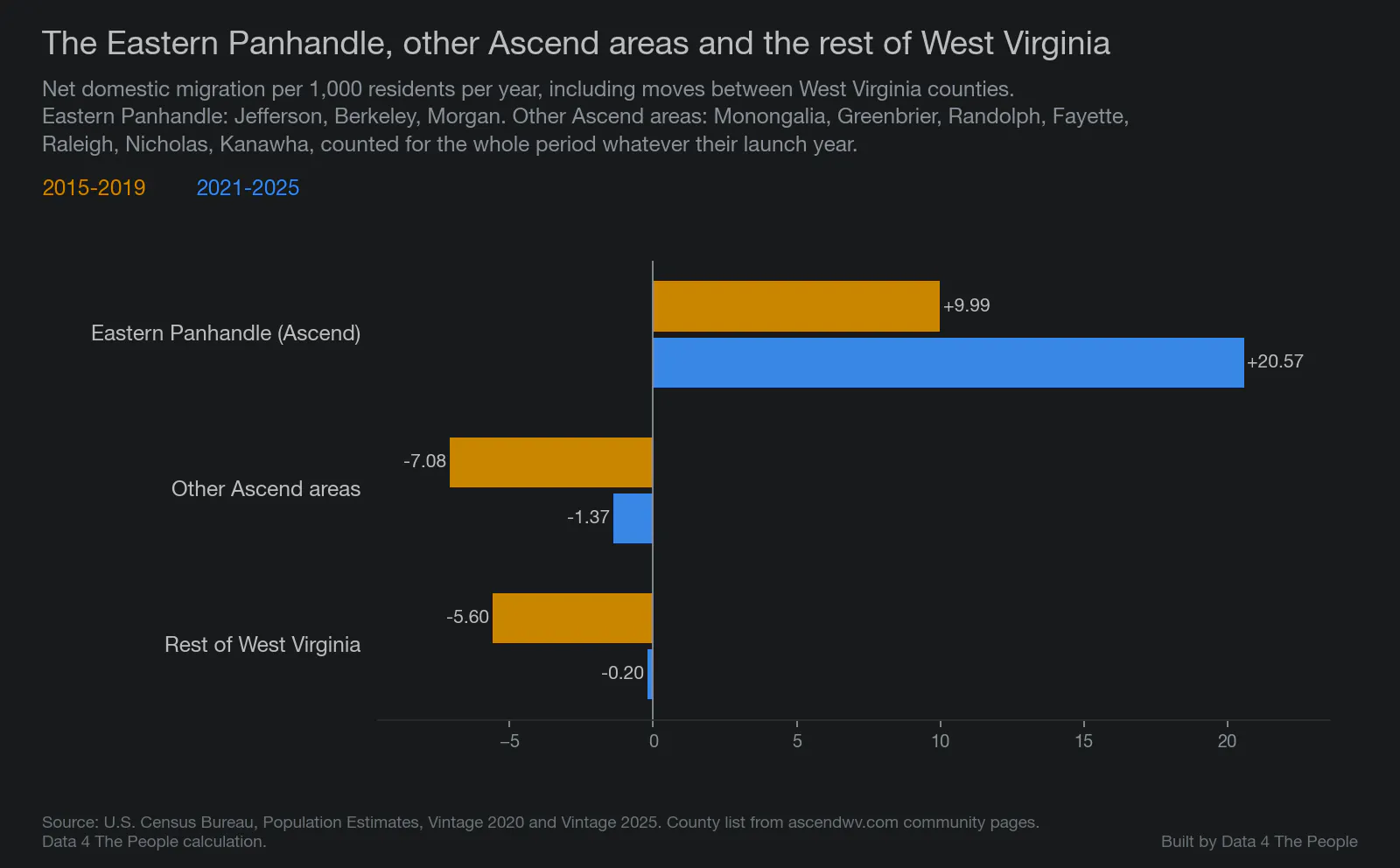
Source: U.S. Census Bureau, Population Estimates, Vintage 2020 and Vintage 2025. County list from ascendwv.com community pages. Data 4 The People calculation.
Leaving the Washington area
So who moved to the Panhandle? IRS tax records, which track households that change address between one year's tax return and the next, point to a broader shift out of the Washington, D.C. area. The Panhandle's net gain from the Washington metro rose 61.2%, from about 1,297 people a year in the three filing years before COVID to 2,091 in the three after it began. The chart below shows each year.
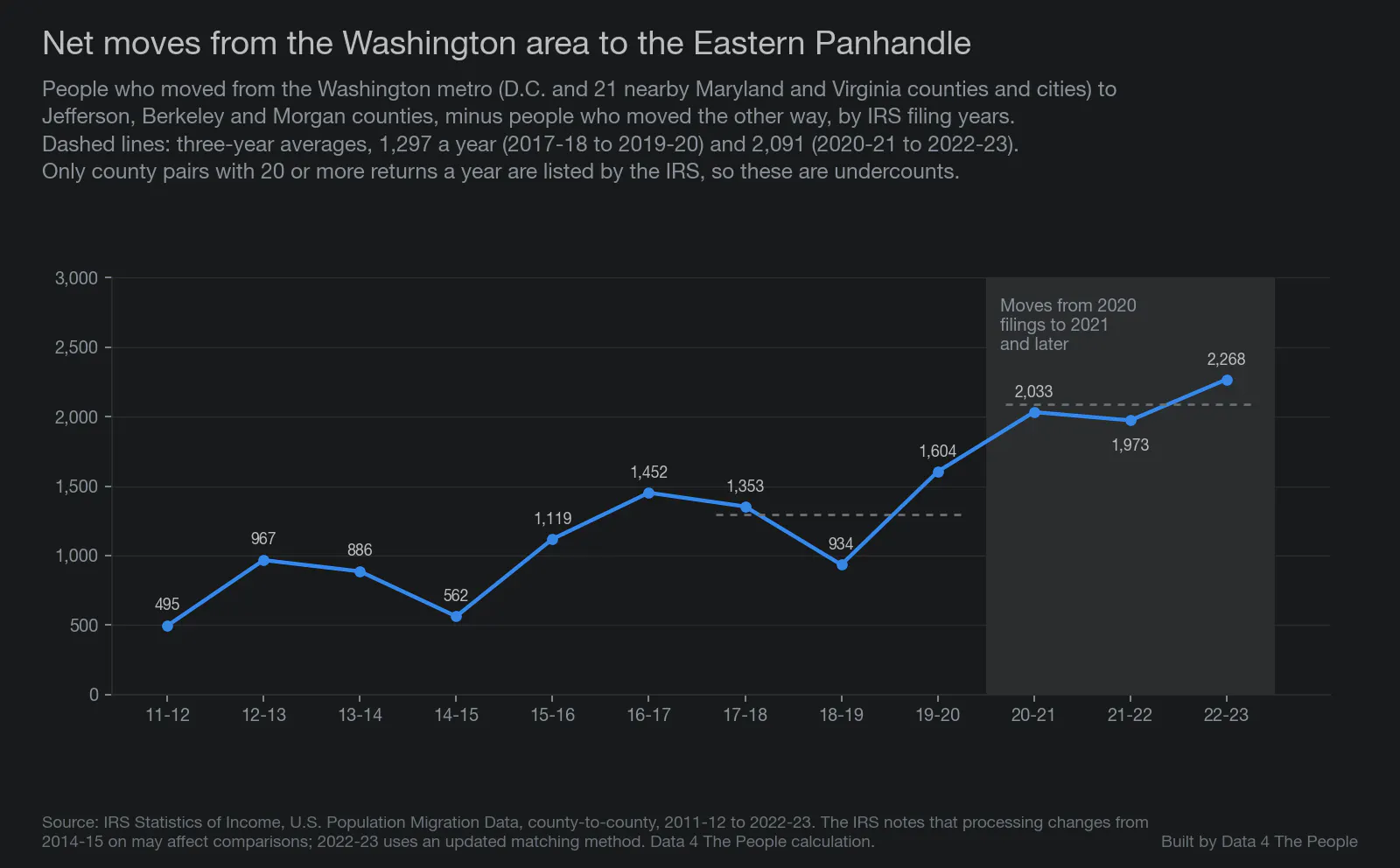
Source: IRS Statistics of Income, U.S. Population Migration Data, county-to-county, 2011-12 to 2022-23. Washington metro: D.C. and 21 nearby Maryland and Virginia counties and cities. Only county pairs with at least 20 returns a year are listed, so counts run low. Data 4 The People calculation.
The timing lines up with the pandemic, but tax records do not say why people moved.
Ascend is small next to the move from the Washington area
Alas, this means that migration from the Washington area to the Panhandle is the primary driver of West Virginia's gains from other states.
Now, Ascend still helped. But its impact was small relative to the impact of people leaving the Washington area. To put some math to that, suppose every one of the 421 people Ascend reports in the Eastern Panhandle had arrived by July 2025. They would add about 0.4 people per 1,000 residents a year. The Panhandle's rate rose by 10.59. In the other Ascend areas, Ascend's 1,224 reported residents would add about 0.5, against a rise of 5.72. Counties without Ascend rose by 5.41.
One is measurable, one is not
But the real value of Ascend, in our view, is its certainty and measurability. By its own count, Ascend has brought 1,641 people to West Virginia since 2021: 827 workers with real jobs, plus their families, spending real money in their communities. JobsOhio has created real jobs too. But the public can't easily check them, and many, like Intel's, are promises, not jobs yet. They are IOUs, so to speak, not cash in hand.
The table below compares the two programs:
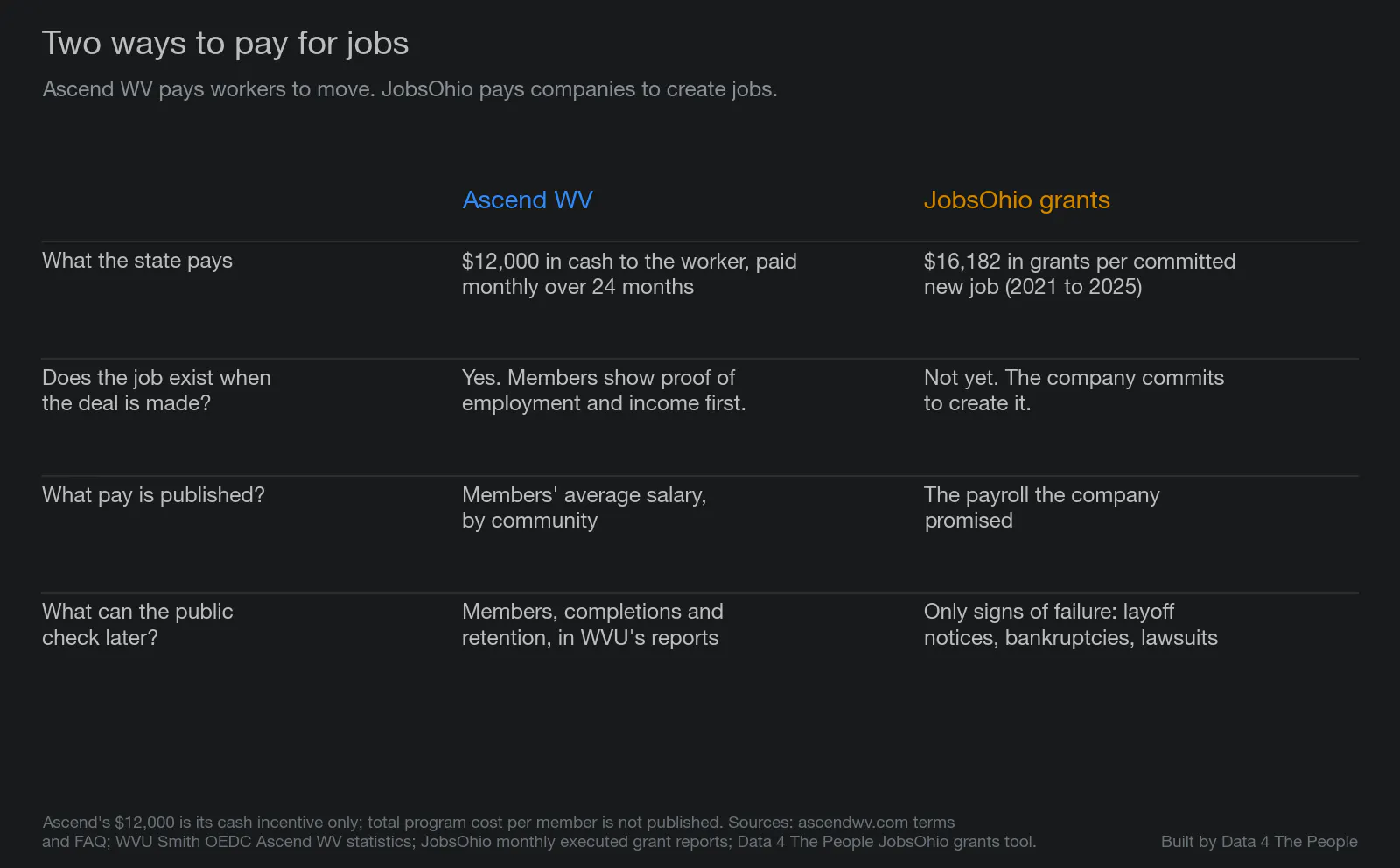
Ascend's $12,000 is its cash incentive only; total program cost per member is not published.
Start with the job. To join Ascend, a worker shows proof of employment and income, and the employer confirms the job. The job exists before the state commits a dollar. A JobsOhio grant works the other way. The company commits to create jobs in the future, and the grant is made on that commitment. A JobsOhio job is a promise. An Ascend member brings a job with them.
Then the pay. Ohio publishes the pay it was promised for jobs that don't exist yet (which is why its bar in the chart below is hatched). Ascend publishes the pay of jobs its members already have. The next chart puts those numbers next to each state's average wage.
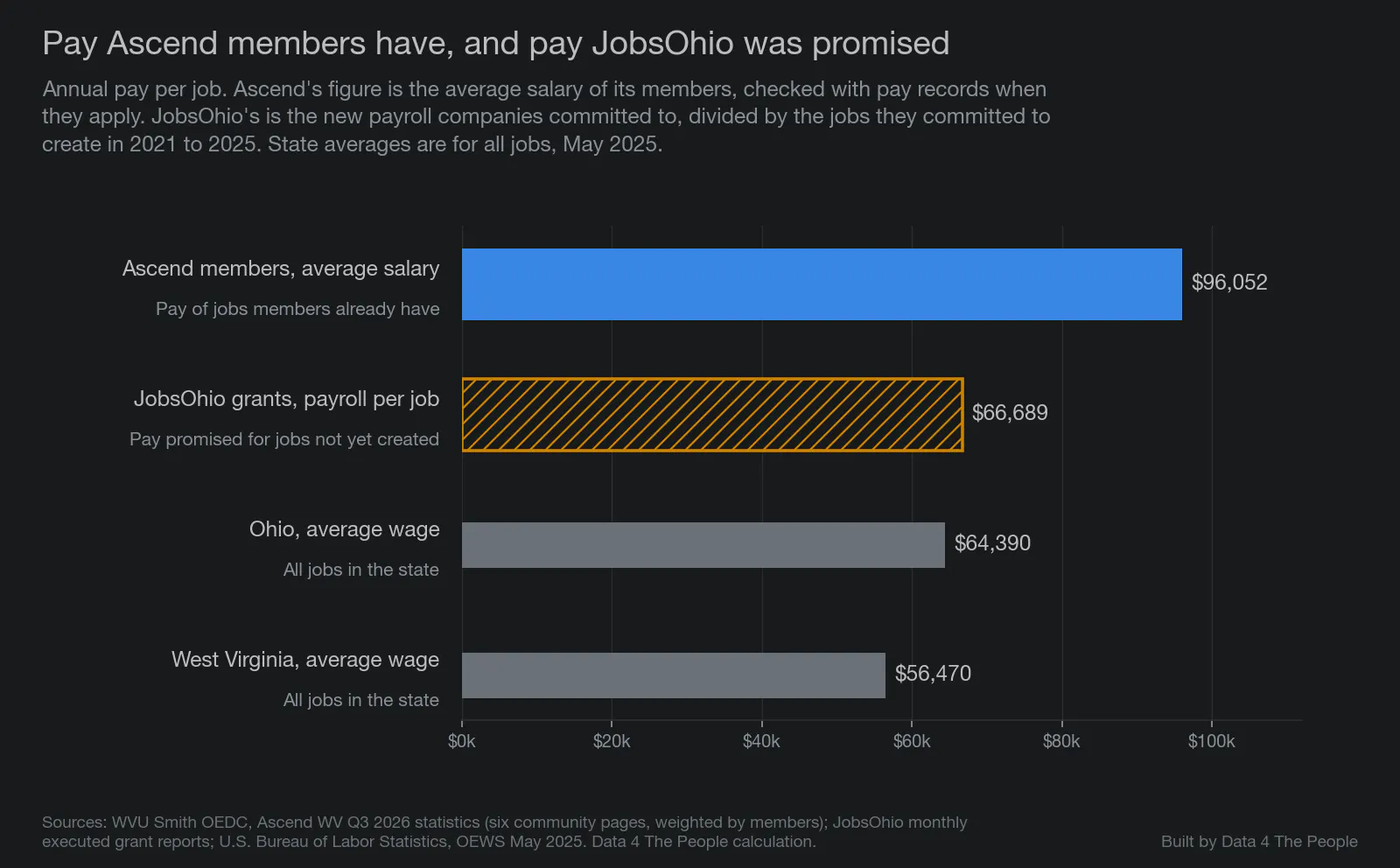
Sources: WVU Smith OEDC, Ascend WV Q3 2026 statistics; JobsOhio monthly executed grant reports; U.S. Bureau of Labor Statistics, OEWS May 2025. Data 4 The People calculation.
Weighting each community by its number of members, Ascend members earn an average of $96,052. That is about 70% above West Virginia's average wage of $56,470. Companies that signed JobsOhio grants from 2021 to 2025 promised an average of $66,689 per new job, about 4% above Ohio's average wage of $64,390. Ascend checks pay when members apply; WVU does not say whether the averages are updated after members arrive.
Then the cost. Ascend pays each member $12,000 in cash. JobsOhio's grants from 2021 to 2025 came to $16,182 per committed job. WVU does not publish what the whole program costs per member, so these two numbers are not a full comparison of cost.
Last, what happens after the money goes out. WVU reports how many members are still in the program and how many have finished it. For JobsOhio, as we found when we built our grants tool, there is no success column. The public can see some failures, through layoff notices, bankruptcies and lawsuits. It cannot see a project that was never built.
Neither program measures how many workers or companies would have come anyway.
Slow and steady wins the race?
Back to Intel. Ohio's roughly $2.1 billion bet has paid out at least $839.4 million so far for 3,000 promised jobs, in a plant now not expected to run until 2030 or 2031. Ohio's $600 million grant agreement lets the state demand repayment if the jobs are not there by the end of 2028. Even a full repayment would come years after the money went out.
Meanwhile, Ascend's $12,000 cash offer to its 827 members adds up to about $9.9 million if every one is paid in full. That is the cash incentive only; WVU does not publish what the whole program costs (its funding totals cover the whole Collaborative that runs Ascend, not Ascend alone), so the two totals are not a full like-for-like comparison. Each member arrived with a job that already existed, at a salary the program publishes.
This is the slow, steady way to grow. There are no big wins. It is one win, one person at a time. But the wins are real, and they are spread across hundreds of households instead of riding on one company's plans. If members stay, the income they bring stays in their communities year after year.
So, does slow and steady win the race? In time, we will find out.
Common questions
What is Ascend WV?
Ascend WV is a West Virginia University program that pays remote workers $12,000 in cash, over two years, to move to one of six parts of West Virginia. Applicants must show proof of employment and income before they are accepted.
How many people has Ascend WV brought to West Virginia?
As of September 30, 2026, WVU reports 827 members and 1,641 new West Virginians, counting family members.
How much has Ohio committed to Intel?
Ohio's package for Intel's planned chip plant was reported at about $2.1 billion when it was announced in 2022. Through June 2025, the state had paid at least $839.4 million of it, including $125.4 million from JobsOhio.
Why did West Virginia start gaining people from other states?
Most of the gain went to the Eastern Panhandle. IRS tax records show more people moving there from the Washington, D.C. area after COVID began. Ascend's members are too few to explain the change.
Photo at top: National Park Service / Buddy Secor.
Update, November 20, 2026: This post now notes the $25 million gift from the Wing 2 Wing Foundation that started Ascend WV, at WVU's request.
Support Data That Serves the Public
Data should empower people, not just institutions. Your support helps us create accessible research, visualizations, and tools that uncover economic inequality and inform better decisions.
Donate
Enjoying this post?
Tell others about it.
More articles like this
Fetching Related Posts
There are no other articles tagged with Research