
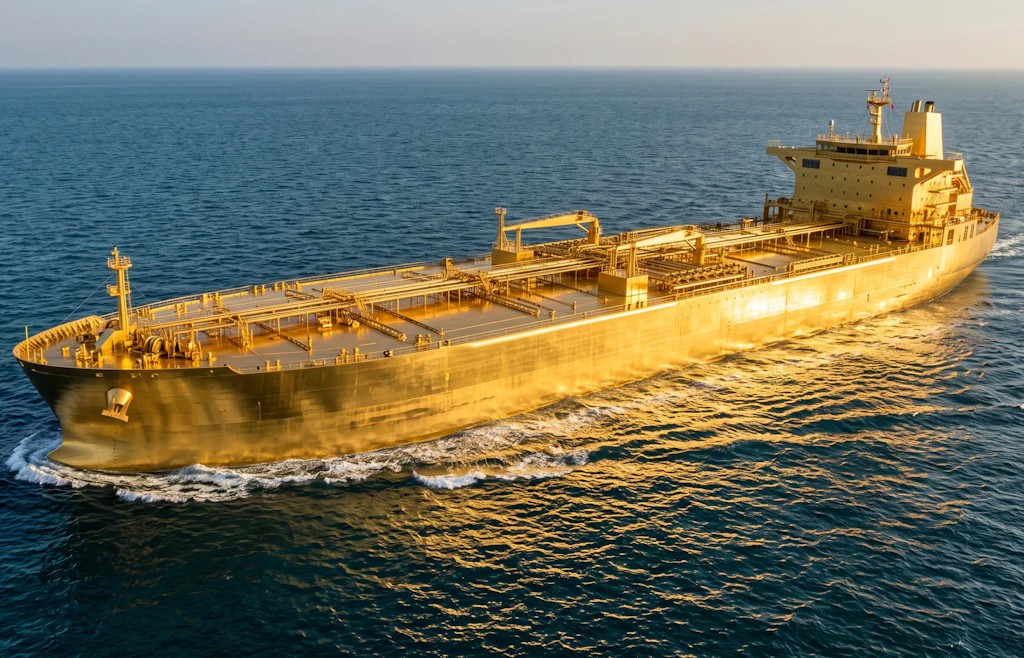
Turns out oil is close to $150, in real life, not on your screen
Supertanker rates are at $862,150 a day. Here is what that does to the price of a barrel.

Eric Pachman
Published
September 14th 2026
In August of 2008 I started working for Morgan Stanley in Times Square as an associate in their sell side equity research department. I was assigned to the oilfield services and commodity shipping team.
One of my first orders of business was to learn all types of ships that are used to transport oil and “dry bulk” products (think, iron ore and coal). I still recall my boss handing me a book called “The Ships of the World.” It was like one of those pamphlets you get at a baseball game detailing all the players on the team, except instead of players, it was the majestic ships that transport our bulk products all over the globe.
The granddaddy of all ships is called the VLCC (very large crude carrier). A VLCC holds two million barrels of crude oil and is about 1,100 feet long. Stand one on end and it would be taller than the Eiffel Tower and only a few stories short of the roof of the Empire State Building. Its cargo is about 84 million gallons of crude, enough to fill 127 Olympic swimming pools, or about a tenth of what the United States burns in a day.
What 2008 taught me
Now, you know what happened in late 2008. But what you may not know was that one month before I started at Morgan Stanley, the day rate to charter a VLCC out of the Middle East was $196,200. In other words, if you wanted to hire this ship to carry one cargo from the Middle East to China, a round trip of about 40 days, it was going to run you about $7.8 million. Within a year the day rate had plummeted to $13,300 per day, and by the summer of 2009 to $7,200, which translates to just $290,000 for that same trip. In other words, in about a year, I witnessed a 96% drop in VLCC day rates.
Long story short, the shipping industry is not for the faint of heart. It is supply and demand on steroids.
But I learned from this experience that we can’t ignore this market. It’s not operating wildly in a silo, but rather its volatility cascades through the global economy.
Where rates are now
Which is why today I have uncovered this data for you. Below, you will see what has happened to VLCC rates since the Iran war started, including the astounding and terrifying rise since the start of July. Rates now sit at $862,150 per day. I don’t even have words to explain how unprecedented this is. Maybe looking at how the prior shocks impacted rates can help. Anything over $200,000 per day used to be considered nosebleed rates. Today's rate is 331% above that mark.
The chart below is a free interactive visualization of weekly VLCC earnings on the Middle East to China route, from March 2019 to today, built from the Baltic Exchange and Fearnleys weekly tanker reports. Hover over any week to read the rate, and tick the box to add the price of Brent crude, physical cargoes against the futures screen. We update it every Friday when the new rate is published.
Why it matters, and how it happened
So, why does this matter? Because unlike most investors think, oil's true form is not a number on a spreadsheet or website. To actually get oil, you need to ship it across the globe, especially so for countries like Japan, which imports more than 99% of its oil, most of it from the Middle East. And that transport now costs over $862,000 per day for a very large crude carrier.
How did this happen? A confluence of factors, stacked on a market that was already tight. Sanctions had already pushed about a fifth of the world's VLCCs out of the trade most buyers can use, and rates were above $200,000 a day the day before the strikes. Then the strait closed. About 58 supertankers, one in ten worldwide, were trapped inside the Persian Gulf. Insurers pulled war-risk cover, and the cover that came back now costs up to 12.5% of a ship's value for a single transit, so only a handful of owners will sail in at any price. The oil that does get out mostly leaves by ship-to-ship transfer, which ties up a second tanker for every cargo. Replacement barrels from the Atlantic take twice as long to reach Asia. And in September the US Navy started sinking Iranian tankers, which shrinks the fleet in the most literal way. Put it together, and good luck finding a VLCC to transport your crude. One caveat: the $862,150 figure is the Baltic Exchange's assessment for a voyage that loads inside the strait, which few ships are making right now. Cargoes that load just outside it pay less, and we use those rates in the arithmetic below. So, while the screen says oil is $106, go and try to buy two million barrels of it and see how much it really is.
What a barrel really costs
We attempted to do that for you. The table adds it up three ways.
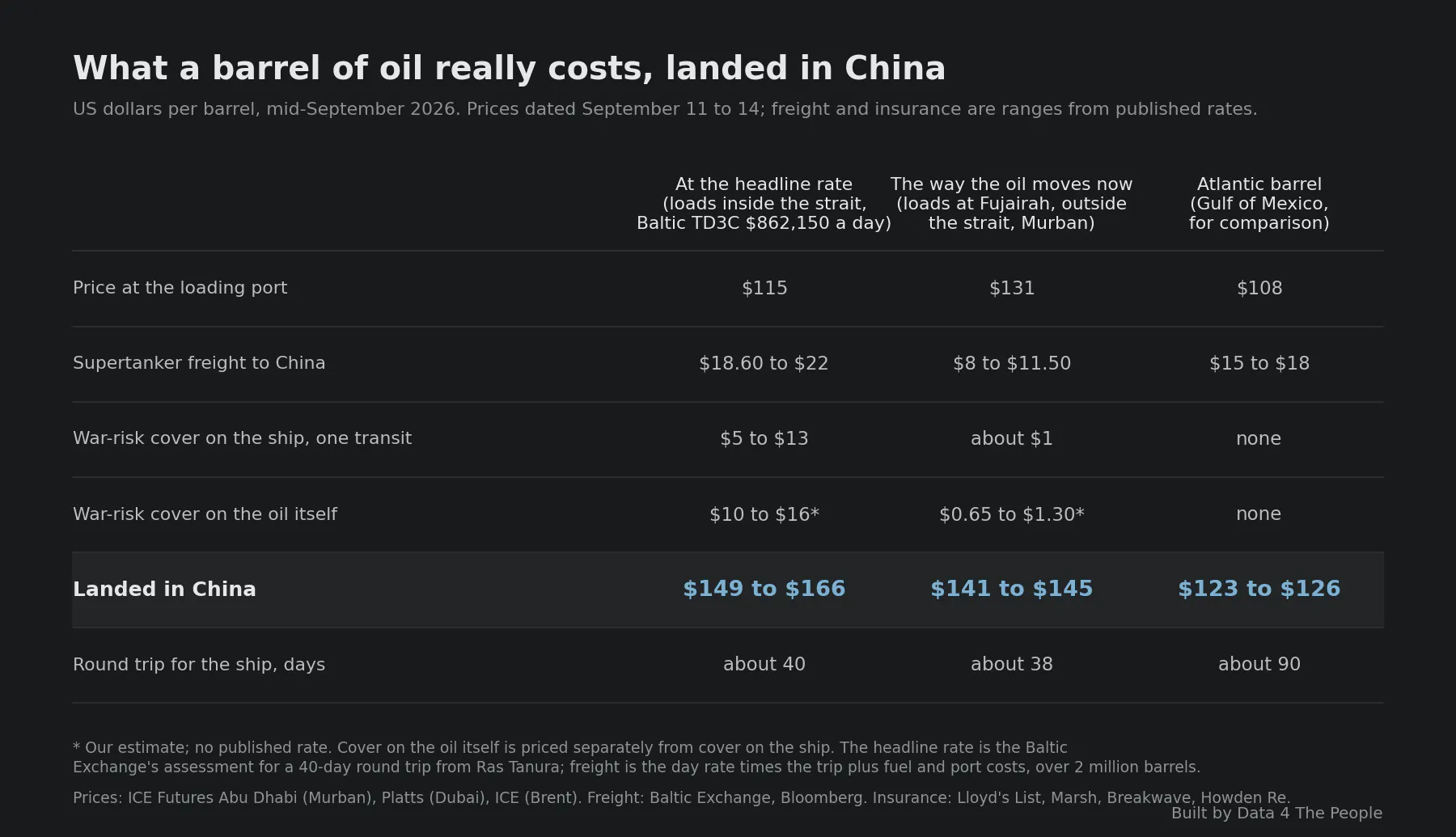
Prices dated September 11 to 14, 2026. Lines marked with an asterisk are our estimates; no published rate exists for them.
Column one is the headline rate. The $862,150 a day is quoted for a supertanker loading inside the strait. Turn the day rate into a cost per barrel, add war-risk cover for the ship and for the cargo, and that barrel lands in China at $149 to $166. Almost no oil moves that way. The rate is real, because contracts and futures settle on it, but very few ships will make the trip.
Column two is how the oil actually moves out of the Middle East, heading east. It is carried just outside the strait to Fujairah and loaded there. Freight for that trip is $8 to $11.50 a barrel and cover is about $2, so the barrel lands at $141 to $145. Now look at the top line. Murban, the crude that loads at Fujairah, was $131 on September 14 while Brent on the screen was $106. Murban normally trades within a dollar or two of Brent. The extra $25 is the price of a barrel that can be shipped. Buyers pay the toll either in freight or at the loading port, which is why the two Middle East columns land close together.
Column three is the barrel that stays out of the Middle East. A cargo from the Gulf of Mexico pays no war premium and lands in China at $123 to $126, cheaper than Middle East oil delivered from next door (relatively speaking). So Asian refiners have the incentive to buy more American crude, which kicks off an unfavorable feedback loop. A US-to-Asia round trip takes about 90 days against 38 from Fujairah, so every barrel that switches ties up a supertanker more than twice as long. Fewer ships are free, freight rises, more Middle East barrels get priced out, more American barrels get pulled across the Pacific, and those barrels come out of American storage tanks while the world's tankers sail the long way around.
This is complexity in action. This isn't some on-again off-again reality television show. It's a complex web of economic incentives and physical supply bottlenecks that, if we really pay attention, we are watching unfold in real time.
So the honest answer to “what does oil cost” is that it depends on where you are standing. The screen says about $106. A refiner in China pays about $140 for the same barrel, and up to $166 if it has to come out through the strait. The $35 to $60 in between is the shipping story, and none of it shows up in the number on the screen.
Close to $150, in real life
Which brings me back to that headline. This past May, an Exxon executive warned that physical Brent cargoes would spike to $150 to $160 once inventories hit record lows. On the screen, that has not happened. Brent is about $106. But a Middle East barrel landed in China costs about $140 today, and up to $166 if it has to come out through the strait. The forecast came true. It just came true at the refinery gate instead of on the screen, and the difference is the ship.
Why this is a living post
This analysis is just another example highlighting the difference between the way the world really works and how people think it works. The latter is almost always a very simplified version of the former. But the former is reality. It is how oil gets to refineries, through those refineries, and into our planes, trains, trucks, and automobiles. And when it is all said and done, this is what matters for the people.
And that’s the reason why we are making this Data 4 Thought a living post. We will update this each week when the data drops so we can all see shipping rates. The data is technically public but buried in hundreds of individual files. We put that together for you so we can see it all: the good, the bad, and the (right now) very ugly.
How we built this
The chart draws on 277 weekly Baltic Exchange assessments of the TD3C route, Ras Tanura to Ningbo, from December 2020; Fearnleys' daily assessments of the same trade, in dollars from March 2019 to April 2023 and in Worldscale points to today; the U.S. Energy Information Administration's daily Brent spot price; and ICE Brent futures closes. The data and code are public at github.com/Data4ThePeople/VLCC.
Common questions
What is a VLCC?
A VLCC, or very large crude carrier, is the largest class of oil tanker in regular service. It carries about two million barrels of crude oil, is about 1,100 feet long, and is the workhorse of the long-haul trade from the Middle East to Asia.
What does a VLCC day rate mean?
The day rate is what the ship earns per day after paying for fuel and port fees, spread over a full round trip, ballast leg included. Brokers call it the time charter equivalent. The figure quoted in the news, and in this chart, is the Baltic Exchange's assessment for the TD3C route from Ras Tanura in Saudi Arabia to Ningbo in China.
How much does it cost to ship a barrel of oil from the Middle East to China right now?
In mid-September 2026, about $8 to $11.50 a barrel for a supertanker loading just outside the Strait of Hormuz, which is how most Middle East crude is moving, and $18.60 to $22 a barrel at the headline rate for a ship loading inside the strait. War-risk insurance comes on top. In a normal year the trip costs $1 to $2 a barrel.
How often is this chart updated?
Every week. The Baltic Exchange publishes its weekly tanker report on Fridays, and the chart is updated when the new rate is out.
Support Data That Serves the Public
Data should empower people, not just institutions. Your support helps us create accessible research, visualizations, and tools that uncover economic inequality and inform better decisions.
Donate
Enjoying this post?
Tell others about it.
More articles like this
Fetching Related Posts
There are no other articles tagged with Data 4 Thought