

The oil inventory contraction deepens. Is this the calm before the storm?
We checked the global data. The oil isn't showing up anywhere.

Eric Pachman
Published
June 15th 2026
Tankers anchored near the Strait of Hormuz, June 11, 2026. Source: ESA Copernicus Sentinel-2, public domain.
Don’t Look Up
A couple of weeks ago we shared one of Data 4 The People's new interactive visualizations with you, one that lets you easily compare weekly seasonal oil inventories against 40 years of history. The idea came from ExxonMobil's warning that oil prices could spike to $150 or $160 per barrel in a matter of "weeks."
Well, it's been two weeks since that dire warning, and Exxon was both right and wrong.
They were right about oil inventories. As you can see in the visualization, U.S. crude oil inventories have continued their downward slide, dropping from 804 million barrels to 776 million barrels - the lowest level for this time of year since 1984.
But so far, Exxon has been wrong about oil prices. Markets have been happy to ignore the dire inventory situation, producing a rare and tenuous stability in prices.
What gives?
There are plenty of theories. The president says the U.S. is escorting tankers through the strait. CNN is reporting that oil is leaking out of the Middle East through other routes: pipelines, the Cape of Good Hope. These explanations are comforting on first glance, and more importantly, they calm our nervous minds, whose worst fear is not knowing why.
But we can actually test these claims. So let's do it.
One critical assumption first. If large volumes of oil are somehow making their way out of the Middle East, that oil has to end up somewhere. Think of it this way: imagine you work at a widget factory, and your job is to take finished widgets off the line and put them in boxes (that's inventory). There are two ways to verify how many widgets are actually being produced. You could listen to people claiming widgets are being stolen off the front of the line, routed around the factory, and somehow arriving at the end anyway. Or you could simply check whether the boxes are full.
So let's check the boxes.
We already checked the U.S. box. If America is funneling oil out of the Middle East like ninjas, it isn't showing up in U.S. inventories - which just hit a 40-year seasonal low. That claim looks fishy. But maybe the oil is showing up in other countries' inventories. So we have to check those too.
The good news is the IEA (the International Energy Agency, the world's most authoritative source of global oil data) tracks exactly this. Here's what global inventories look like.
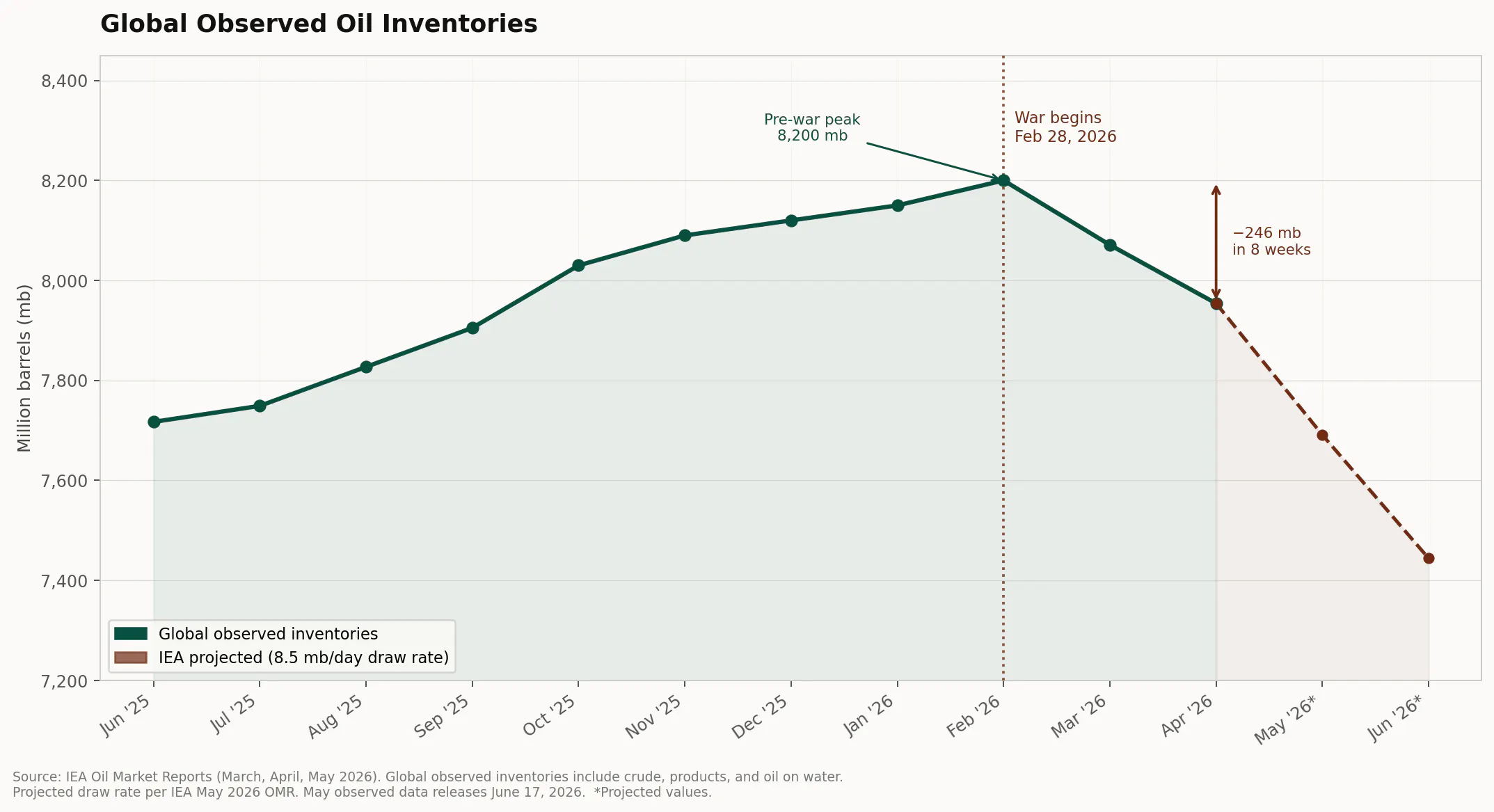
Global observed inventories include crude, products, and oil on water. Projected draw rate per IEA May 2026 OMR. May observed data releases June 17, 2026.
The boxes aren't filling up anywhere else either. Global observed inventories fell 246 million barrels in just eight weeks - the fastest depletion rate in the IEA's 52-year history. If dark oil were flowing at meaningful scale, that number would be smaller. It isn't.
Could surging global demand be consuming all this oil before it reaches inventory? No. The IEA now forecasts global oil demand to actually contract by 420,000 barrels per day year-on-year in 2026 - the steepest quarterly drop since COVID. But before you take comfort in that number, consider what's driving it. As Carolyn Kissane, Associate Dean at NYU's Center for Global Affairs, argues in a must-read commentary for Project Syndicate, this isn't simply weak demand - it's forced adaptation. Countries starved of oil are accelerating the switch away from it. Four-day workweeks, work-from-home mandates, industrial rationing, restrictions on air conditioning, and coal substitution in China's petrochemical sector. What began as a supply shock is quietly becoming a structural demand shift. If Kissane is right - and the data suggests she may be, the world that emerges on the other side of this crisis will consume meaningfully less oil than the one that entered it. We strongly recommend reading her full piece here.
So here is the honest answer, and you may not like it.
We don't know why oil prices haven't reacted yet.
But here is what we do know: inventories need to start rising. Or at least stop falling. And while the forced adaptation Kissane describes is real, it strains credulity to believe that countries can structurally wean themselves off oil in a matter of months - when decades of climate policy, economic incentives, and technological progress couldn't do it at anything close to the speed this crisis demands. Adaptation is happening at the margins. The inventory math is happening at the core. This war and the supply bottleneck it has created, which Americans separated from the conflict by an ocean seem to have largely absorbed as background noise, or worse, something to gamble on through day trading and prediction markets - will eventually produce real shortages if it isn't resolved, and resolved soon. We don't know exactly how or when that moment arrives. We just know the process is underway.
This all reminds me of the movie Don't Look Up. At any point, the imminent threat could have become common knowledge - what our friend Ben Hunt would call the moment it's "known that everyone knows." But that moment didn't come until one person finally looked up, minutes before the asteroid hit.
Such is humanity. We have this extraordinary capacity to ignore problems until the day we pull into a gas station and the pumps are dry. Then we freak out and buy all the toilet paper off the shelves just in case. I'm not predicting that will happen. I hope we get through this - though the data, if I'm being straight with you, does not inspire confidence. But unless we pay attention to what the data is actually telling us - and stop reverse-engineering narratives to fit what we wish were true - we may not see it coming until it's right above us.
Support Data That Serves the Public
Data should empower people, not just institutions. Your support helps us create accessible research, visualizations, and tools that uncover economic inequality and inform better decisions.
Donate
Enjoying this post?
Tell others about it.
More articles like this
Fetching Related Posts
There are no other articles tagged with Data 4 Thought