
Why you should care about sulfur
A leftover from oil refining is a key ingredient in fertilizer. Its price has risen more than 1,000% since 2024, and the war closed the route that close to half the world's seaborne supply takes.

Eric Pachman
Published
October 8th 2026
Twenty-five years ago, I stepped into my first job out of undergrad, building refinery optimization models for ExxonMobil. Very early on I learned about sulfur, and how important it is to remove it during the refining process. My timing was not a coincidence. A few weeks before I started, the EPA had finalized a rule that would cut the sulfur allowed in highway diesel to 15 parts per million by 2006. Less than a decade earlier, diesel could carry as much as 5,000. Refiners had about five years to figure out how to get there, and that is what the models were for. One reason to care is what sulfur does when it burns. It leaves the tailpipe as a gas, reacts with water and oxygen in the air, and comes back down as sulfuric acid, which has the pesky side effect of being one of the main ingredients in acid rain.
And so here I was, building molecular-level models to figure out how our refineries were going to meet specs for Ultra Low Sulfur Diesel.
This is when I met my arch-nemesis: dibenzothiophene.
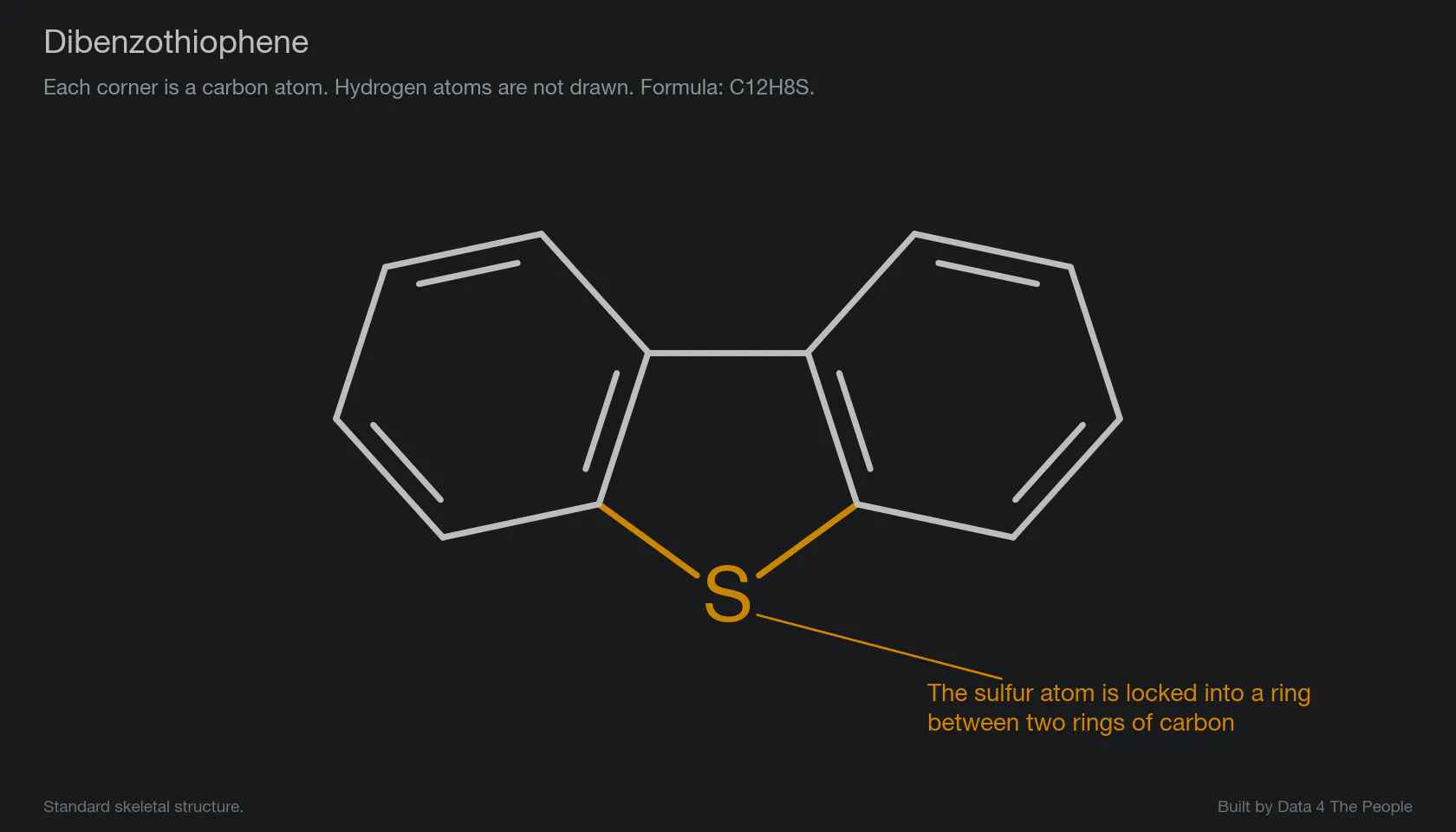
Dibenzothiophene. The sulfur atom, marked S, is part of a ring fused between two rings of carbon.
You see, what I learned very quickly is this one class of hydrocarbons locked the sulfur up so tightly that the equipment refineries had at the time could barely crack it out. Refiners had to build a “bigger hammer” to do it. Until then, we had to measure the concentration of dibenzothiophenes in the crude oil we purchased to ensure that it was low enough for the diesel to meet spec after it worked its way through the refinery. I spent the better part of two years learning about and modeling dibenzothiophenes. Those were the days.
You may be wondering if this story has completely come out of left field. Have I been walking around for decades thinking about sulfur, the way I have been thinking about sterile water?
No.
I honestly haven't given sulfur a second thought in years. That is, until my former boss from ExxonMobil came across Data 4 The People, called me, and recommended I take a look at what's going on with sulfur right now, as it’s a story about refining that few people know, but need to know… if they, you know, eat food.
And so, we come full circle. The work refiners did in those years to pull more sulfur out of fuel is the same work that supplies the sulfur for fertilizer today. This is a good thing, because sulfur is a key input to the fertilizers that help grow our food. But as my boss warned, the same issues facing refineries that are driving up crack spreads could be impacting the global supply of sulfur.
I was intrigued by this connection. So, I brushed off the cobwebs of my knowledge of sulfur and started researching. Here is what I found.
From a refinery to a farm field
Sulfur starts out as something refiners need to get rid of and ends up as something fertilizer makers need to buy. The diagram below follows it through six steps, and shows how much is sitting in storage at each one, as far as public data can tell us.
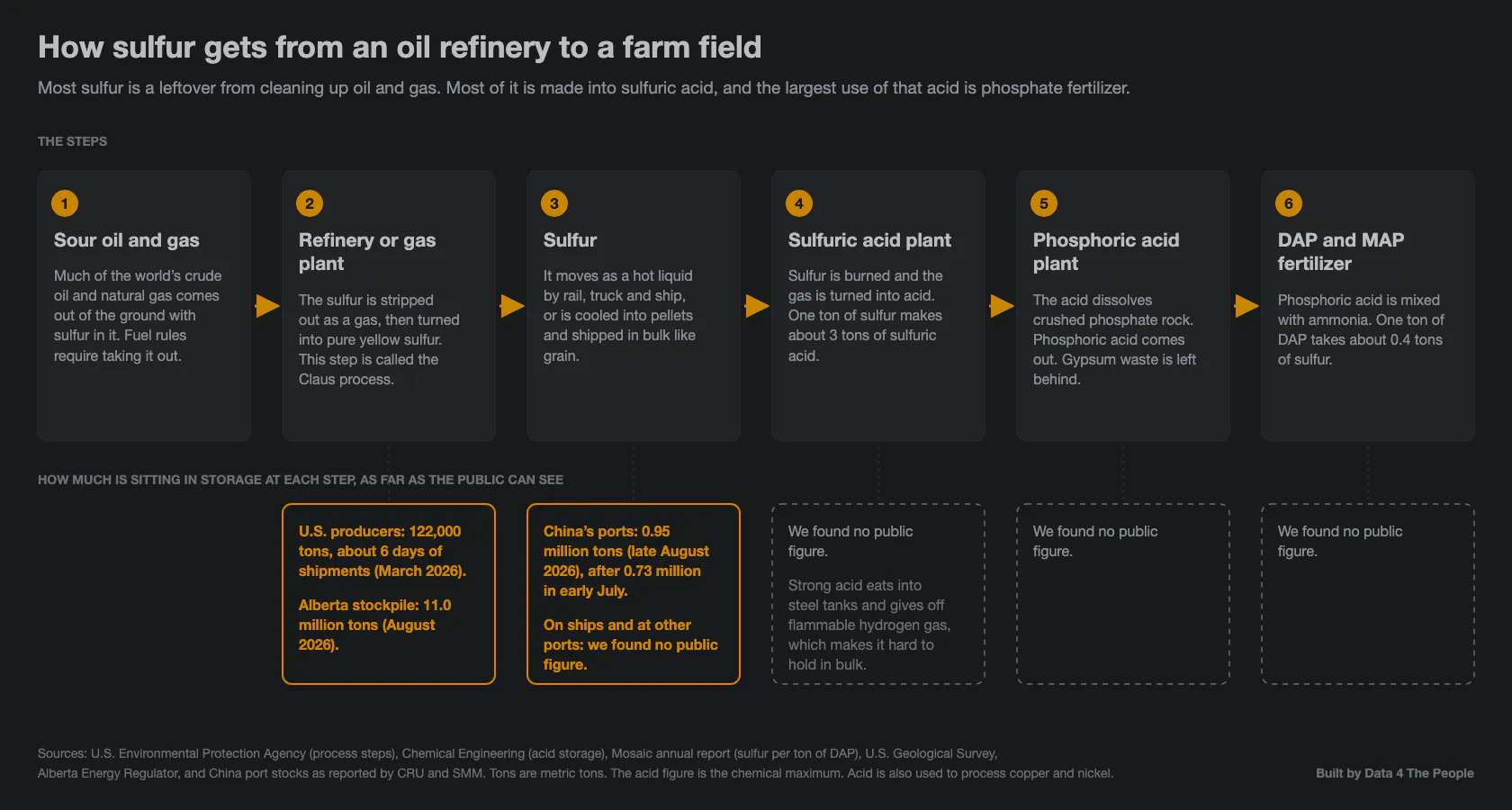
The six steps from oil and gas to phosphate fertilizer, with the storage figures we could find. Sources: EPA, Mosaic, USGS, Alberta Energy Regulator, CRU and SMM.
The yellow sulfur that comes out of a refinery is burned to make sulfuric acid. By the chemistry, one ton of sulfur makes about three tons of acid. That acid is then used to dissolve phosphate rock, which frees the phosphate that plants need. Add ammonia and you have DAP and MAP, the two main phosphate fertilizers.
The U.S. Geological Survey says about 90% of the sulfur used in the United States is turned into sulfuric acid, and the Environmental Protection Agency says most of that acid goes to phosphate fertilizer. Mosaic, a large U.S. phosphate producer, says it takes about 0.4 tons of sulfur to make one ton of DAP.
The sulfur does not end up in the fertilizer. It leaves the plant as gypsum waste. It is a processing chemical that gets used once, so fertilizer makers need a steady supply of it.
Fertilizer is not the only thing that needs this acid. Sulfuric acid is also used to pull copper, nickel and cobalt out of ore, and to make rare earths and battery chemicals, according to the International Energy Agency. In May, the research firm Benchmark Mineral Intelligence estimated that more than half of this year’s lithium, cobalt and rare earth production was exposed to disruptions in sulfur and sulfuric acid, as Mining.com reported.
One more thing sets sulfur apart from most raw materials. Because it is a leftover from cleaning up oil and gas, the amount produced depends on how much fuel is being processed. A higher sulfur price does not bring more of it out of a refinery. This is really important to keep in mind.
It was not always a leftover. For most of the 1900s, the United States mined sulfur directly, pumping superheated water into deposits deep under the Gulf Coast to melt the sulfur and bring it to the surface. Sulfur recovered from oil and gas passed mined sulfur in 1982, and the last U.S. mine closed in 2000.
Where the world’s sulfur comes from
The world made about 84 million metric tons of sulfur in 2025, according to the U.S. Geological Survey. The next chart shows who made it.
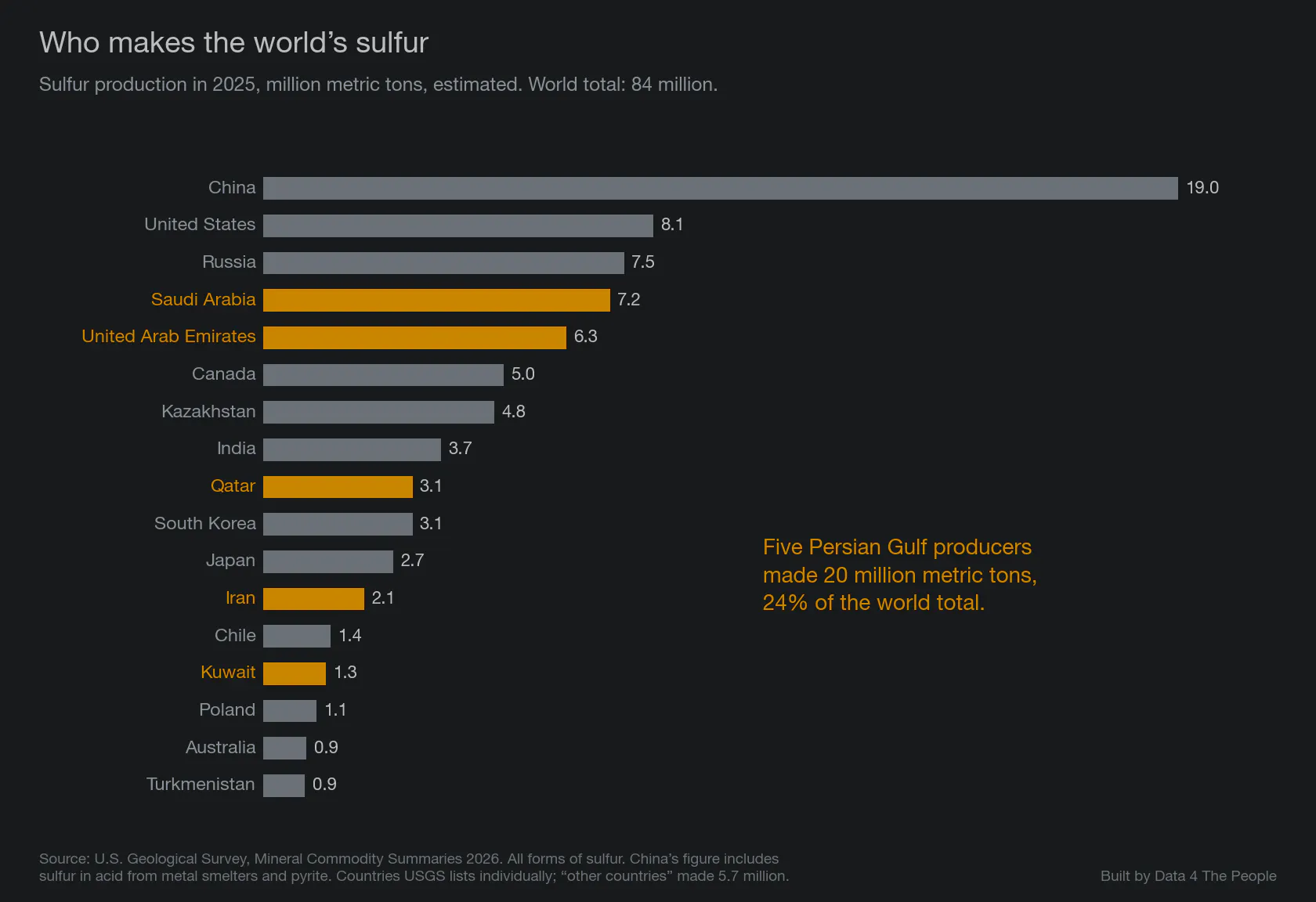
Sulfur production by country in 2025. The five Persian Gulf producers are highlighted. Source: U.S. Geological Survey.
Saudi Arabia, the United Arab Emirates, Qatar, Iran and Kuwait made about 20 million tons between them, or 24% of the world total. That share understates how much the rest of the world leans on them. China, the largest producer, uses its own sulfur and still imported 9.6 million tons in 2025. The Gulf countries make far more than they use, so they export it. The trade publishers Argus, CRU and SMM put the Gulf’s share at 45% to almost 50% of all the sulfur that moves by sea, and those cargoes leave through the Strait of Hormuz.
The United States is in a different position. It makes about 8.1 million tons a year and, after subtracting what it exports, relies on imports for about 14% of what it uses, according to the USGS.
The price was climbing long before the war
There is no free, up-to-date public price for sulfur, so we built one from customs records: the average value of a metric ton of sulfur exported from the United States each month. It tracks the benchmarks the trade press reports. The chart below compares it with sulfuric acid, DAP fertilizer and diesel since January 2024.
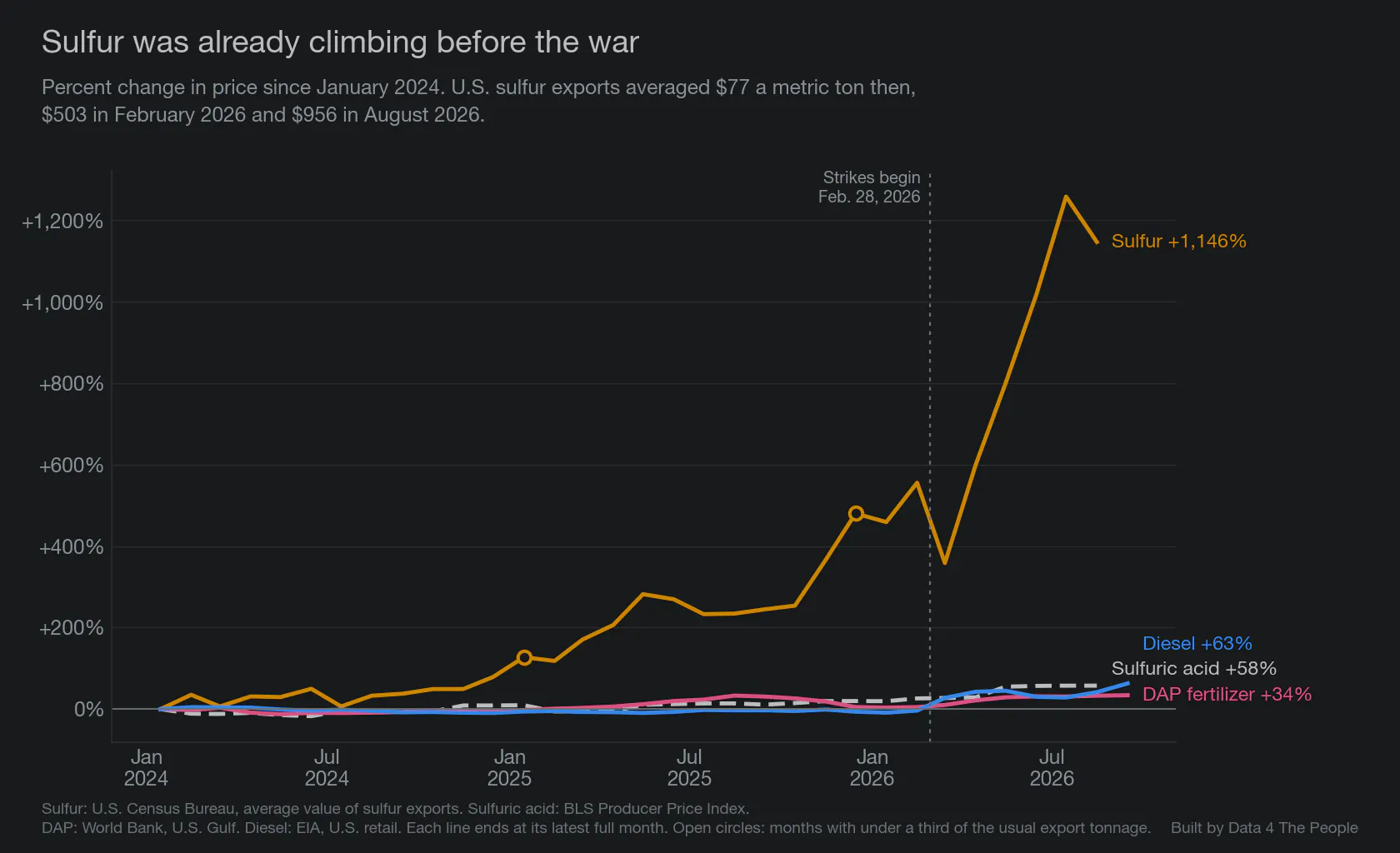
Percent change in price since January 2024. Sources: Census Bureau, Bureau of Labor Statistics, World Bank, EIA.
U.S. sulfur exports averaged $77 a metric ton in January 2024. By February 2026, the last full month before the war, the average was $503. That is a rise of 556% with the Strait of Hormuz wide open.
Trade publishers point to several reasons. CRU estimated that the world used about 1.9 million tons more sulfur than it made in 2025. Nickel plants in Indonesia, which use sulfuric acid to pull nickel out of ore for batteries, were buying more. Kazakhstan had sold down its stockpile. And at the start of November 2025, Russia put a temporary ban on exports of several kinds of sulfur.
By February 2026 prices in the Gulf had started to slip. Argus reported that the Middle East price fell 7% in the four weeks before the strikes.
The tracker below lets you measure all four prices from a different starting month: January 2024, February 2025, or February 2026, the last month before the war. It also has a table of the numbers behind each line. The tracker is free to use.
Then the strait closed
The first strikes on Iran came on February 28, 2026. On March 2, Iran’s Revolutionary Guard announced that the Strait of Hormuz was closed. The same week, QatarEnergy halted sulfur production after a drone attack on its Ras Laffan complex, and Kuwait’s state oil company told customers it could not meet its export contracts.
Some sulfur got out during a pause in the fighting in June. By late September, Argus reported that sulfur traffic through the strait had settled at one to three ships a week. China’s sulfur imports for January through July were down 59% from a year earlier, the lowest since 2002, according to CRU.
The next chart shows what has happened to prices since February.
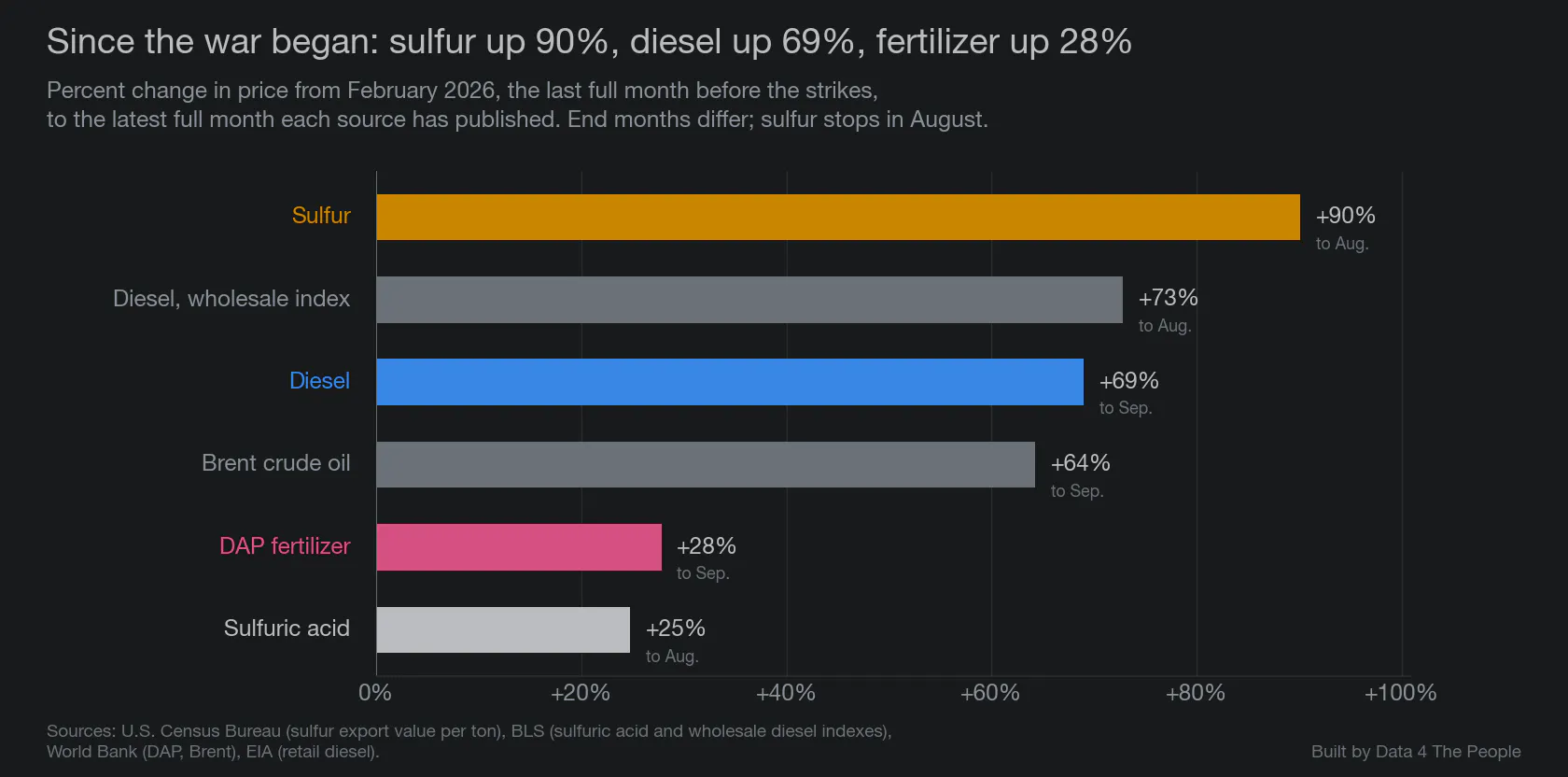
Percent change in price since February 2026. End months differ by source. Sources: Census Bureau, Bureau of Labor Statistics, World Bank, EIA.
Sulfur is up 90% through August. Retail diesel is up 69% through September, from $3.72 a gallon to $6.29. Both have risen much more than the products at the end of the chain. DAP is up 28% and the sulfuric acid price index is up 25%.
Why fertilizer has not kept up with sulfur
If sulfur has risen more than 1,000% since early 2024, why is DAP up only 34%? The chart below splits the price of a ton of DAP into two parts: the sulfur needed to make it, and everything else.
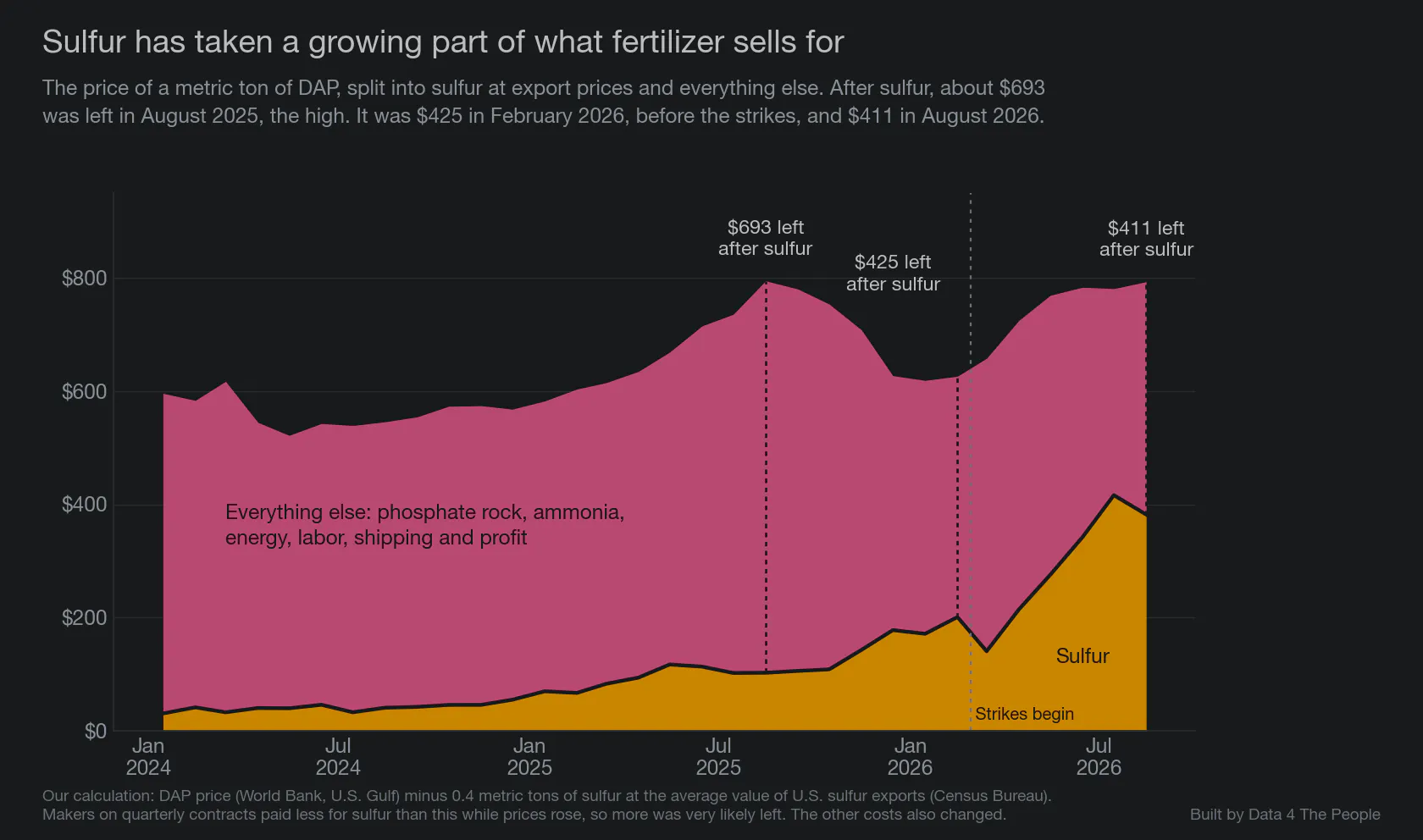
The price of a metric ton of DAP, split into sulfur at export prices and everything else. Our calculation from World Bank and Census Bureau data.
In January 2024, the sulfur in a ton of DAP cost about $31. The DAP sold for $596. Sulfur was about 5% of the price, so it could rise a long way before it showed up in the price of fertilizer.
By August 2026 the sulfur cost about $382 and the DAP sold for $794. At export prices, sulfur was close to half of what the fertilizer sold for.
The part left over after sulfur is what has to pay for the phosphate rock, the ammonia, the energy, the workers and the profit. It was about $693 a ton in August 2025. It was $425 in February 2026 and $411 in August. Most of that drop came before the war, over a stretch when the price of DAP fell and the price of sulfur rose.
One caution. Producers on contracts paid less than export prices while prices were rising, so the real squeeze is very likely less severe than the chart. The upper band is also not a measure of profit, because the other costs in it changed too.
Producers have responded by making less. Mosaic said in August that its plant in Faustina, Louisiana had been completely idled and that its Bartow, Florida plant was running at 40% of its target rate. Mosaic has cited both the high price of sulfur and its limited availability, with sulfur shipments through the strait still far below normal.
Sulfuric acid is a separate case. More than a quarter of the world’s supply is a byproduct of metal smelting, according to CRU, and it costs the same to make whatever sulfur costs. Much of the acid that is made from sulfur is used inside the fertilizer plant that made it and never has a market price.
Acid from China also became harder to get. Bloomberg reported in April that China would halt exports of sulfuric acid starting in May. We did not find a public announcement from China’s government, but SMM reported that China’s acid exports in August were down 99% from a year earlier. Chile, the world’s largest copper producer, buys more than 1 million tons of Chinese acid a year.
What is in storage
How much sulfur is on hand? In the United States, not much. The chart below compares the stock held by U.S. sulfur producers with the stock of diesel and heating oil, both measured in days of supply.
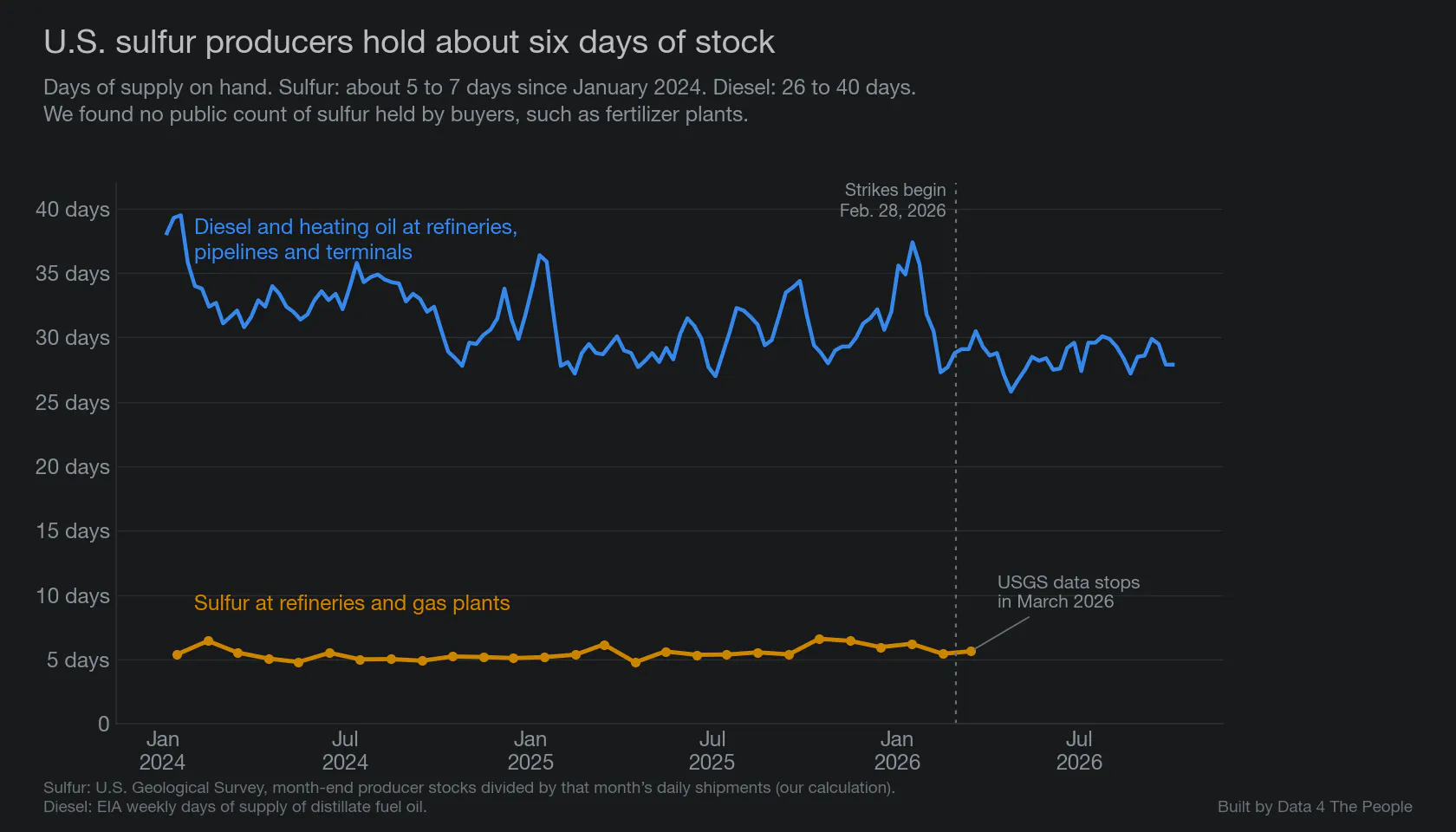
Days of supply on hand. Sulfur is our calculation from USGS data. Diesel is EIA’s published figure.
U.S. sulfur producers held 122,000 tons at the end of March 2026, the latest month the Geological Survey has published, more than six months ago. That stock is about six days of shipments. Sulfur comes out of a refinery every day and has to leave every day. Diesel and heating oil stocks, by comparison, have covered 26 to 40 days of demand since 2024 and stood at about 28 days in early October.
The two figures do not measure quite the same thing. The sulfur number counts only what producers hold, not what is sitting at the fertilizer plants that buy it.
The public record beyond that is thin. We found three sulfur stockpiles with numbers attached, and the next chart shows all three.
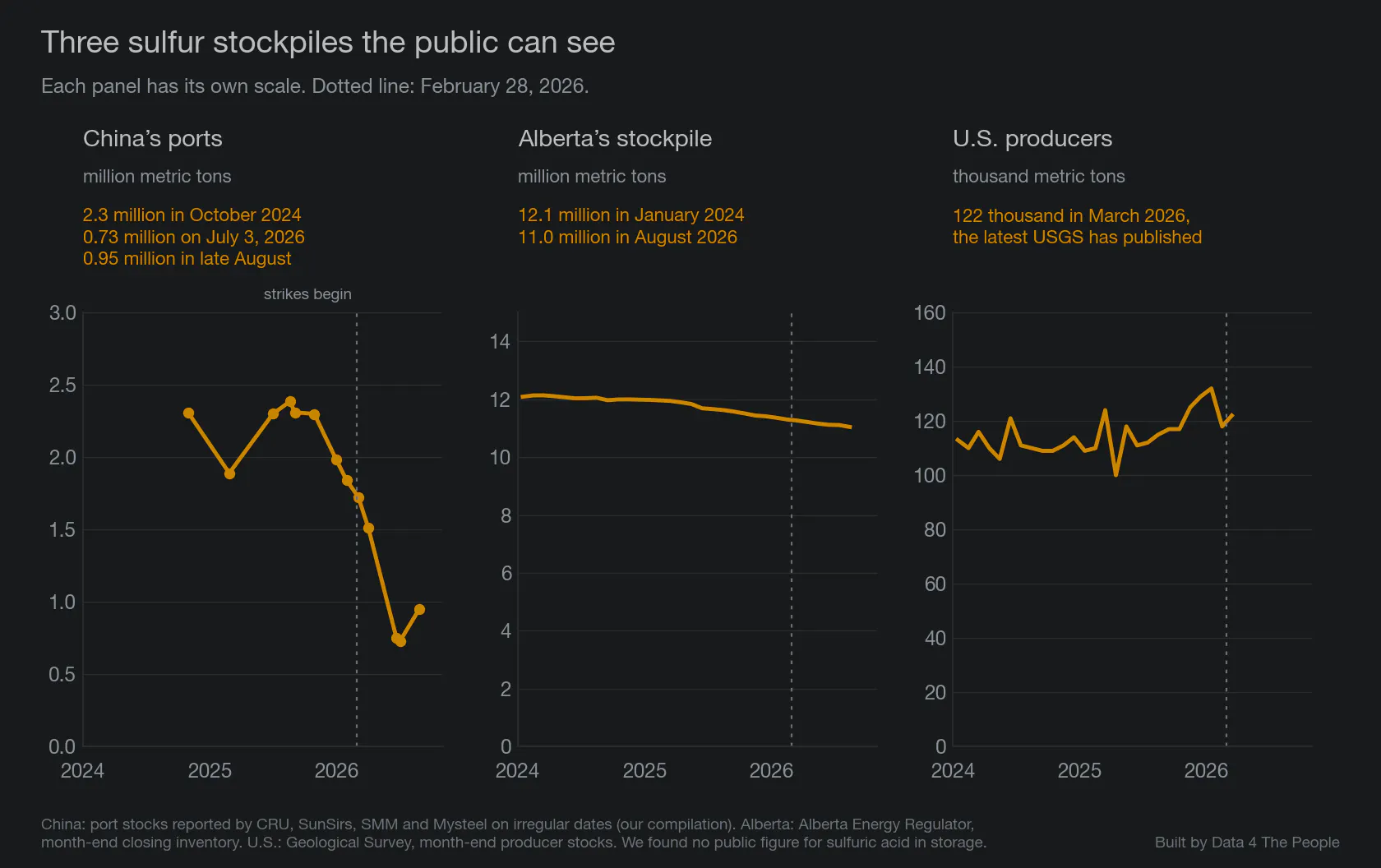
Sulfur held at China’s ports, in Alberta, and by U.S. producers. Each panel has its own scale. Sources: CRU, SunSirs, SMM, Mysteel, Alberta Energy Regulator, USGS.
China’s port stocks fell the most. They were about 2.3 million tons in October 2025, the same as a year earlier, and 0.73 million on July 3, 2026, which the trade publisher SMM called the lowest since 2017. They had recovered to 0.95 million by late August. For scale, China imported about 800,000 tons a month in 2025.
Alberta holds the largest pile we could find: 11.0 million tons at the end of August, built up over decades at gas plants and oil sands sites. It has been shrinking slowly since 2024, and it did not shrink faster after the war began. Sulfur in a block has to be melted and moved by rail to Vancouver before it can be shipped, and CRU put the cost of that at $180 to $200 a ton.
That is all we could find. We found no public count of the sulfur held at fertilizer plants, no figure for sulfuric acid in storage, and no figure for fertilizer stocks.
Where things stand
The sellers in the Gulf post a price each month. The chart below shows the one from Abu Dhabi’s state oil company, Adnoc, next to our U.S. export average.
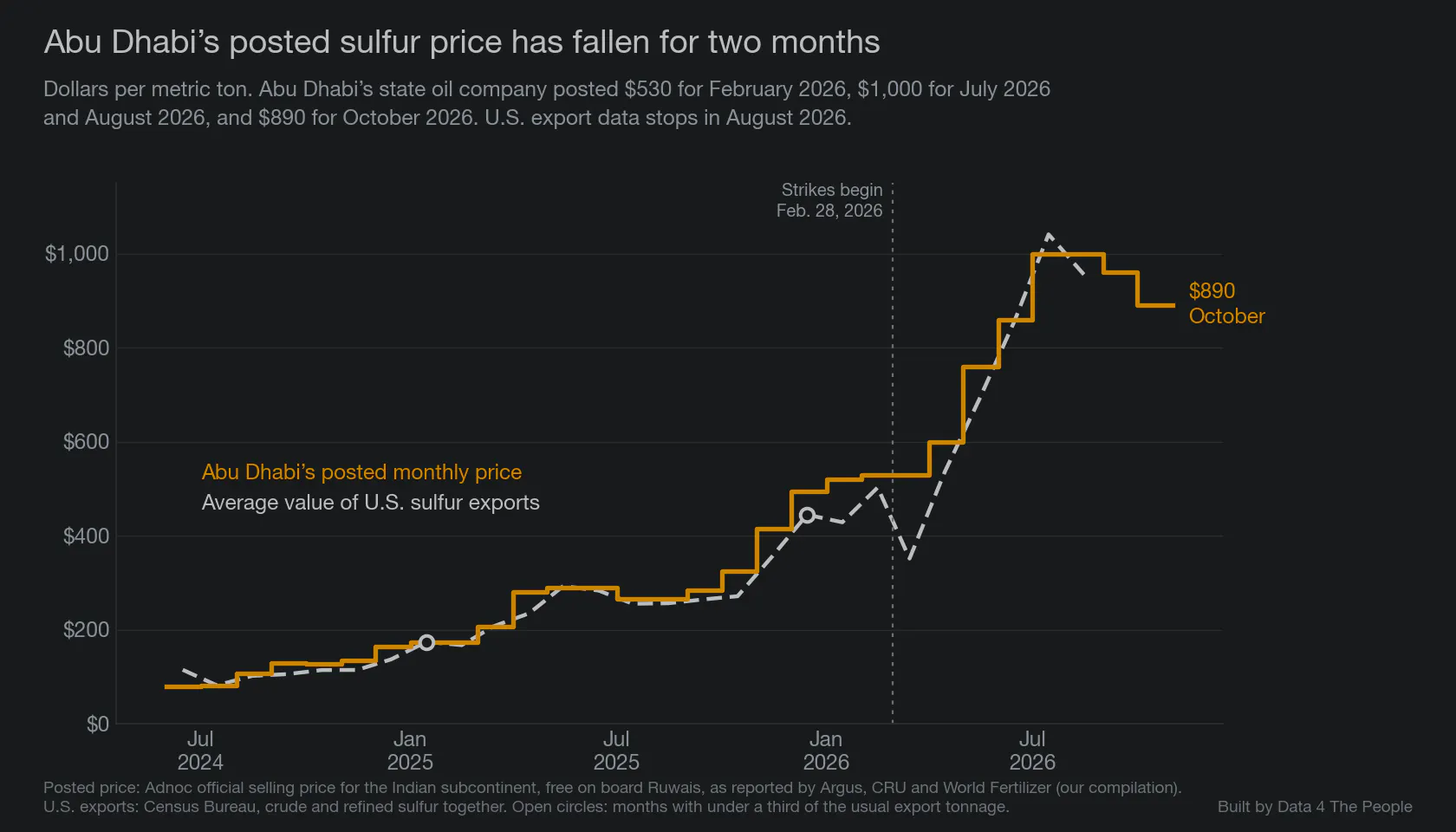
Adnoc’s posted monthly sulfur price and the average value of U.S. sulfur exports. Posted prices as reported by Argus, CRU and World Fertilizer.
Adnoc posted $530 a ton for February, $1,000 for July and August, $960 for September and $890 for October. Argus described the $1,000 price as a record. The October price is still 68% above February.
CRU wrote in September that buyers were cutting back and putting off purchases, not paying the going price. That lines up with the idled fertilizer plants. In our view, it suggests prices are easing partly because less fertilizer is being made, which is more of a relief for the sulfur market than for the people who buy fertilizer.
Why this matters
I now understand why my former boss urged me to research sulfur. It feels to me that it could be the canary in the coal mine for the risks that could come to pass in more widely followed markets, like diesel.
Here we are, with prices finally declining, not because the situation has resolved itself – there is no putting the toothpaste back in the tube on this one – but rather, as far as I can tell, because companies like Mosaic are just throwing up their hands saying we’re not going to produce as much fertilizer at this price. If you are looking at the chart hoping for the pressure to ease, this may seem like a good development. If you are a person who eats food, not so much. But unlike refineries, which can catch fire quickly when something goes wrong (as one in Venezuela did this week), global supply chains take a very long time to turn into pain and suffering. Less fertilizer today can mean lower yields tomorrow. And lower yields can mean less food and higher prices for that food.
What this does not tell you
- Our sulfur price is an average from customs records, not a market quote. It lags the market and moves when the mix of cargoes changes. Our January 2024 starting point is 12% above the Geological Survey’s figure for the same month, so the long-run rise could be closer to 1,300% than 1,146%.
- The sulfur cost inside a ton of DAP is priced at export values. Producers on contracts paid less while prices were rising. We do not have their actual costs beyond what Mosaic has reported.
- Inventory data covers three stockpiles. We found no public figure for sulfuric acid in storage, for sulfur held by fertilizer makers, or for fertilizer stocks.
- U.S. sulfur stock data stops in March 2026, one month into the war. The series used to run about two months behind and is now more than six months behind.
- The China port figures and Adnoc prices are compiled from trade press reports on irregular dates. They are not a published dataset.
- Price series end in different months. Sulfur and sulfuric acid run through August 2026, DAP and diesel through September.
Common questions
Why is there a sulfur shortage?
Most sulfur is a leftover from refining oil and processing natural gas, so the supply depends on how much fuel is processed, not on the price of sulfur. The trade publisher CRU estimated that the world used about 1.9 million tons more sulfur than it made in 2025. In March 2026 the war closed the Strait of Hormuz, the route for close to half of the sulfur that moves by sea.
How much have sulfur prices gone up?
The average value of U.S. sulfur exports rose from $77 a metric ton in January 2024 to $956 in August 2026, a rise of 1,146%. It was already $503 in February 2026, the last full month before the war.
Why is fertilizer so expensive?
Sulfur is used to make the sulfuric acid that turns phosphate rock into DAP and MAP, the two main phosphate fertilizers. At August 2026 export prices, the sulfur needed for a ton of DAP cost about $382, close to half of the $794 the fertilizer sold for. In January 2024 it was about $31.
What is sulfur used for?
About 90% of the sulfur used in the United States is turned into sulfuric acid, according to the U.S. Geological Survey. Most of that acid goes to phosphate fertilizer. It is also used to pull copper, nickel and cobalt out of ore.
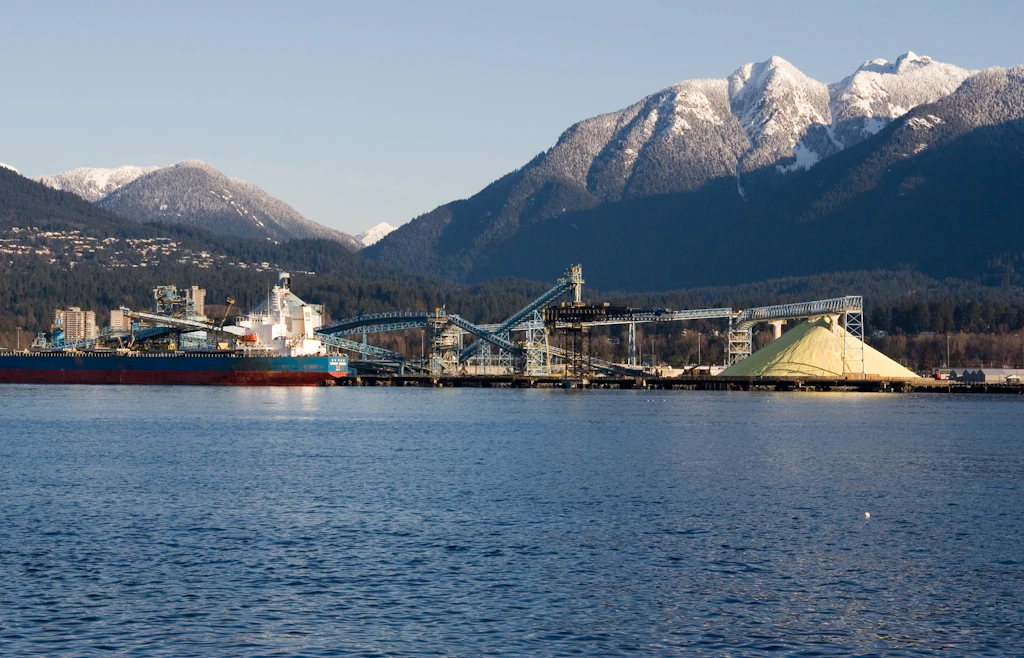
Photo at top: a sulfur pile and ship loader in North Vancouver, British Columbia, in 2008. [Photo by KimonBerlin](https://commons.wikimedia.org/wiki/File:North_Vancouver_from_Stanley_park._The_yellow_pile_is_sulphur_from_Alberta._(2289533764).jpg), cropped, [CC BY-SA 2.0](https://creativecommons.org/licenses/by-sa/2.0).
Support Data That Serves the Public
Data should empower people, not just institutions. Your support helps us create accessible research, visualizations, and tools that uncover economic inequality and inform better decisions.
Donate
Enjoying this post?
Tell others about it.
More articles like this
Fetching Related Posts
There are no other articles tagged with Research