

We may be running out of the fuel that runs our economy
Diesel is closing in on its all-time record while crude lags far behind. Inventories are scraping 30-year lows. America's answer: a trade fight with the country that feeds its refineries, and an emergency reserve draining while exports roll on.

Eric Pachman
Published
August 23rd 2026
AI image generated by Google Gemini
We interrupt your regularly scheduled programming (our "Stores That Stayed" series on SNAP retail authorizations) to bring you this public service announcement.
While the market dreams of copious AI earnings growth, an energy crisis is breaking out. In our view, it is of a magnitude not seen since 1973.
The Pump Is Telling You Something
Start with the price you can see from the driver's seat. Last week, the average price of diesel at the U.S. pump jumped 20 cents to $5.45 per gallon. That is within 36 cents of the all-time record set in June 2022, and up 88 cents in just six weeks. Crude oil has been rising too, but not nearly as fast. It still trades roughly 24% below its early-April high. Here is another way to see it. One barrel equals 42 gallons, so diesel at the pump now sells for about $229 per barrel, while the crude oil it's made from costs about $84. That gap is now $145 per barrel. In 2021, the last calm year before the Ukraine war shook oil markets, it averaged about $70. Today's gap is the widest ever recorded, and the three widest weeks on record are the last three. Taxes and delivery costs inside that gap have barely moved. What has exploded is the cost of turning crude into diesel.
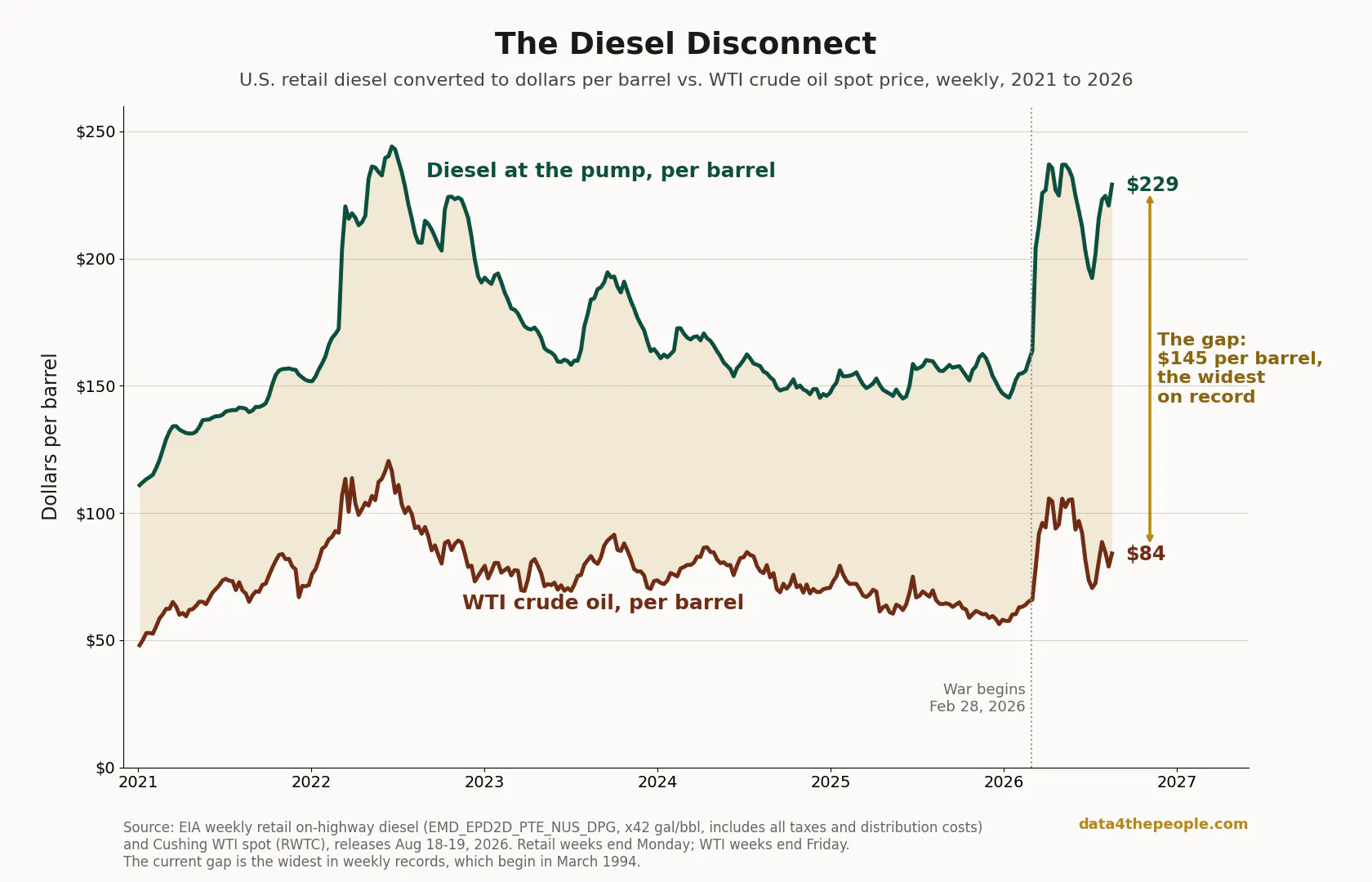
In short, oil markets are screaming that our diesel is in critical condition.
Running on Empty
U.S. distillate inventories tell the same story. Last week's drop took us within spitting distance of the lowest distillate inventories on record for this time of year.
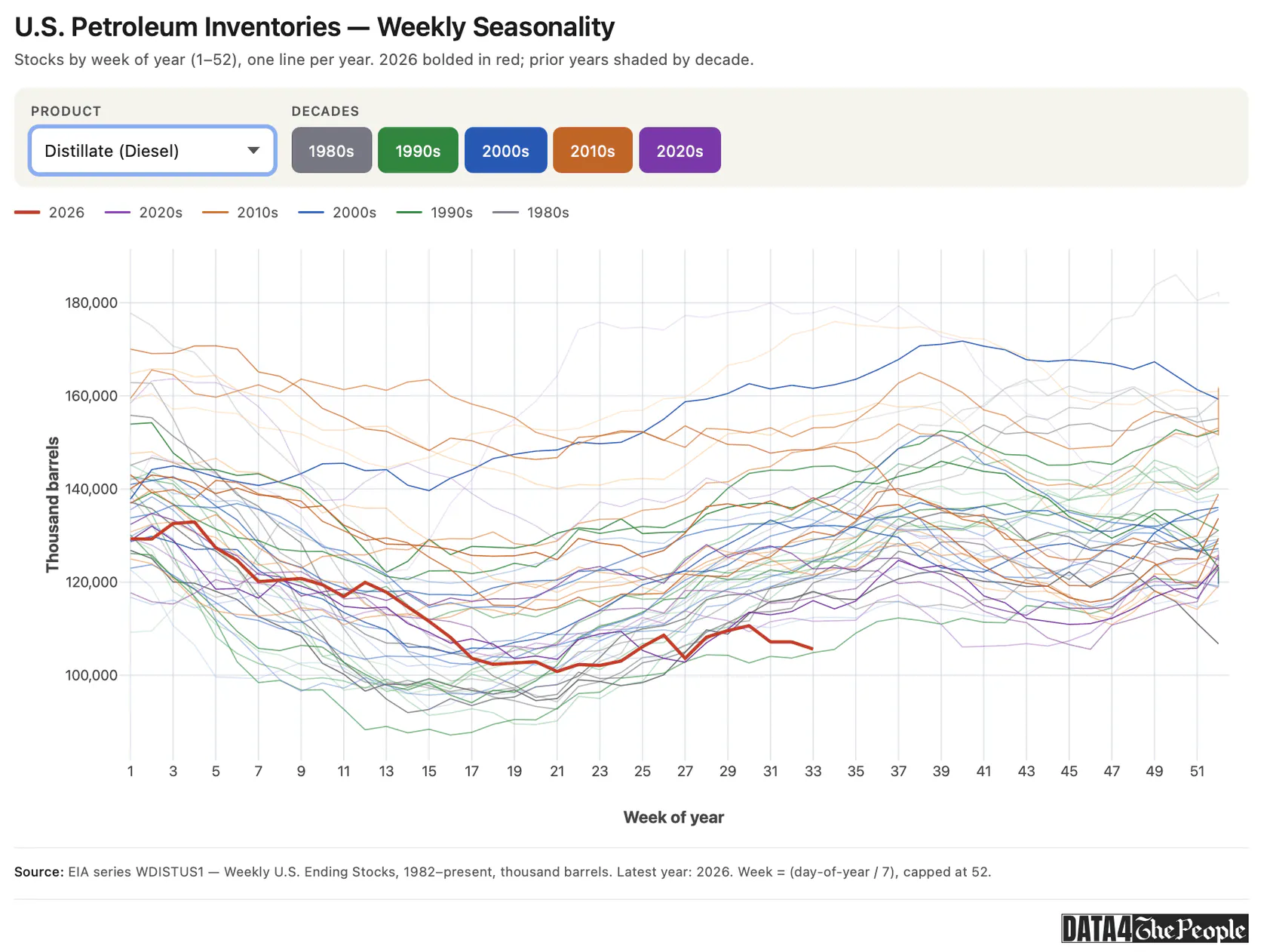
Why does this matter? "Distillate" is a group of molecules in crude oil that includes the diesel that moves our food and goods by truck and train, and the jet fuel that powers our planes. Distillate fuels our economy. And we may be running out of the fuel that runs our economy.
Two Ways Out
So is there anything we can do to avert this crisis, outside of building a time machine to prevent this war from ever starting?
Yes. Two things.
First, we could keep the oil we produce on our shores and run it through our own refineries. Our oil is not the most distillate-heavy in the world, but every barrel helps. We could have been doing this since the start of the war.
Second, we could strengthen ties with the country we rely on most for the heavy oil that is best for making diesel: Canada. We import roughly 4 million barrels of Canadian crude every single day. Roughly half of a Permian (the largest oil basin in the U.S.) barrel comes out of the ground as "naphtha," the stuff that makes gasoline, not diesel. You can crack big molecules into smaller ones, but you cannot fuse small molecules together to make diesel - at least not in any refinery America has. A Canadian heavy barrel is the mirror image. Roughly two-thirds of it is heavy material, and our Midwest and Gulf Coast refineries spent billions on the machines (e.g., cokers and hydrocrackers) that crack it into diesel. Take away the heavy barrels and those machines run empty. Refinery engineers at Honeywell modeled exactly this swap and found diesel production falls.
Instead, we are doing the exact opposite of both.
Canada's Trump Card
Start with Canada. Late Friday night, trade talks collapsed. New 50% U.S. tariffs took effect on about $20 billion of Canadian goods, and Prime Minister Carney says Canada will match them dollar for dollar. Here is what most people do not realize: in this fight, Canada holds the trump card. It is the oil. In 1981, we imported fewer than 200 thousand barrels of Canadian crude per day. Today it is roughly 4 million, more than half of all the crude we import. Nearly every barrel that Midwest refineries run comes from Canada.
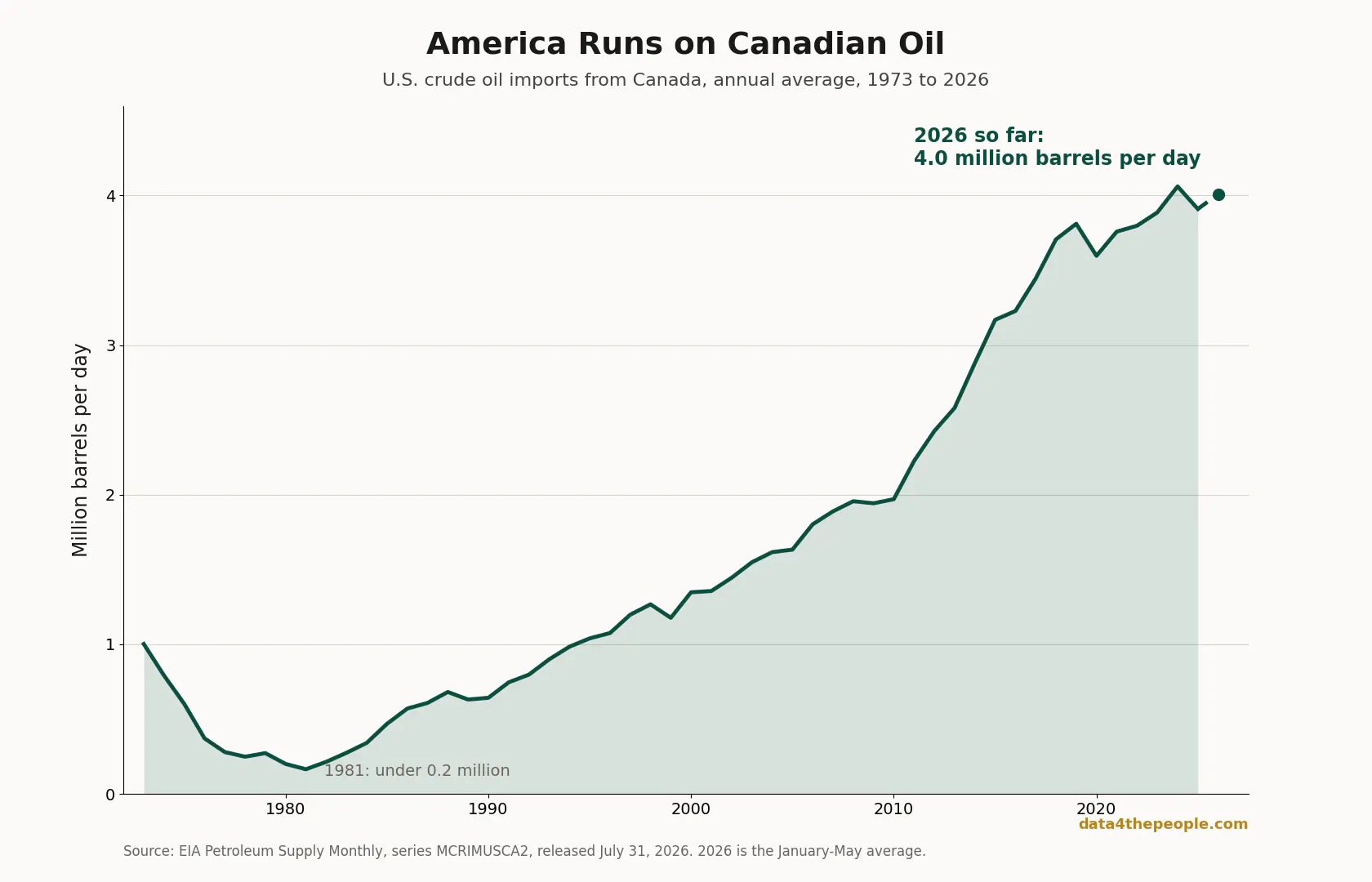
As of this writing, oil is not on either country's tariff list. But if this fight escalates, oil could get caught up in it. Canada has something we desperately need, and that gives it a different weapon: an export tax, a charge on its own oil as it leaves the country. Think of it as a tariff in reverse. Canada has used it on us before. In 1973, of all years, Canada taxed its oil exports to the United States, then put them on a schedule to be phased out completely. That squeeze is why the chart above bottoms out in 1981. Just last year, Ontario briefly slapped a 25% surcharge on the electricity it sends to three American states. And here is the twist: we could not answer in kind, because the U.S. Constitution flatly bans taxing our own exports. Canada faces no such limit. If Canadian oil gets caught in this crossfire, the cost of making diesel in America jumps at the worst possible moment.
Draining the Reserve
Now look at our own oil. Instead of keeping it here, we keep shipping it abroad while we drain our emergency oil, the Strategic Petroleum Reserve (SPR). Since the start of the year, we have pulled 120 million barrels from the reserve, taking it down to 293 million, its lowest level since early 1983, back when the government was still filling it for the first time. Some estimates put its minimum operating level near 300 million barrels. We are already below that. Meanwhile, we have exported 972 million barrels of crude so far this year.
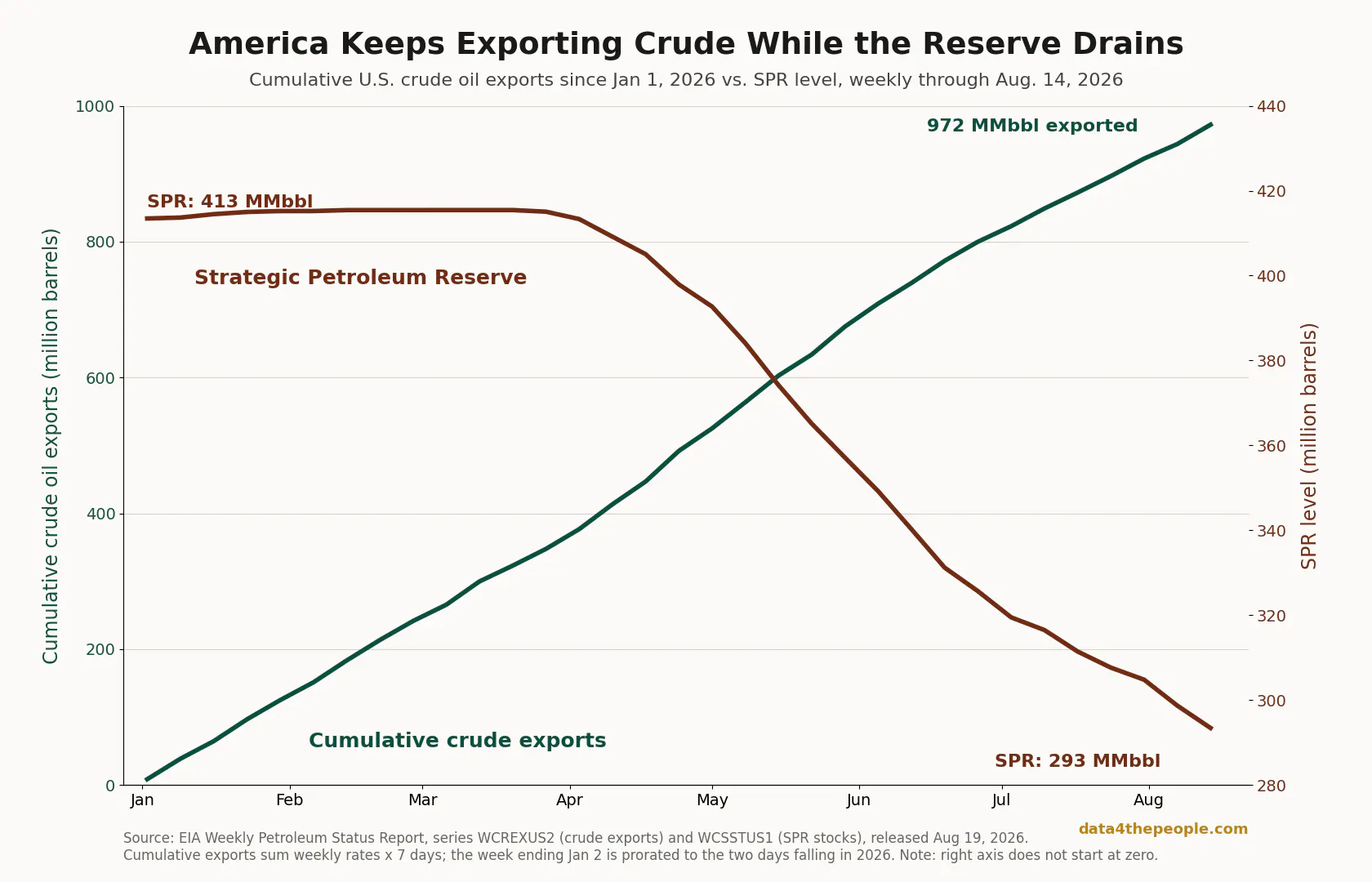
Now simplify this down to a mass balance (oil in = oil out) with the boundary drawn around our nation. Since the war began, we have drained 122 million barrels from the SPR and exported 731 million barrels of crude. That is roughly six barrels shipped out for every barrel pulled from the reserve. This is not about specific barrels moving from salt caverns onto tankers. It is the inputs and outputs of one system, our nation. And it makes this a true statement: we have effectively exported 29% of our emergency oil reserve since this war began. We are siphoning out reserves purportedly created to protect Americans and shipping them out of the country.
Where Our Awareness Lies
Look, you can ignore all of this if you want. All we really control is our awareness. The stock market's awareness is laser focused on the "hopium" that AI company earnings can compound at staggering rates for years to come. Maybe they can. We don't know or really care, as that is not where our awareness lies.
Instead, our awareness is always on the data. It's on the ever-changing probabilities of each branch of the decision tree that we call the U.S. economy. And it's on the nonsensical behavior we have catalogued today, behavior that increases the risk of catastrophic impact to hundreds of millions of American lives.
Is it too late to avert this crisis? Maybe. But it is never too late to take control of your awareness and start seeing the branches of the decision tree as they are rather than how we want them to be. We can't tell you what to do right now. But we can tell you this: if more people start studying data with an intent to learn, we can avert the next preventable crisis.
Support Data That Serves the Public
Data should empower people, not just institutions. Your support helps us create accessible research, visualizations, and tools that uncover economic inequality and inform better decisions.
Donate
Enjoying this post?
Tell others about it.
More articles like this
Fetching Related Posts
There are no other articles tagged with Data 4 Thought