
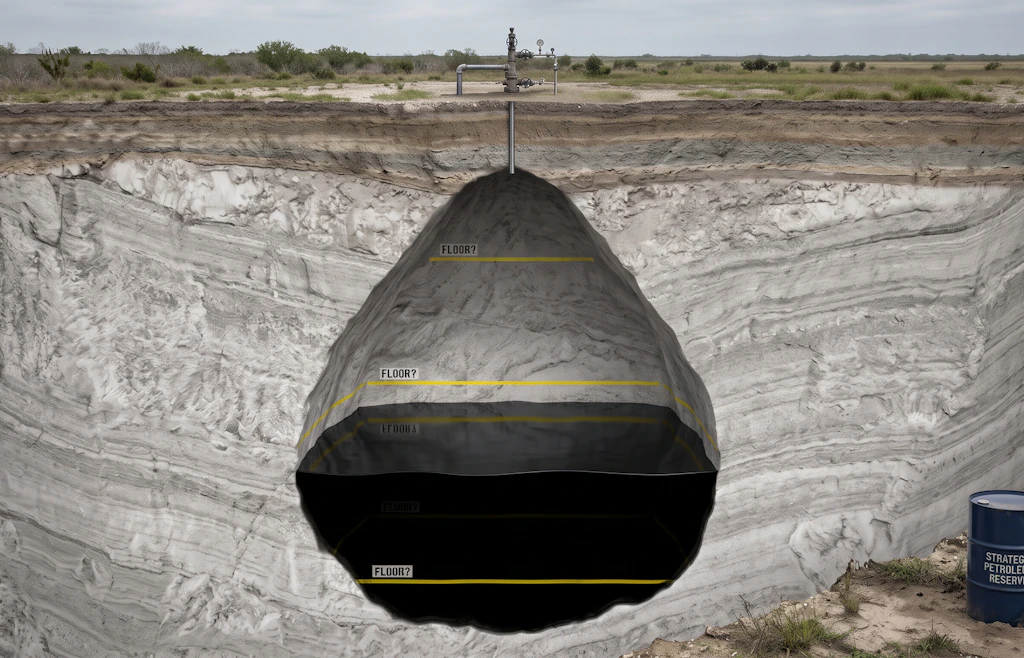
The Latest Oil Loans Could Push Our Emergency Reserve Below the Floor Experts Warned About
The government just lent out another 40.55 million barrels. If companies take all of it, the Strategic Petroleum Reserve would fall to about 242 million barrels, below the range some experts call its practical bottom.

Eric Pachman
Published
November 3rd 2026
The Energy Department has lent out another 40.55 million barrels from the Strategic Petroleum Reserve, or SPR. If the companies take all of it, and no borrowed oil comes back first, the reserve would hold about 242 million barrels. That is below the 250 million to 300 million barrels that some experts call the reserve's practical bottom, and it would be the lowest level since early 1982.
So we may soon find out whether those experts are right.
This is a quick update. For how these oil loans work, see our first post on the 2026 exchange. For how they compare with the 2022 oil sales, see our second.
What was just lent, and to whom
The department posted the results of two more rounds on October 29. In the first, awarded as of October 13, companies took 23.8 million of the 40 million barrels offered, or 59.5%. In the second, awarded as of October 28, they took 16.75 million of the 17 million offered, or 98.5%. The chart below shows who borrowed the oil in each round.
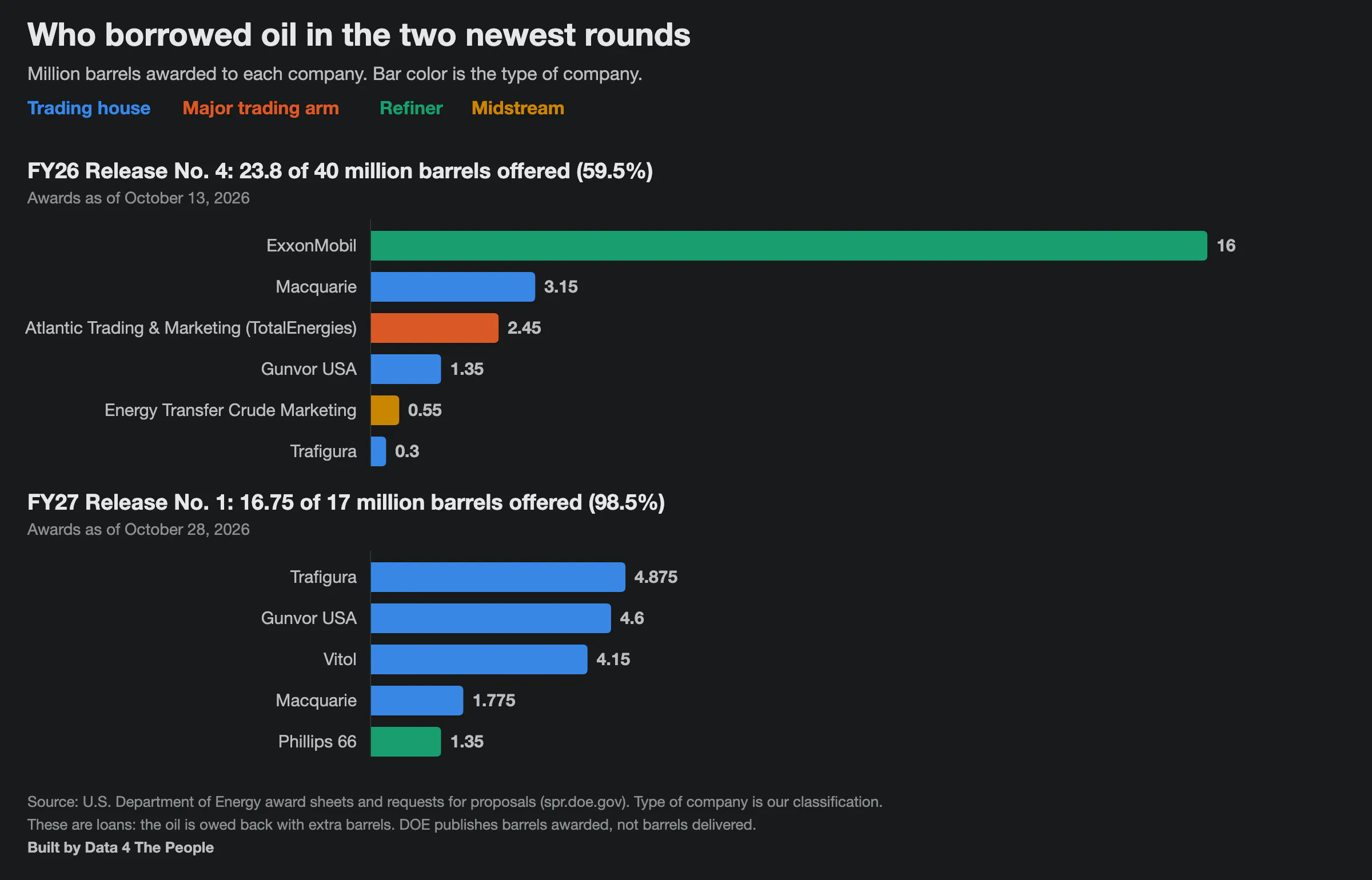
Source: U.S. Department of Energy award sheets and requests for proposals. Type of company is our classification.
The two rounds went to different kinds of borrowers. In the first, a refiner, ExxonMobil, took 67.2% of the oil, and trading companies took 20.2%. In the second, trading companies took 91.9%: Trafigura, Gunvor, Vitol and Macquarie. These are firms that buy and sell oil but do not run U.S. refineries. Across both rounds, trading companies took 20.2 million barrels, or 49.8%.
When the oil is due back
These are still loans. Companies pick up the oil from November 2026 through January 2027 and must return it later, plus extra barrels. How much extra depends on how late they return it.
- First round: returns run from April 2027 to December 2029. The extra oil owed ranges from 7% to 17.5%.
- Second round: no oil is due back before October 2028, and the last window ends in December 2029. The extra oil owed ranges from 14% to 19.5%.
Those are the minimums. Companies could offer more extra oil to win, and the department does not publish what each one offered. Its requests for proposals say it may post each winner's offer data "excluding exchange ratio," which is the extra oil.
The last time the government lent oil, the return dates did not hold. In late 2021 and early 2022, it made 13 smaller oil loans. Return dates moved back on 10 of them, and on seven, all or part of the oil was pushed back by two years or more. Some of that oil was rescheduled to come back this year. What remained of a 3-million-barrel loan Trafigura took in January 2022 was moved to July through October 2026, and the records do not show whether it has come back. A 2.7-million-barrel ExxonMobil loan from March 2022 was due back in June and July 2025 under the contract on file. It was moved twice, and is now due between October 1 and November 30 of this year. Several of the changes say directly that the delay cost the borrower nothing extra: "There is no adjustment to the premium as a result of this extension." The government agreed to every change, so the companies did not miss their deadlines. We covered those loans in detail in our second post.
In short, it's best to take these payback dates with a grain of salt.
What the first round could pay
The chart below repeats the math from our first post for the first of the two rounds, using futures prices on October 6, the day bids were due, and the smallest amount of extra oil the government would accept.
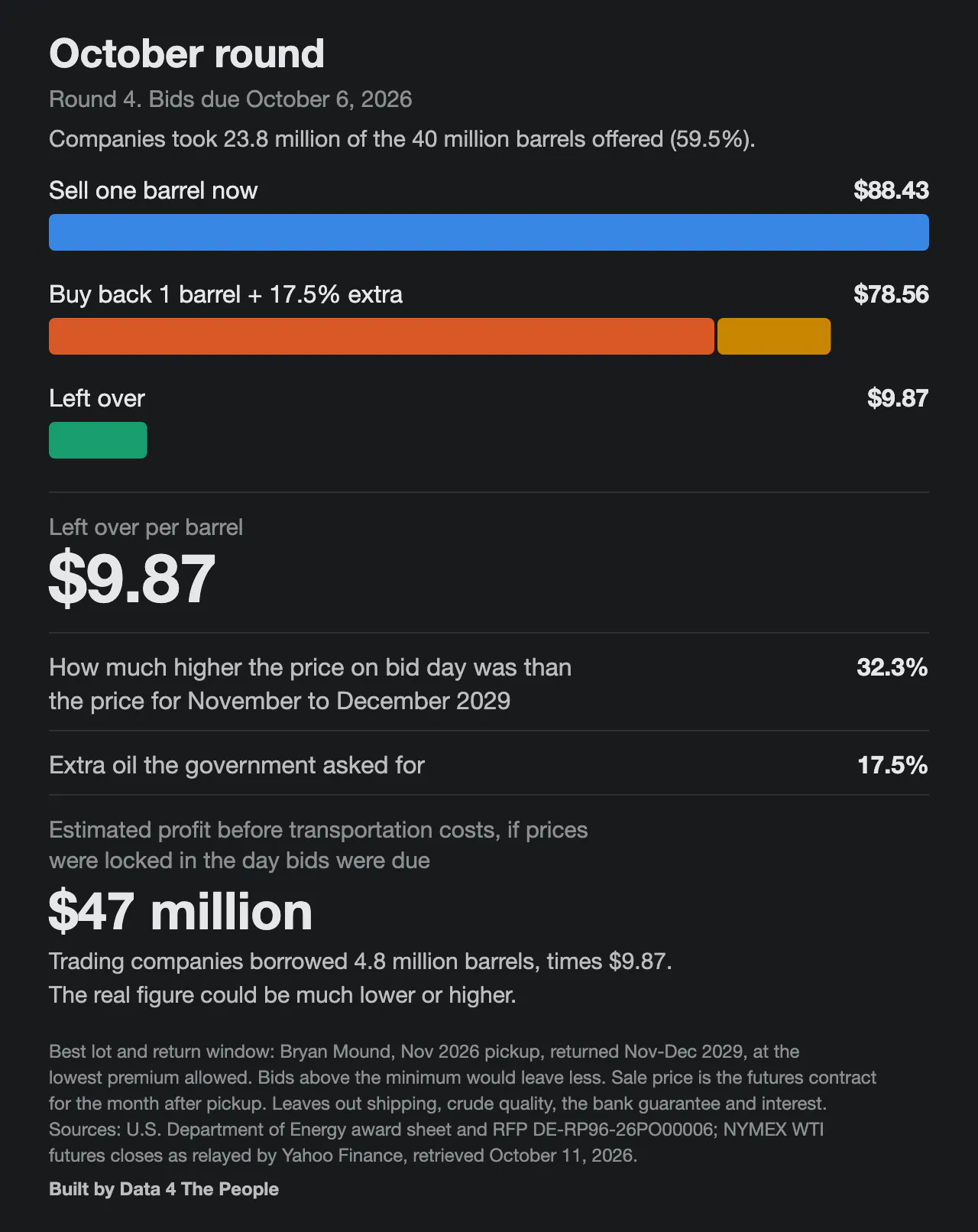
Source: U.S. Department of Energy award sheet and request for proposals; NYMEX WTI futures closes as relayed by Yahoo Finance. Best lot and return window shown, at the lowest premium allowed. Before shipping and other costs.
We cannot do the same math for the second round yet. We do not have futures prices for its bid day, October 21, that we can check against a second source. But the signs point to a trade that borrowers expected to pay well. Companies took 98.5% of the oil even though the government asked for more extra oil than in the first round, and trading companies took 92% of it. That's enough of a signal to tell me that borrowers expected a lot of money to be made in this round.
How low can the reserve go?
It's becoming clear, based on the disagreement in expert opinions, that the true bottom is not known.
- The Energy Department has said at least 70 million barrels must stay in the reserve to safely manage the underground salt caverns that hold the oil, according to CNBC.
- Siddharth Misra, a petroleum engineering professor at Texas A&M, told CNBC that 70 million barrels is the strict physical minimum, and that "the practical operational floor for the crude inventory is between 250 million and 300 million barrels." Below 300 million, he said, the reserve loses its ability to pump oil quickly in an emergency.
- Amos Hochstein, a former senior energy adviser to President Biden, told CNBC: "I don't know anyone who believes we can go below 300."
- Analysts at Rapidan Energy describe a "soft-ish floor" of about 170 million barrels, according to CNBC.
- Oil executives surveyed by the Federal Reserve Bank of Dallas in September split widely. The largest group, 31%, put the absolute minimum at 100 million to 150 million barrels. Another 19% put it at 250 million to 300 million.
- Congress has written one number into law: 252.4 million barrels. It applies only to one kind of short emergency drawdown, not to loans like these. Congress lowered it from 340 million in 2021.
The reserve held 282.6 million barrels in the week ending October 23, according to the Energy Information Administration. Take away 40.55 million and it would hold about 242 million. That is below Misra's range and below the line Congress set for short drawdowns. It is still well above the department's 70 million barrels and Rapidan's 170 million.
The real low point depends on timing. If oil from the first 2026 loans comes back starting this fall (I'm not holding my breath), we could stay above 250 million barrels after these withdrawals.
What to watch
The weekly numbers will tell us how low the reserve goes this winter, and whether the experts who drew the line at 250 million to 300 million barrels were right. We will keep watching. You can watch alongside us each week using our free interactive oil inventory data visualization.
What this does not tell you
- The extra oil each company agreed to return. The department publishes only the minimum. Our profit math uses the minimum, so it is the most a borrower could make at those prices.
- Which lots and return dates each company chose. The award sheets list only a company and a barrel count.
- The profit on the second round. We do not have checked futures prices for its bid day.
- When oil actually leaves or comes back. The weekly level is net. It cannot separate pickups from returns.
- Where the true floor is. The estimates above come from different people using different measures, and they do not agree.
- Whether every barrel awarded is picked up. The department publishes barrels awarded, not barrels delivered.
Common questions
How much oil is in the Strategic Petroleum Reserve now?
The reserve held 282.6 million barrels in the week ending October 23, 2026, according to the Energy Information Administration. If companies take all 40.55 million barrels just lent out, and none comes back first, it would hold about 242 million.
How low can the Strategic Petroleum Reserve go?
Experts do not agree. The Energy Department has said at least 70 million barrels must stay in the reserve to safely manage its salt caverns. A Texas A&M petroleum engineering professor told CNBC the practical floor is 250 million to 300 million barrels. Analysts at Rapidan Energy describe a floor of about 170 million.
Who borrowed oil in the latest rounds?
In the round awarded as of October 13, ExxonMobil took 16 million of the 23.8 million barrels awarded. In the round awarded as of October 28, trading companies (Trafigura, Gunvor, Vitol and Macquarie) took 91.9%. Across both rounds, trading companies took 49.8%.
When does the borrowed oil have to come back?
Oil from the first round is due back between April 2027 and December 2029, and oil from the second between October 2028 and December 2029. When the government last lent oil, in late 2021 and early 2022, return dates moved back on 10 of 13 loans.
Support Data That Serves the Public
Data should empower people, not just institutions. Your support helps us create accessible research, visualizations, and tools that uncover economic inequality and inform better decisions.
Donate
Enjoying this post?
Tell others about it.
More articles like this
Fetching Related Posts
There are no other articles tagged with Data 4 Thought