
Exxon says $150 oil is weeks away. Here's why I'm not dismissing it.
Gas already costs the average household an extra $133 a month. It could get much worse.

Eric Pachman
Published
June 1st 2026
$150 oil? Why I’m not dismissing Exxon’s warning
On May 4th, I wrote about the gasoline "war tax" — the extra dollars we're paying at the pump thanks to the war with Iran. Back then the tax, the extra cost for the average household versus before the war (Feb 27), was about $101 a month. Just under a month later, it's $133. For context, that's about what a family cell phone plan costs… except you didn't get four new phones. Clearly, this is headed the wrong direction.
But salvation is near! Or so the excitement goes. Oil prices have been falling on speculation of a deal to end the war. Never mind the inconvenient fact that no one actually knows the terms, and that Iran and the U.S. seem to be telling different stories about who controls the Strait of Hormuz once anything is signed. The market has spoken, and it expects a deal to land and oil to magically start flowing again.
Meanwhile, the same week that news dropped, an ExxonMobil senior vice president stepped up at an investor conference and said the company's modeling pointed to physical Brent crude hitting $150 to $160 a barrel within weeks as inventories bottom out. At the same conference, Chevron's CEO struck the same tone, warning that the market's "shock absorbers" have been drawn down and that prices face real upward pressure heading into June and July.
What gives? Did Exxon and Chevron not see the news? What are they looking at that has them sounding alarms at the very moment oil prices were sliding?
That's what I set out to understand over the weekend.
But first, a disclosure: my first job out of college was refinery modeling and simulation for ExxonMobil. I worked there just under five years. You can say what you want about oil and gas companies, but I've never seen one more analytically rigorous than Exxon - a company chock-full of engineers who check their work a dozen times before saying anything out loud. It's still the only place I've known that pays its technical leaders as much as senior management. So when I saw the $150 claim, it stopped me in my tracks. The Exxon I know doesn't say something like that publicly unless it expects it to happen.
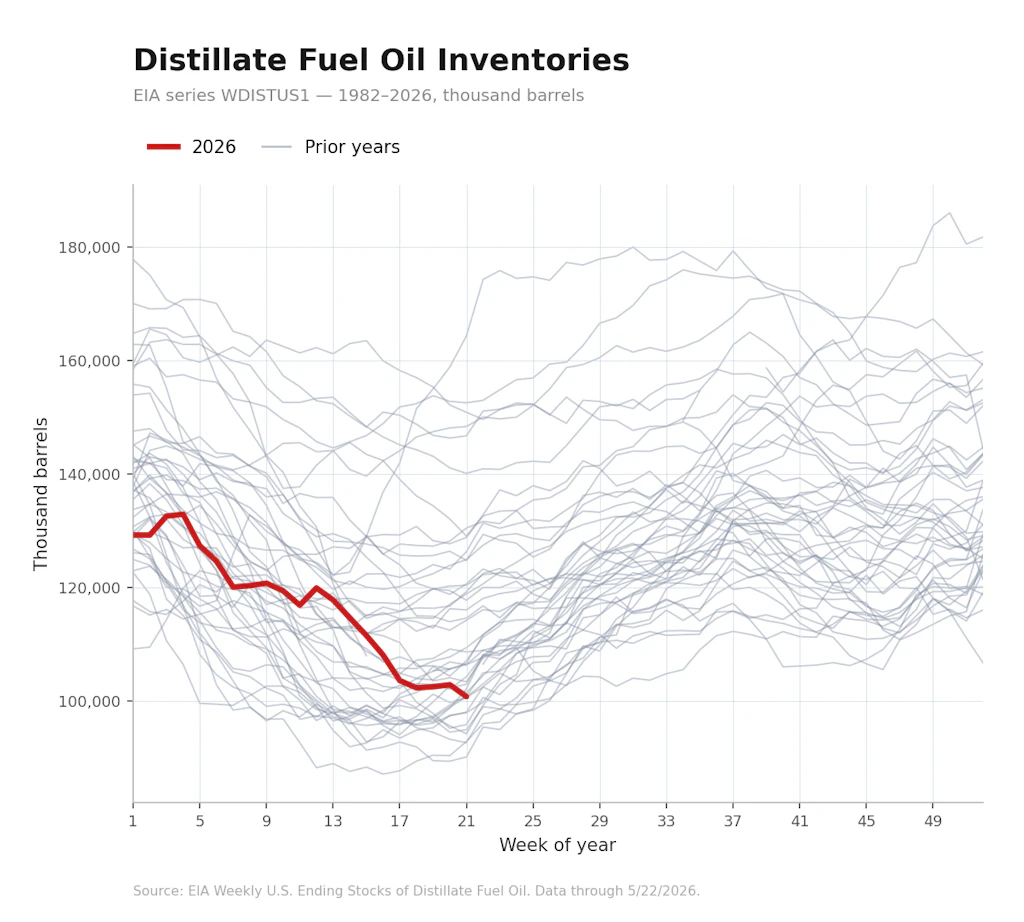
So what prompted it? If I had to guess, it's the petroleum inventory charts - which are, frankly, terrifying:
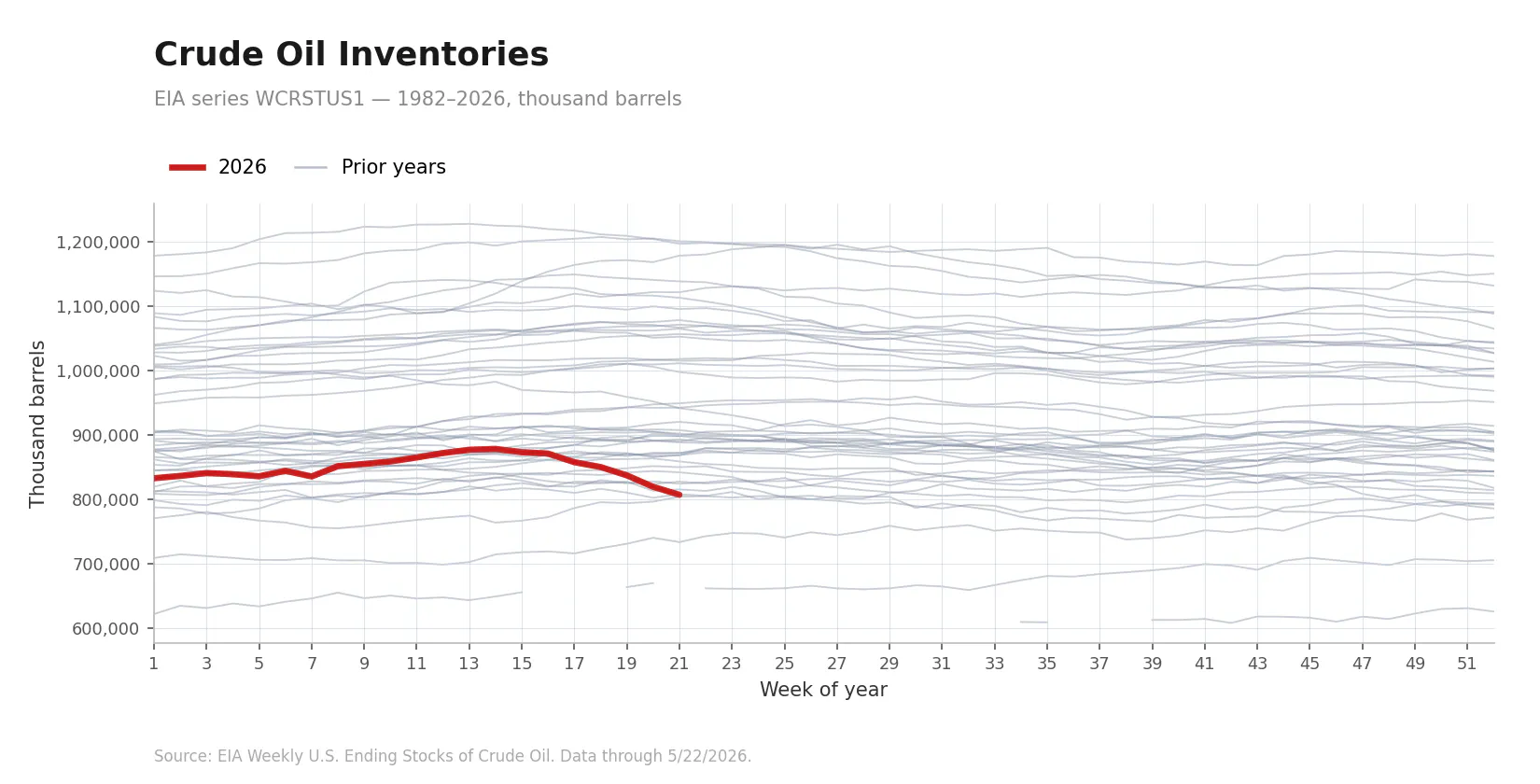
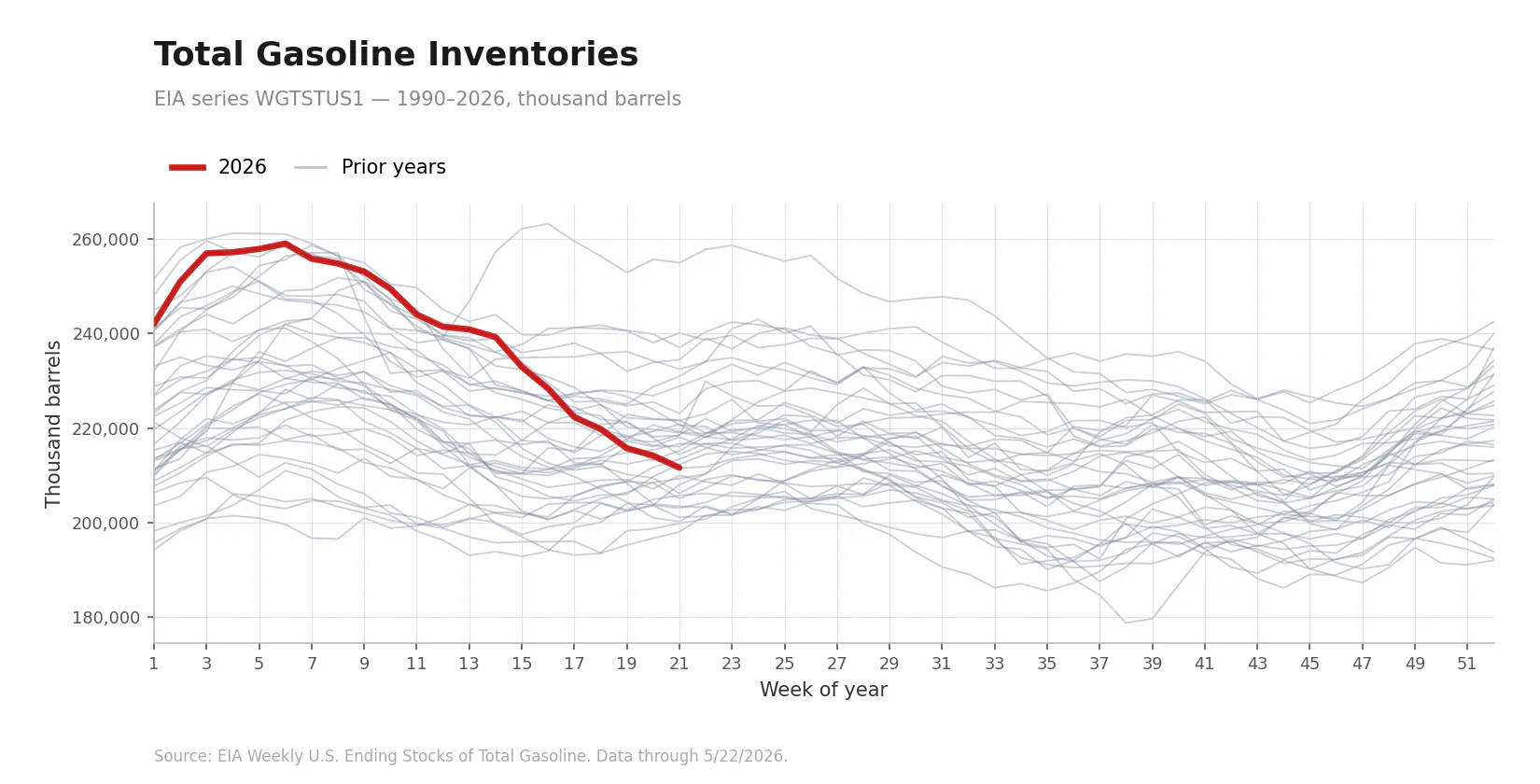
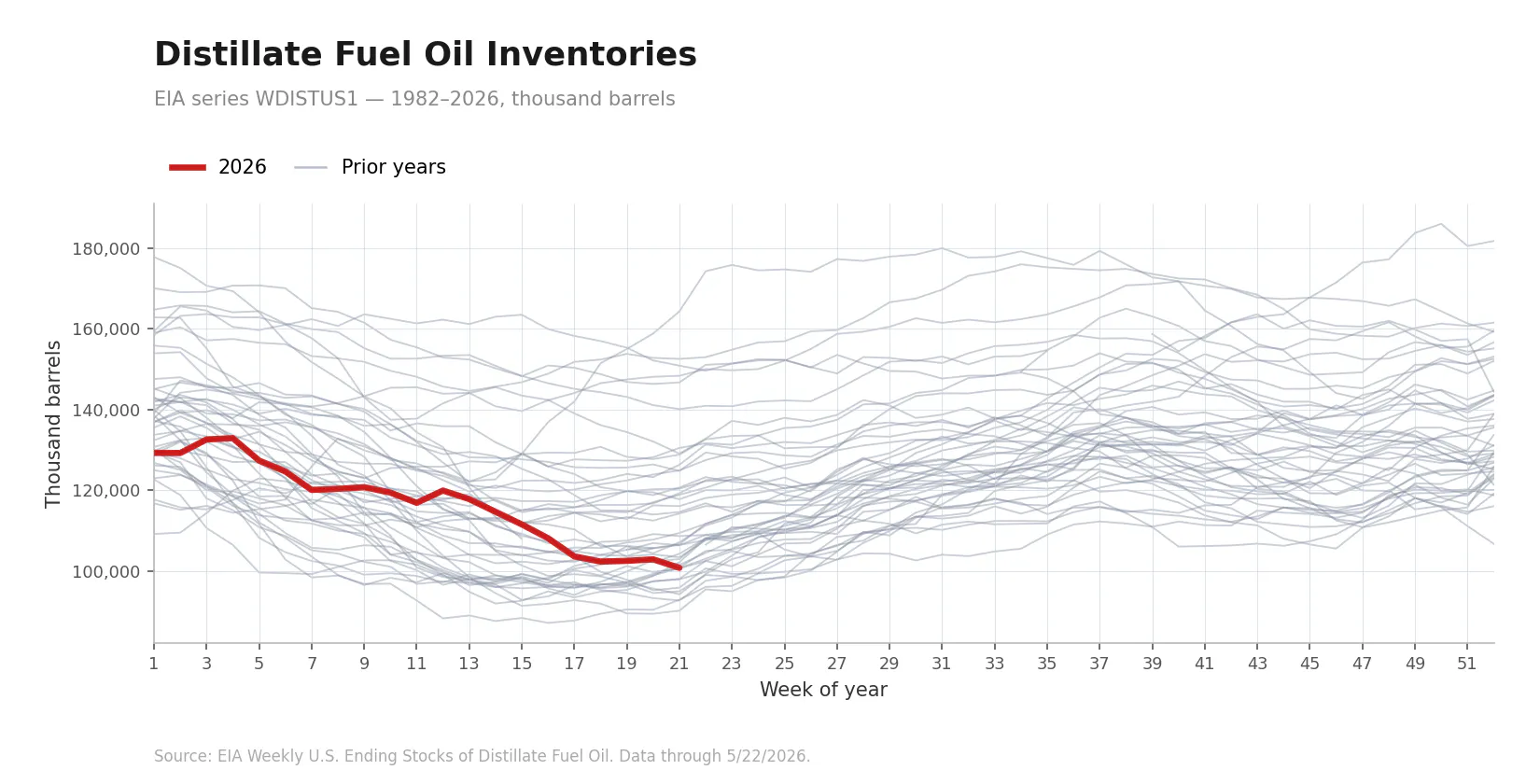
Look at crude. After climbing through the spring, inventories have turned and are falling fast - the steepest decline of any year on the chart. If that slope holds, we're heading for territory we haven't seen since the early 1980s, when those bottom grey lines were set. Gasoline was comfortable before the war and is now sliding toward the low end of its range. And distillate (i.e., diesel) is the one that should stop you cold: stocks are now lower than they've been more than 90% of the time in over 40 years of record. Spend a minute with all those faint grey lines. Those are the prior years - four decades of them. Try to find one with a downward slope like the one we're on now. There isn't one. That's the terrifying part - it's not just where we are, it's how fast we're getting there.
So this is likely what the oil companies see. And don't fall for the lazy claim that they're just "talking their book." Oil companies don't control the screen price of crude - global markets do. The majors are largely price-takers on the commodity; they live with whatever the market hands them.
So let me ask plainly: if the U.S. really had more than enough oil to go it alone, why are we watching these inventory draws at all? Who should we believe - the comfortable narrative, or the data?
And here's why I keep coming back to it. This isn't a story about Exxon's free cash flow or which energy stock catches the updraft. Strip away the investor framing and what these charts describe is a bill - one that lands on a kitchen table, not a trading desk.
Go back to that war tax. At $133 a month, a family is already absorbing the cost of a phone plan they never signed up for. But that number was built on today's prices - and today's prices assume a deal gets done and the barrels flow. If Exxon is right, and inventories grind to their floor before any deal materializes, the pump price doesn't drift up. It lurches - the same way a near-empty tank doesn't ease toward empty, it just hits E.
And the people who feel it first aren't the ones who can shrug it off. It's the commuter with a 40-mile drive and no transit option. It's the household where filling two tanks already means trimming the grocery run. At some point the math stops working: when it costs more to drive to the job than the shift pays, people don't go. That's not a moral failing. It's arithmetic.
Now follow that thread, because this is where it stops being one family's problem and becomes everyone's. The economy we take for granted is a vast, invisible web of people driving to do things for us - and nearly every strand runs on a tank of gas or diesel. The lawn that gets mowed. The package that shows up. The home health aide who visits your mother. The trucker restocking the shelf, the contractor at the job site, the kid delivering the food. None of it is automatic. All of it assumes someone can afford the drive. Pull hard enough on the cost of a gallon of gas and you don't just raise prices - you start pulling people out of the system entirely. The service gets slower, or pricier, or one day it simply isn't there.
We've built a world of staggering convenience on the quiet assumption that fuel is cheap and always will be. We rarely notice the connective tissue holding it together - until it's stressed. If these charts are right, we may be about to find out just how deep that interconnectivity runs, and how much of what "just works" today was only ever working because gas was affordable.
I can't tell you what's going to happen. But the inventories are flashing a bright red warning sign - and the people with the least cushion are standing closest to it.
Maybe it turns around and Exxon's warning proves wrong. I hope it does.
The good news is we won't have to wait long to find out who's right.
The bad news is we won't have to wait long to find out who's right.
Support Data That Serves the Public
Data should empower people, not just institutions. Your support helps us create accessible research, visualizations, and tools that uncover economic inequality and inform better decisions.
Donate
Enjoying this post?
Tell others about it.
More articles like this
Fetching Related Posts
There are no other articles tagged with Data 4 Thought