

Who takes care of Manhattan?
Yesterday we mapped the care economy nationally. Today we go down to the county, and into the five boroughs.

Eric Pachman
Published
June 23rd 2026
Who Takes Care of Manhattan?
Yesterday we wrote about how America's aging is fueling an extreme concentration of job growth in the Medicaid care economy. We told that story at the national level, and then state by state. The pattern was hard to miss: in a growing number of states, a handful of Medicaid-funded care industries now account for an outsized share of every new job being created.
But a state is still an abstraction. The story gets very real when you go down to the county, where people actually live and work. So we did. We pulled the latest annual employment data from the Bureau of Labor Statistics and looked at one thing, county by county: health care and social assistance as a share of all jobs.
But one finding stood out. It happens to involve five of the most familiar counties in the country: the five boroughs of New York City.
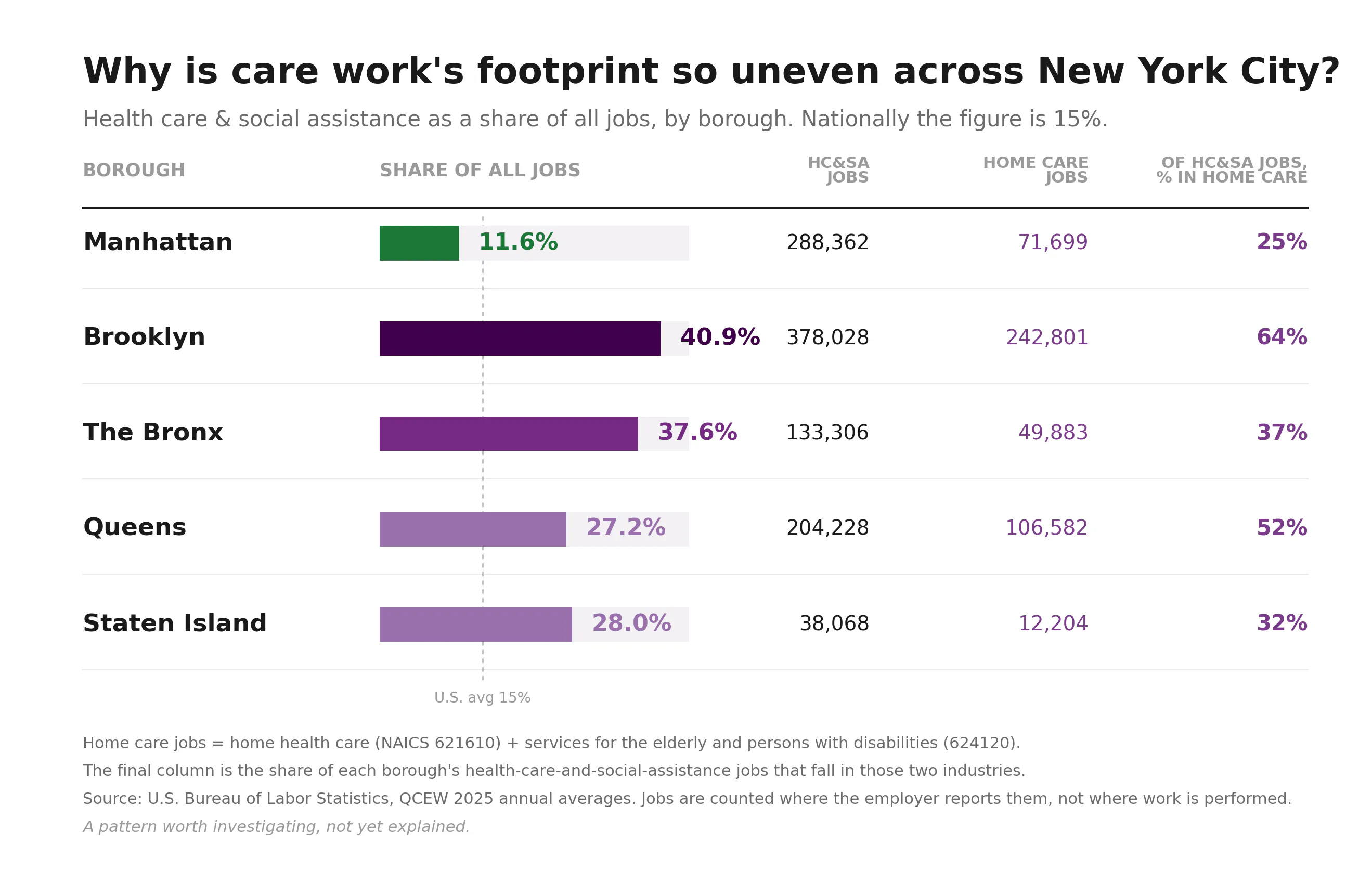
Figures independently re-derived from the raw QCEW annual file and cross-checked: the five boroughs sum to 4,653,359 total jobs, consistent with New York City's known employment base.
Look at the picture. One borough is an outlier in the low direction: Manhattan, where health care and social assistance make up just 11.6% of all jobs, below the national average of 15%. That part makes sense. Manhattan's job base is enormous and diverse, anchored by finance, media, and professional services, so care work is a small slice of a very large pie.
Now look at the other four. Brooklyn, Queens, the Bronx, and Staten Island all sit far above the national average. And Brooklyn is staggering. At least 40% of all jobs in Kings County are in health care and social assistance. Drill into that 40%, and roughly two-thirds of those jobs are in home and personal care: people paid to take care of others, the elderly and the disabled, in their homes and communities.
(We say "at least" deliberately. A small amount of government health employment is withheld from the public data for confidentiality, which means these shares are conservative floors. The true numbers are, if anything, a little higher.)
What explains the gap?
What separates Manhattan from the borough across the river? We cannot tell you definitively. But we understand this industry well enough to offer a few educated guesses, and they are worth sitting with.
New York pays families to care for their own. Through its Medicaid program, New York compensates people to provide home care to elderly and disabled relatives, and New York's home-care program is among the largest and most generous of any state. Paying family caregivers through Medicaid is not unique to New York, but few states do it at anything close to this scale. If that is happening more in the outer boroughs than in Manhattan, it would show up in the data exactly like this.
The data counts a job where the employer files paperwork, not where the work is done. This is the quiet one. Home care in New York runs through licensed agencies, and a single agency can staff aides across the entire city, and well beyond it, from one central office. So ask yourself: how many home health aides who care for Manhattan's elderly actually live in, and are dispatched from, the cheaper boroughs? If the agency that employs them files its paperwork from an office in Brooklyn or Queens, those workers can be counted there even though the care is delivered on the Upper East Side. Our own look at the data shows Brooklyn's home health employment concentrated in a small number of very large agencies, an average of more than 600 workers per establishment. That alone does not prove those aides are working in other boroughs. But it is another clue pointing in that direction.
What we can and cannot say
Let me be clear about the limits here. We cannot decompose that 40% into family caregivers, commuting aides, and everyone else. The public data does not allow it, and we are not going to pretend otherwise. This is a pattern worth investigating, not a conclusion we have proven.
But here is what we think it should hammer home, and it is simple. Manhattan cannot be Manhattan without the boroughs around it. The borders between these counties are real lines on a map, but the economy does not respect them, and neither does the work of caring for people.
We know this already, if we stop to think about it. The typical home health aide caring for an elderly New Yorker earns $39,680 a year; the best-paid top out around $46,000. On that wage, in this city, you are not living in Manhattan. You are living in Brooklyn, or the Bronx, or Queens, and traveling to where the care is needed. What the data does is show us how far it has gone. At least 40% of Brooklyn's jobs are now in health care and social assistance. Manhattan's economy, and Manhattan's care, run on people who cannot afford to live in it.
And it runs deeper than wages. The people doing this work are sorted across the city along lines of origin, too. More than half of New York's immigrant home care aides live in Brooklyn, with another quarter in Queens; in Brooklyn alone, nearly four in five home health aides are foreign-born. The immigrants in the city's highest-paid professions, the physicians, the lawyers, the bankers, have a better shot at living in Manhattan. Same city, opposite ends.
So I keep coming back to the same question. If the workforce caring for Manhattan's elderly lives outside Manhattan, and if the people who cook its food and clean its hotel rooms likely do too, then what exactly is "Manhattan"? Is it really just the boundaries we see on a map, and only the people fortunate and wealthy enough to live within them?
New York just makes it easy to see. The boroughs are packed so tightly that the dependence shows up on a map. But this is not a New York story. Open your eyes and look at how your local economy functions, see what you find, and think about how real the lines that define your community truly are.
Maybe it is time to redraw the lines.
Notes on the data
- Source: U.S. Bureau of Labor Statistics, Quarterly Census of Employment and Wages (QCEW), 2025 annual averages. Health care and social assistance is NAICS sector 62.
- Shares are conservative floors. Each borough has some state or local government health employment withheld for confidentiality. Those withheld jobs are excluded from the figures shown, so every share is a minimum.
- Home and personal care, or "home care,” is approximated by two industry codes: home health care services (NAICS 621610) and services for the elderly and persons with disabilities (NAICS 624120).
- Jobs are counted where the employer reports them, not where the work is physically performed. For home care, where large agencies staff clients across multiple boroughs from a central office, this means a borough's job count reflects employment administratively based there, which is not the same as care delivered there. The New York City Comptroller's office has noted the same limitation: QCEW captures workers who live outside the city but work in it.
- The family-caregiver program referenced above is New York's Consumer Directed Personal Assistance Program (CDPAP), a Medicaid program that pays consumers' chosen caregivers, including most relatives and friends but generally not spouses. As of 2025 it was consolidated under a single statewide fiscal intermediary, Public Partnerships LLC (PPL), which concentrates payroll reporting and is relevant to the place-of-work caveat above.
- Wage figure: BLS Occupational Employment and Wage Statistics (OEWS), May 2025, New York-Newark-Jersey City, NY-NJ metro area. Home Health and Personal Care Aides (SOC 31-1120): annual median $39,680, annual mean $41,120, top of published range $46,570.
- Who does this work. The figures on this workforce come from independent analyses of Census data. The Center for an Urban Future finds that 79% of Brooklyn's home health aides are foreign-born, that home health and related aide work is the single largest occupation for immigrants living in every borough, and that more than half of the city's immigrant aides live in Brooklyn. Citywide, the Center for Migration Studies puts home health and personal care aides at roughly three-quarters foreign-born. The New York City Comptroller's care-workforce report finds the city's care workers are 89% women, significantly older than other workers (home health aides average age 51), and far more likely to have been born outside the United States.
Support Data That Serves the Public
Data should empower people, not just institutions. Your support helps us create accessible research, visualizations, and tools that uncover economic inequality and inform better decisions.
Donate
Enjoying this post?
Tell others about it.
More articles like this
Fetching Related Posts
There are no other articles tagged with Data 4 Thought