
I tried to prove a popular narrative. The data pushed back.
A look at urban heat islands and poverty across 44 U.S. cities - and where the conventional wisdom breaks.

Eric Pachman
Published
May 29th 2026
Where the Heat-Poverty Narrative Holds - and Where It Doesn't
Happy Friday! Today marks two weeks of weekday Data 4 Thought updates. I'm quite excited about the streak, and plan to make it three next week.
Yesterday I wrote about the structural decline in routine doctor visits. Today I'm writing about the relationship (or lack thereof) between poverty rates and urban heat islands (UHIs). Natural transition. Welcome to my mind.
To deliver insights five days a week, I have to let my mind wander. I have questions about all sorts of things - and with AI, I can now 80/20 a lot of these questions in an hour instead of days. That's what Data 4 Thought is turning into: an "80/20" first pass at the many questions I haven't had time to dig into. Some will turn into deep dives. Some won't. But I'm having fun, and learning a ton - not only about America, but about how to harness AI's power for good.
Let's explore UHIs.
There's a piece of conventional wisdom that people living in poverty are more likely to live in urban heat islands. I didn't set out to disprove this - I set out to prove it. My bias is to use data and storytelling to give voice to the voiceless in America, and I've always been fascinated by UHIs. So I figured: why not give Claude something meaty to chew on this morning?
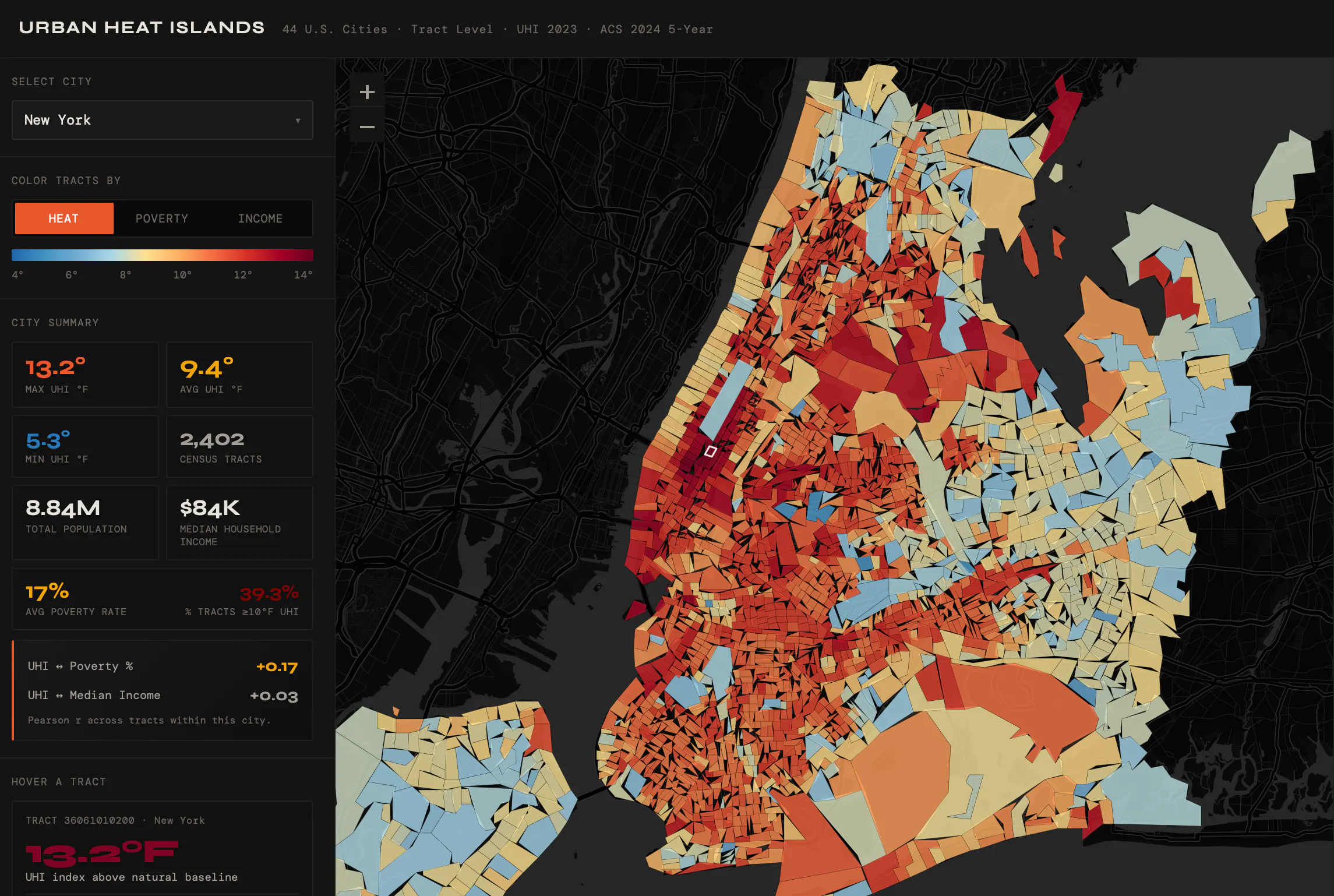
I downloaded data from Climate Central and data.census.gov, and - beep, bop, boop - out popped an interactive visualization showing temperature deviation, poverty rates, and median income by census tract across 44 U.S. cities. Here's New York:
Source: Climate Central, Census
First reaction: WTF. I did something similar a couple of years ago and it was a pain. I knew what the map should look like - Central Park notably cooler than surrounding Midtown - and Claude churned this out like a walk in the (Central) park.
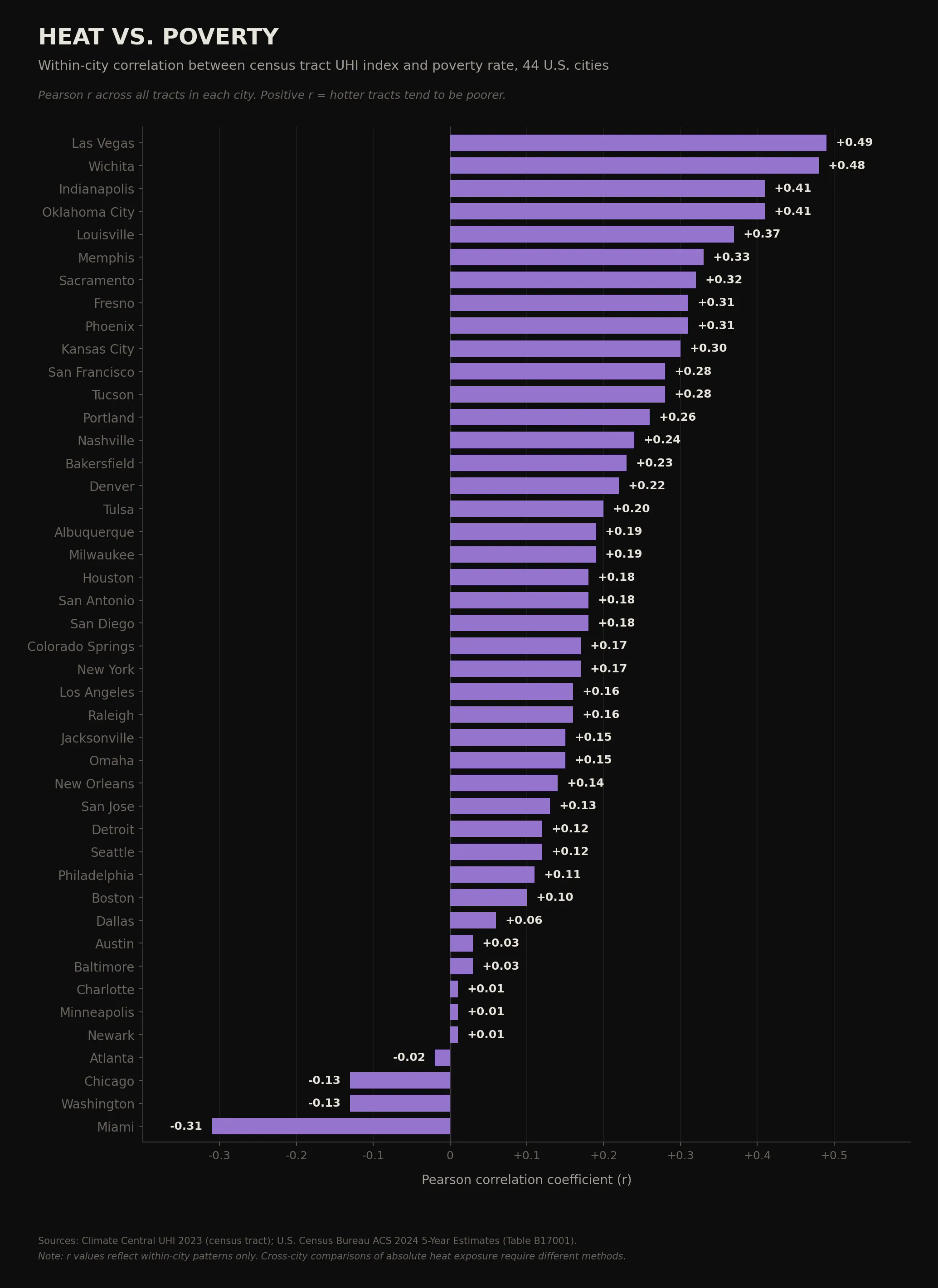
Then I asked Claude to measure the correlation between poverty rate and heat exposure for every city. To my surprise, for most cities the relationship is weak or nonexistent. This pushes back on a popular narrative that America's poor are systematically exposed to higher urban temperatures. It's true in Las Vegas, Wichita, Oklahoma City, Indianapolis. But not in New York. Not in Chicago. Not in Philadelphia.
Eye-opening stuff.
Source: Climate Central, Census
One important caveat: the Climate Central UHI index isn't a thermometer reading.
It's modeled from albedo (how much sunlight a surface reflects), green space, population density, and building characteristics. So we're measuring how built a neighborhood is, not necessarily what the temperature was on a given July afternoon. Still, it's the best granular proxy we have, and the variation across cities is striking.
Look - this is an 80/20 analysis. The data sources are solid (I checked) and I spot-validated several cities, but it isn't a peer-reviewed paper. AI doesn't deliver "perfect" in an hour yet. What it does deliver is the ability to ask a real question and get a defensible answer the same morning, instead of two weeks later.
The bottleneck has shifted for research. To do this kind of work now, you need three things:
- Knowing what question is worth asking
- The instinct to find the right data sources
- The honesty to report what the data actually says - especially when it disagrees with what you expected
If the finding here bothers you - if you wanted the data to confirm the simpler story - you have two choices. Wait for someone to publish a fully validated version (that may be Data 4 The People eventually). Or build your own. I'd opt for the second if you have the time. There's no better way to learn than to build.
Go find a question this weekend. See what you find.
Support Data That Serves the Public
Data should empower people, not just institutions. Your support helps us create accessible research, visualizations, and tools that uncover economic inequality and inform better decisions.
Donate
Enjoying this post?
Tell others about it.
More articles like this
Fetching Related Posts
There are no other articles tagged with Data 4 Thought