

The structural decline in routine doctor check-ups
Exploring the data that shows the decline in routine doctor check-ups

Eric Pachman
Published
May 28th 2026
What happened to routine healthcare visits?
Let’s talk healthcare this morning.
If you didn't know, there's a wonderful public database called the Medical Expenditure Panel Survey (MEPS), published by the Agency for Healthcare Research and Quality (AHRQ). MEPS publishes two different sets of data - household and institutional.
I've pulled this "Usual Source of Care" chart directly from the Household Component. It's wild, and quite terrifying in my opinion.
What is Usual Source of Care? In AHRQ's own words:
"For each individual family member, the respondent is asked whether there is a particular doctor's office, clinic, health center, or other place that the individual usually goes to if he/she is sick or needs advice about his/her health."
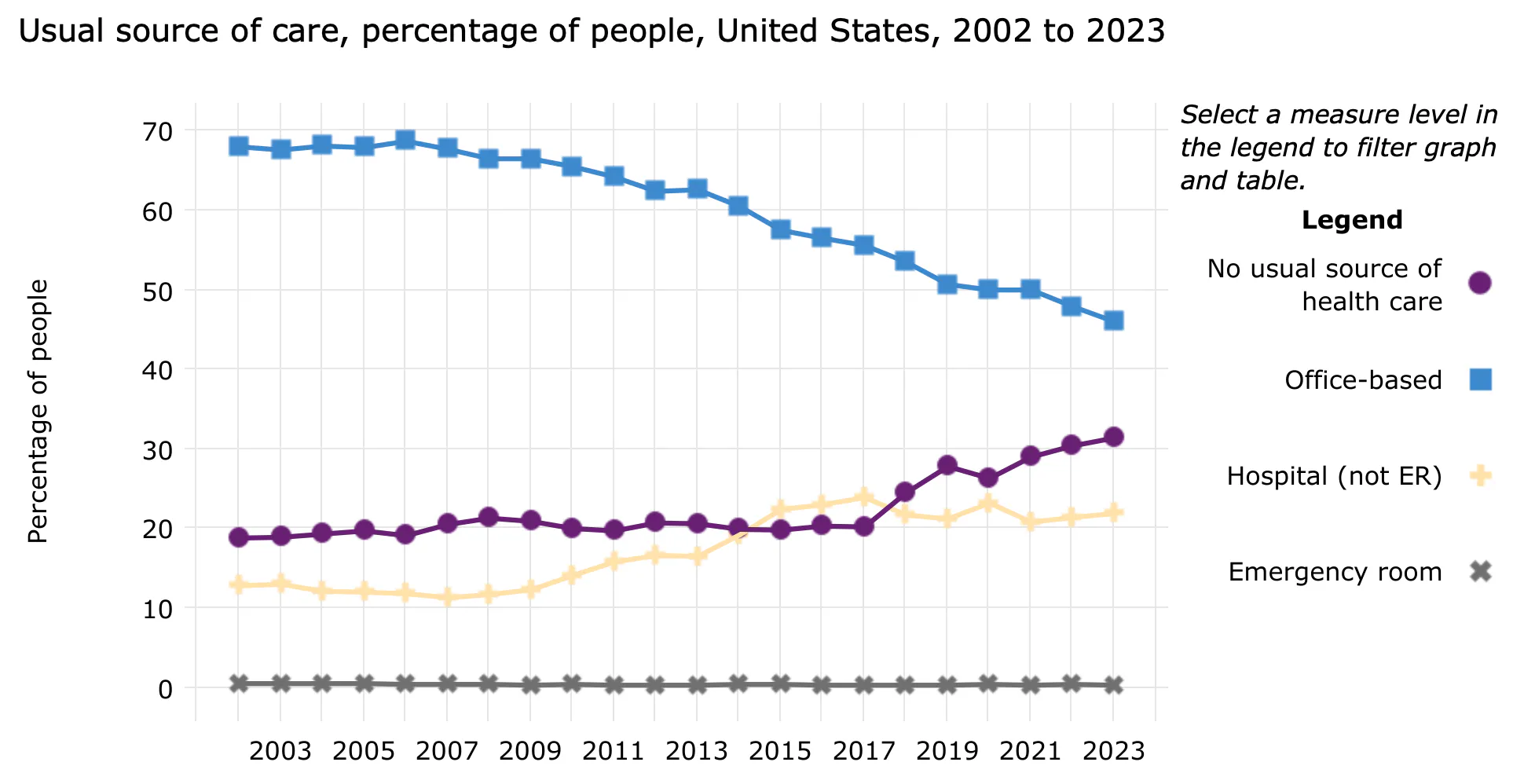
What we learn from this: back in 2006, 68.7% of individuals reported seeing a healthcare practitioner in an office setting. By 2023, that had declined to just 46%. Meanwhile, "No usual source of healthcare" surged from 19.2% to 31.4%, and "Hospital (not ER)" climbed from 11.8% to 21.9%.
By the way, telehealth is not driving this. According to AHRQ, telehealth is a modality, not a source - so if a patient shifted from in-person to telehealth visits with the same provider, that still counts as "office-based."
It feels like we sometimes make things too complicated. We love spending time and money on fancy healthcare tech solutions, complex policy proposals, and finger-pointing. But maybe the solution is sitting right in this chart - or at least, the chart is worth sitting with. What's driving this shift? Is it provider shortages? Cost barriers? Or has technology gradually eroded the relationship side of healthcare - and with it, our trust in it? Maybe we actually need to get back to seeing our doctors, nurses, nurse practitioners, and physician assistants in real life, rather than asking AI for a diagnosis or taking supplement advice from paid influencers. Or maybe the answer is something else entirely.
I don't know… but this is certainly some Data 4 Thought.
Support Data That Serves the Public
Data should empower people, not just institutions. Your support helps us create accessible research, visualizations, and tools that uncover economic inequality and inform better decisions.
Donate
Enjoying this post?
Tell others about it.
More articles like this
Fetching Related Posts
There are no other articles tagged with Data 4 Thought