
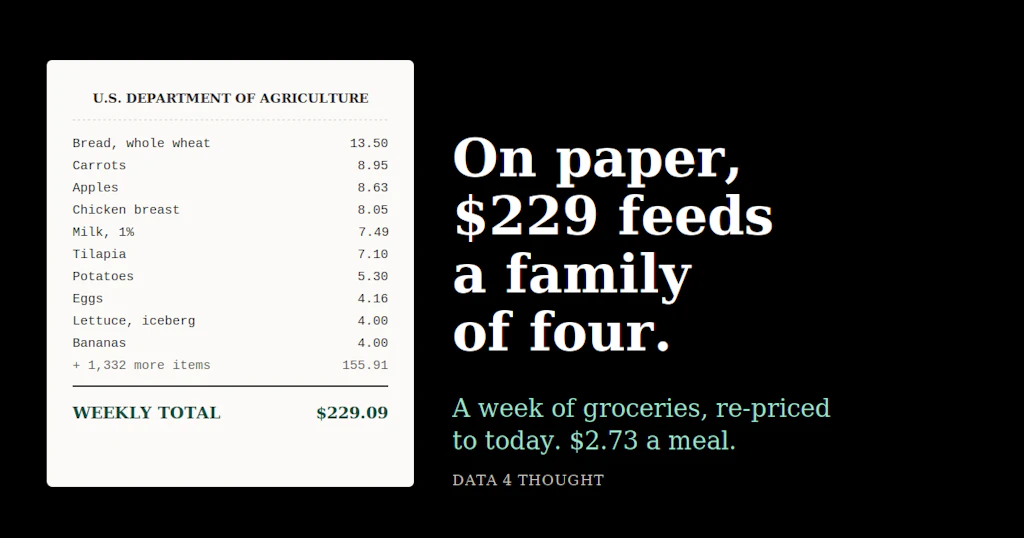
The government says $229 a week feeds a family
We pulled the federal spreadsheet that sets the SNAP benefit and priced every line.

Eric Pachman
Published
June 18th 2026
On Paper, $229 Feeds a Family of Four.
Somewhere inside the U.S. Department of Agriculture is a spreadsheet that decides how much money a family on food assistance has to feed itself. It is called the Thrifty Food Plan.
It is not a guideline or a suggestion. It is the number. Federal law says the cost of this specific basket of food sets the maximum SNAP benefit. The plan is the lowest of four official USDA food plans, the floor beneath the floor.
So we pulled the file and read it.
The list
What we found is not a tidy nutrition pamphlet. It is a 3,573-line inventory of specific foods in specific forms: bread by the type, fish by the species, milk split four ways by fat content. The USDA evaluated all 3,573 and kept 1,342 of them in the basket. The rest it considered and set to zero.
The basket was last built from scratch in 2021, and priced then at $192.84 a week for a family of four. To see what it costs to buy today, we rebuilt it from the bottom up. Rather than take the government's single headline figure, we re-priced all 1,342 foods individually, scaling each one by its own food-inflation rate from federal price data through the most recent month available. Apples moved by the price of apples, eggs by the price of eggs, bread by the price of bread. The USDA updates its number by moving broad food categories in bulk; we did it line by line, which is finer than the official method and lets the receipt show exactly where the money goes.
Our total lands within about a percent of the figure the government publishes. We built it a harder way and arrived at the same place, which is how we know the receipt is real.
Here it is. A week of groceries for a family of four, as defined by the federal government, at today's prices.
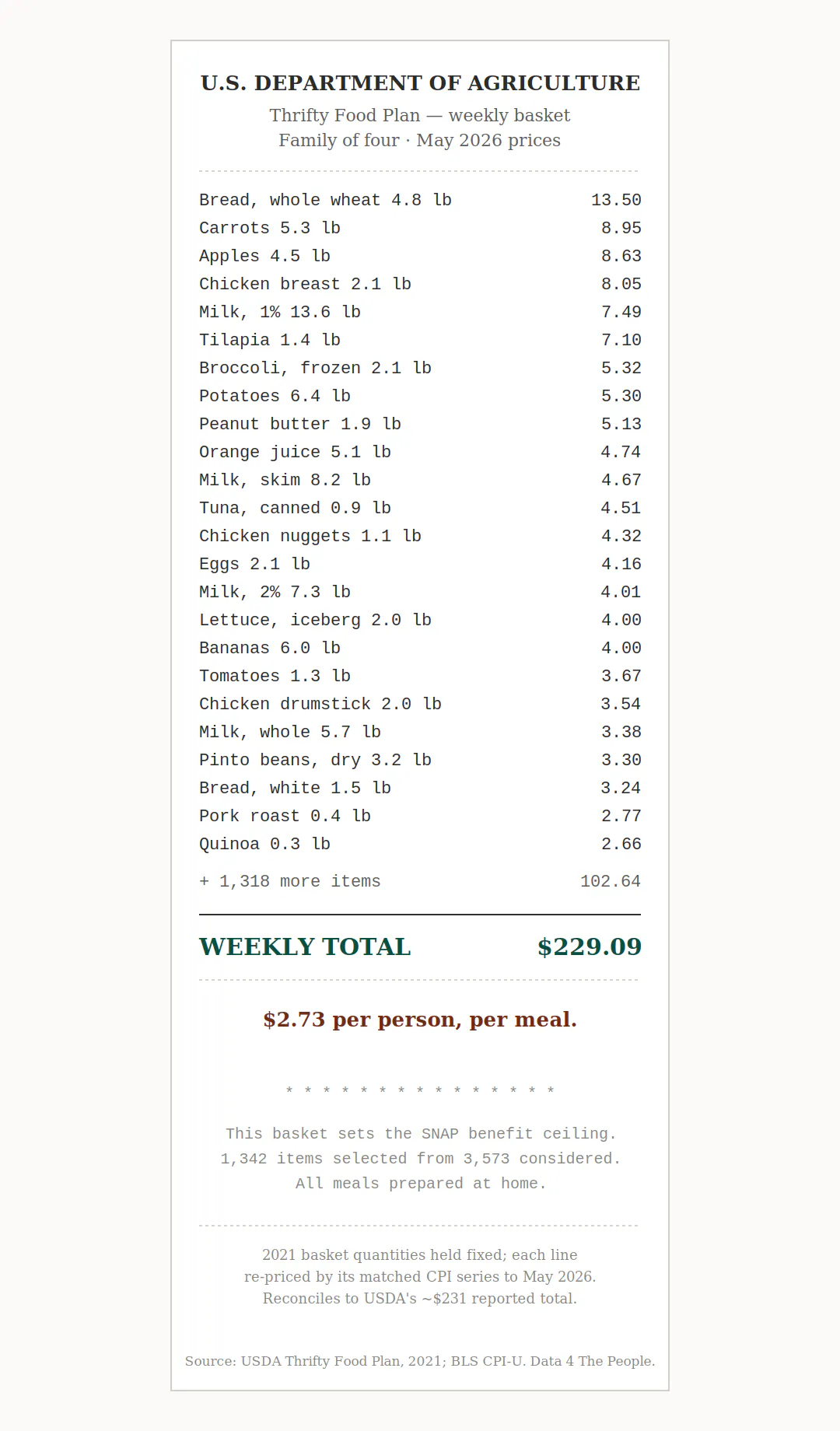
$229 a week… in theory
$229.09 feeds a family of four for a week. That is 84 individual meals, three a day for four people. No extra money for snacks. It works out to $2.73 per person per meal. $8.19 per person per day.
And every cent of it assumes a particular kind of life. Look at the pork roast: the basket allots about seven ounces for the entire family for the week, at $2.77. That is one modest dinner, split four ways, for the price of a tall coffee at Starbucks. Or the honey: about a third of an ounce for the week, twelve cents' worth, in a quantity no store actually sells. The basket is full of numbers like that, and we'll come back to them. The plan assumes you will cook it all at home, because the entire basket assumes every meal is prepared at home. No takeout, no school lunch bought, no rotisserie chicken on a night that fell apart. It assumes you have a kitchen, the time to use it, and a store nearby that stocks fresh lettuce and tilapia and whole wheat bread at the national average price.
How many of the families living on this number actually live inside those assumptions? A working parent with a long commute and no car. A household in a neighborhood with a dollar store and a gas station but no supermarket. A kitchen with a hot plate and no oven. The receipt is arithmetically honest. It just assumes a life that millions of the people needing food assistance don't have.
The receipt is only the beginning. Behind that $229 sit a stack of assumptions about how people shop, cook, and live, and each one is worth pulling apart on its own. There are also 1,342 items on this list, many in quantities a store would never sell, and soon you will be able to dig through every one of them yourself. We are just getting started on this thread.
Support Data That Serves the Public
Data should empower people, not just institutions. Your support helps us create accessible research, visualizations, and tools that uncover economic inequality and inform better decisions.
Donate
Enjoying this post?
Tell others about it.
More articles like this
Fetching Related Posts
There are no other articles tagged with Data 4 Thought