
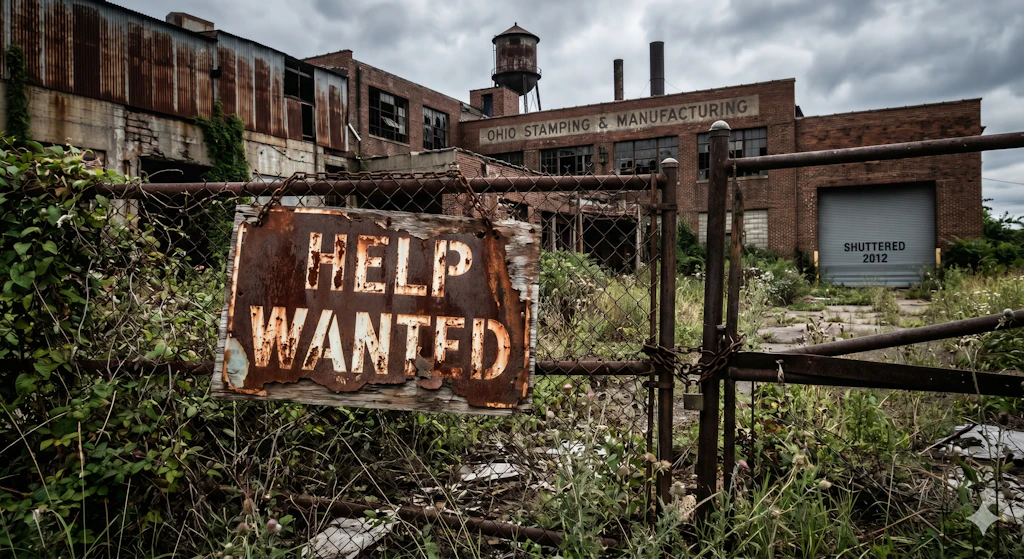
The U.S. Manufacturing Job Renaissance Is a Pipe Dream - Here's Why
The counties that need jobs the most are the least equipped to support them. Here's the data.

Eric Pachman
Published
May 25th 2026
The Manufacturing Jobs Myth
Happy Memorial Day from Data 4 The People!
We hope you enjoyed our daily dose of data analytics last week. We'll keep this cadence going, dropping some “Data 4 Thought” (our riff on "Food for Thought") in your inbox at 9am each weekday morning. Our goal is not to answer questions but to give you data - data most people are missing - so you can start asking the right ones.
This morning we’d like to revisit our recent deep dive into the U.S. labor force. A couple of months ago, we showed how the share of counties with labor forces in structural decline (colored red in the maps below) has exploded from 8% to 32% over the past 15 years. American inequality isn't only impacting people - it's impacting geography.
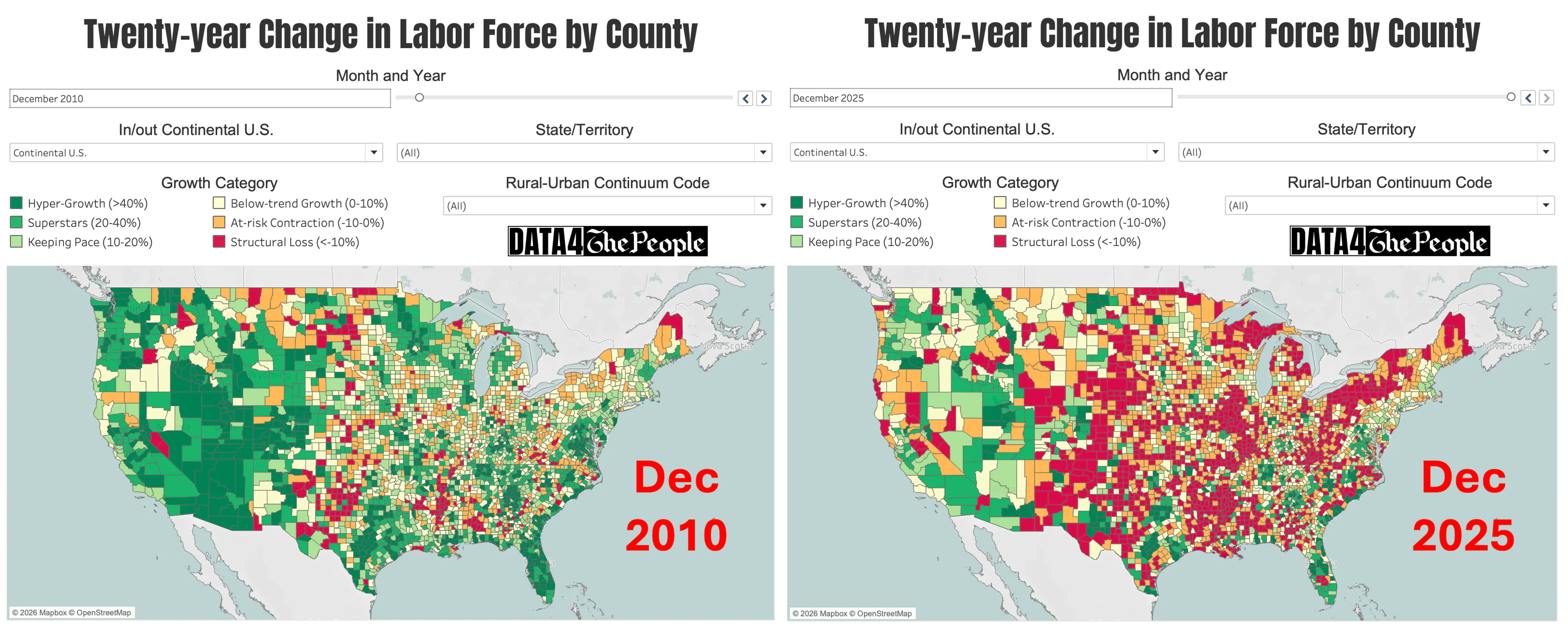
Source: Data 4 The People
We barely scratched the surface on why this matters. Today we want to highlight one problem no one is talking about: without a growing (or at least stable) labor force in affordable counties, any hope for an American manufacturing renaissance is a pipe dream. Good sound bites, but fundamentally impossible.
To understand this, let's pretend we're Vice Presidents of Manufacturing for Widgets Incorporated. You've been tasked with expansion and found insanely cheap land in Pine Bluff, Arkansas - Jefferson County. But your process needs workers, lots of them. So you do your research and find Jefferson County's labor force is down 32% over the past 20 years, gutted by an aging population and outmigration.
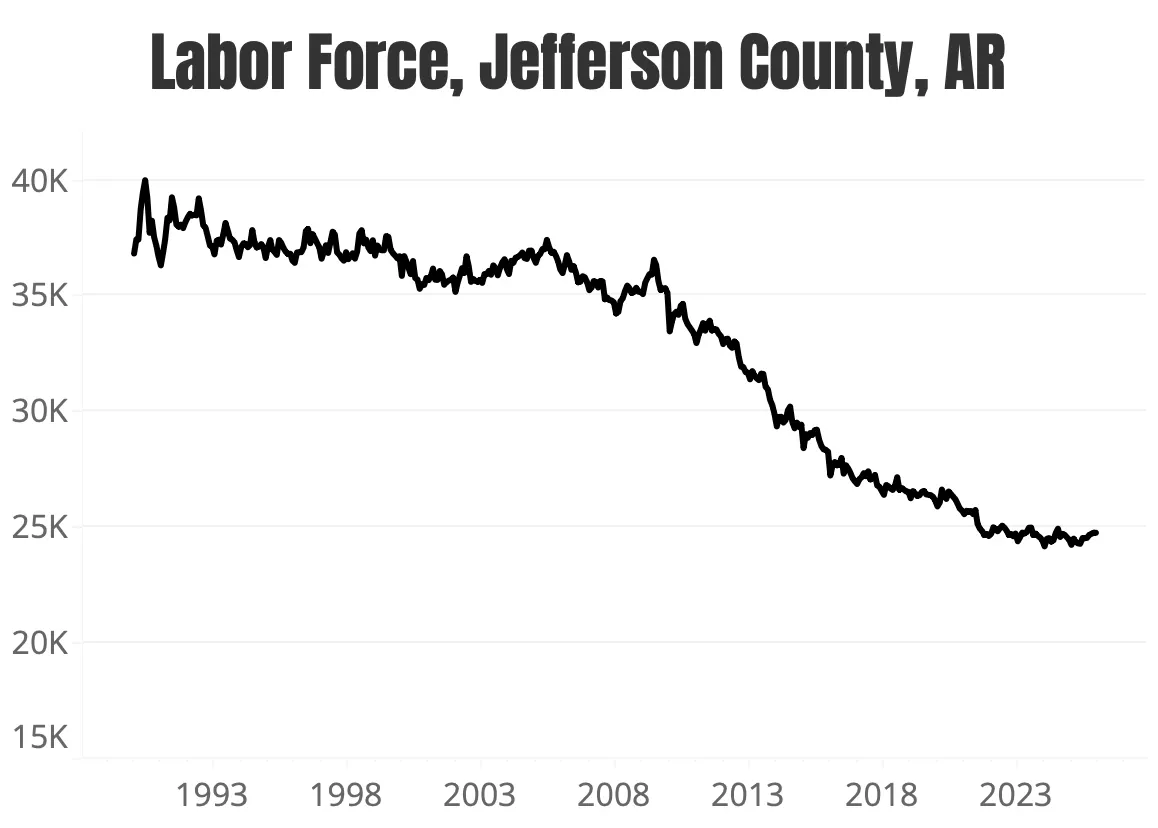
Source: BLS
Lesson learned. Better to find labor-rich areas first, then find the land. So you pull data for every county in the country. What you find is shocking.
Over the past twenty years:
- 32% of all counties lost at least 10% of their labor force
- 56% of all counties had workforces that contracted
- 76% of all counties had labor force growth of less than 10%
You need proven labor force growth to scale. That rules out more than three-quarters of all U.S. counties. So what's left? This map:
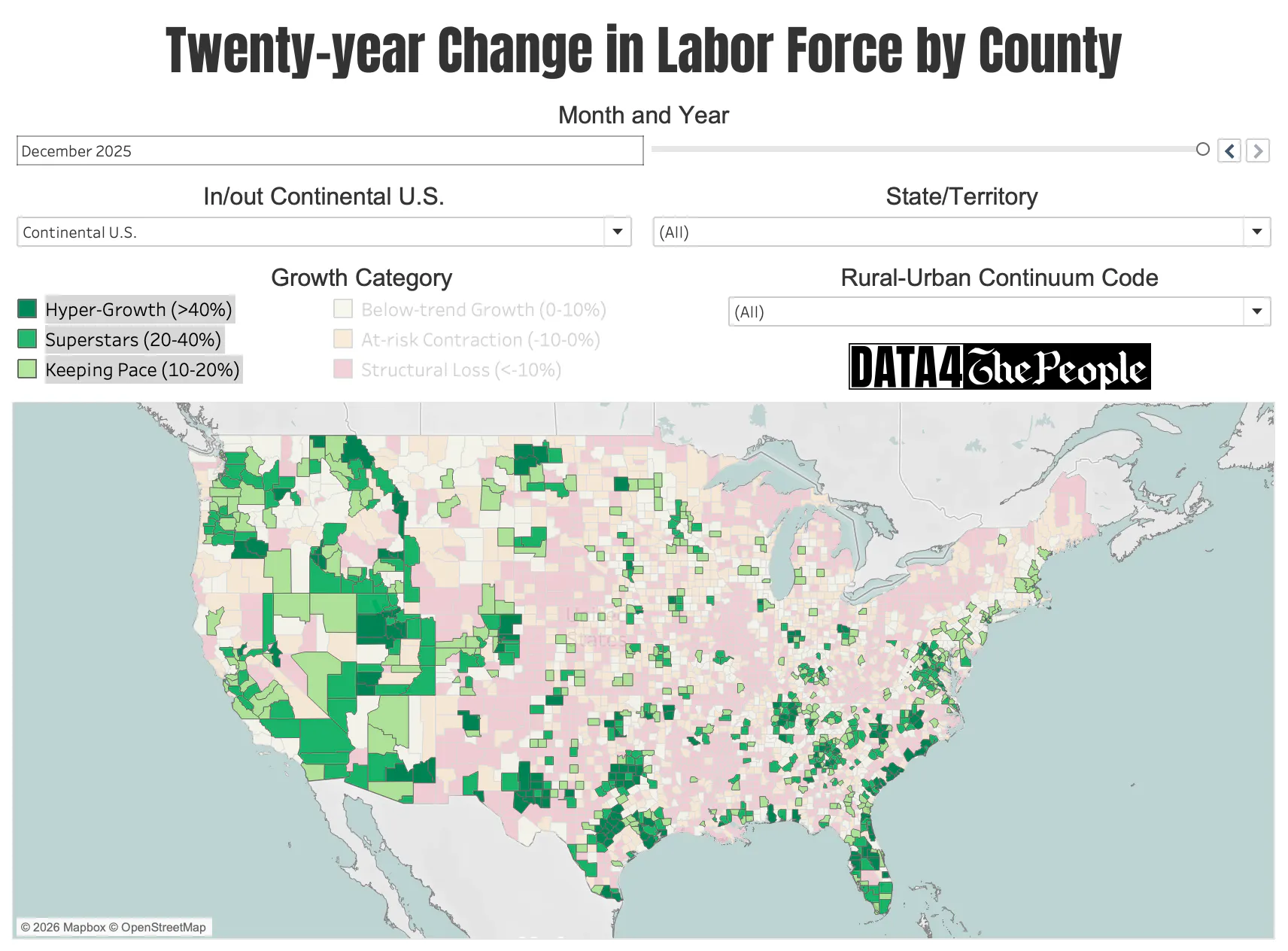
Source: Data 4 The People
The suburbs of expensive big cities. COVID migration destinations in Idaho, Florida, and Texas. Oil towns. Not much else. If you want workers, you'll have to build somewhere a small townhome runs $600K+… and pay accordingly. Meanwhile, places like Pine Bluff, with far lower costs of living, are slowly dying off, uninvestable without sizable subsidies.
Now, after going through this thought experiment, would you bet your own money on a U.S. manufacturing resurgence? Still think we can reverse this ⬇️ decline?
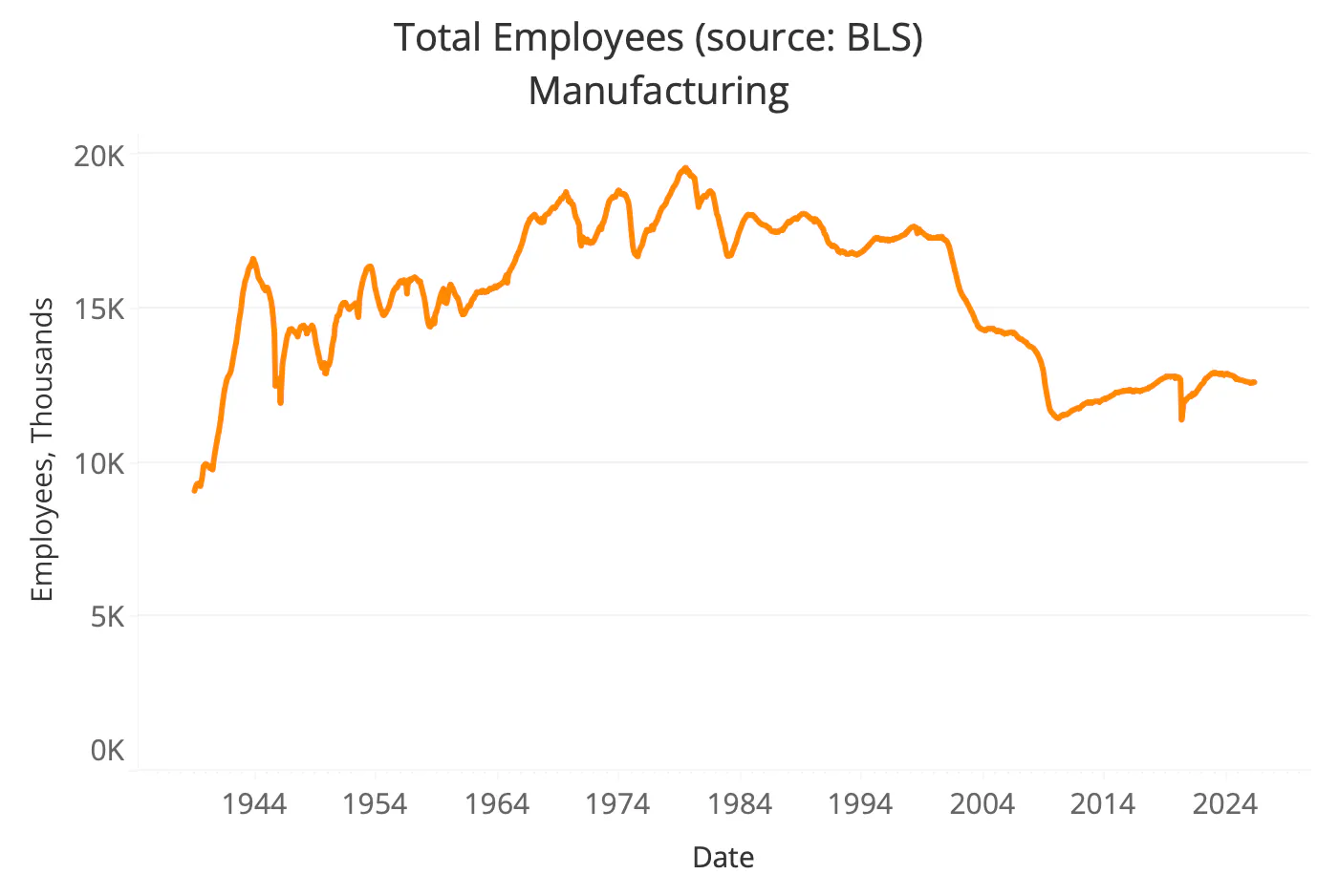
Source: BLS
This doesn't have to be our destiny. We can invest in smart, realistic workforce development. We can look our biases and prejudices in the eye and open our workforce to those being forced out or undermined in their pursuit of the American Dream. But it starts with honestly diagnosing the problem - which takes courage, because the reality of America is far easier to ignore.
On Memorial Day, that's the least we can do to honor those who gave everything for this country. They didn't die for us to let it fall into disrepair. Wake up, pay attention, take action.
Support Data That Serves the Public
Data should empower people, not just institutions. Your support helps us create accessible research, visualizations, and tools that uncover economic inequality and inform better decisions.
Donate
Enjoying this post?
Tell others about it.
More articles like this
Fetching Related Posts
There are no other articles tagged with Data 4 Thought