
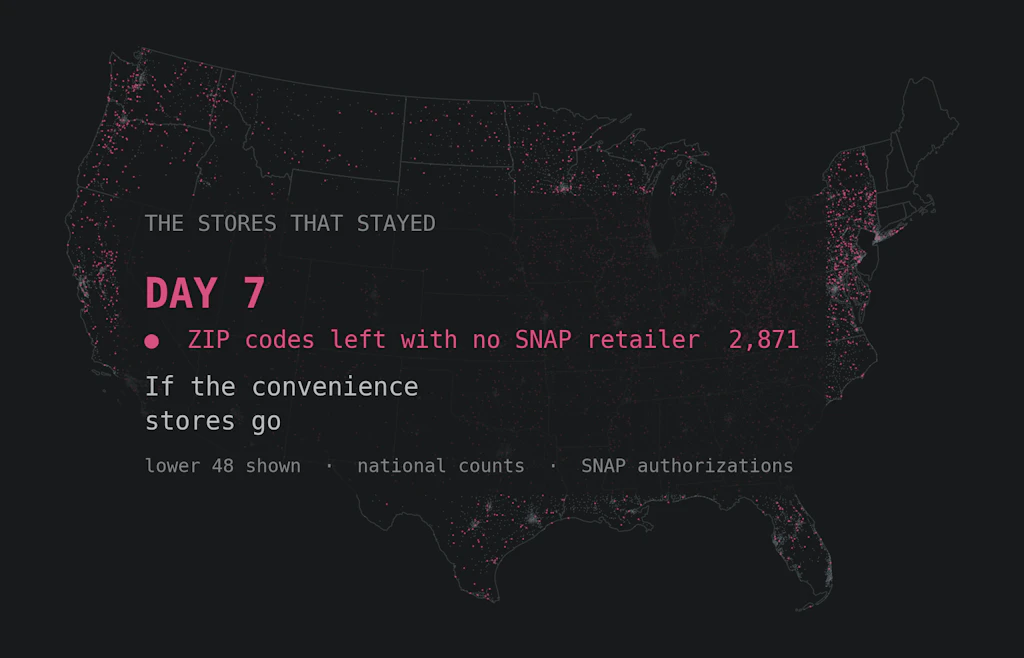
Sizing the risk to SNAP of the imminent stocking rule changes
An epilogue. A stocking standard twelve years in the making, the guidance that still has not arrived, and a map of who would bear the risk if it goes wrong.

Eric Pachman
Published
August 28th 2026
An epilogue. A stocking standard twelve years in the making, the guidance that still has not arrived, and a map of who would bear the risk if it goes wrong.
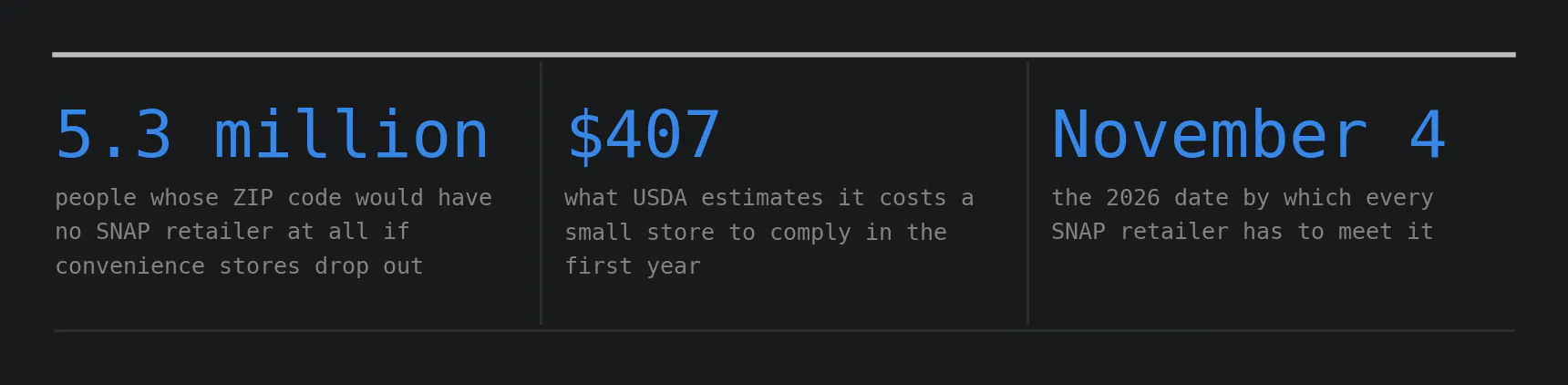
5.3 million people whose ZIP code would have no SNAP retailer at all if convenience stores drop out. $407 what USDA estimates it costs a small store to comply in the first year. November 4 the 2026 date by which every SNAP retailer has to meet it.
This is an epilogue. Seven days over twenty years of data left us with one finding: your experience of America depends very much on where you live. Yes, we knew that already. But we spent the week steeped in what it does to the most foundational thing people need each day: healthy food.
Now we look forward. The path of least resistance is for this to get worse. But this post is about something narrower — one specific rule change, months away, that could severely impair food access in nonmetro areas.
It is a risk, not a certainty. It's like Y2K. Maybe the rule lands and nothing happens. Or maybe SNAP-authorized retail gets cut by a third. The scary part is that we don't know.
Stocking rule — background
The rule that lands in November was written twelve years ago, and the story of why it took twelve years is most of the reason to pay attention to it.
Congress raised the bar itself. Section 4002 of the Agricultural Act of 2014, signed February 7, 2014, rewrote the definition of a retail food store so that a store had to offer "a variety of at least 7 foods" in each of the four staple categories (dairy, fruits or vegetables, grains, and protein), "including perishable foods in at least 3 of the categories." Before that the statute named no number at all; the floor of three varieties was USDA's own regulation, not an act of Congress.
USDA wrote the matching rule two years later. Enhancing Retailer Standards in SNAP published December 15, 2016 at 81 FR 90675, effective January 17, 2017, with existing stores given until January 17, 2018 to comply. Seven varieties in each of four categories, three stocking units of each, a perishable food in three categories: 84 units in all.
Then Congress blocked its own instruction. Section 765 of the Consolidated Appropriations Act, 2017 (P.L. 115-31), signed May 5, 2017, barred the department from spending any money to "implement, administer, or enforce the 'variety' requirements" of that rule.
But read the rest of the sentence and it is not a repeal. It is a condition. The prohibition holds until the Secretary "amends the definition of the term 'variety' ... to increase the number of items that qualify as acceptable varieties in each staple food category." Until then, USDA was ordered to apply the standard in force the day before the 2014 Farm Bill passed.
That fallback has governed every SNAP retailer for the nine years since, and it is the one still in force this morning: 3 varieties in each of four categories, 3 stocking units of each — 36 units — with a perishable food in 2 categories rather than three. The regulation on the books said something else the whole time. The codified text still read seven varieties; the 36-unit floor is what the rider made USDA actually enforce.
And the rider never went away. It has ridden every agriculture appropriations act since, including the one signed November 12, 2025 that funds the government through this fiscal year, where it sits at section 726 of Division B of P.L. 119-37. What changed is that USDA finally met its condition. It proposed a new framework for what counts as a distinct variety on September 25, 2025 (90 FR 46081), and finalized it on May 8, 2026 at 91 FR 25082 — effective July 7, 2026, with every authorized retailer required to implement by November 4, 2026.
So the thing arriving in November is not really a new stocking standard. It is the 2014 standard, released. The unit count is not even new: USDA's 2016 rule computed the same 84 units this one does. Nine years of argument were about a single word, and the rule that ends it is a rule about what "variety" means.
What's a food?
We are 67 days from implementation day. You would think that after twelve years between the statute and its arrival, the details would be settled.
Give USDA its due: on the central question, they are. The rule defines a distinct variety at length (7 CFR 278.1(b)(1)(ii)(C)-(E)), in a default rule plus three carve-out groups. Foods differ if they come from a different plant, a different animal, or a different main ingredient. Different cuts of the same animal are not separate varieties — the rule says so in as many words, listing "different cuts of meat" among the things that do not count. So hamburger and steak are one protein, not two. Milk and cream are two, because the rule states that "Cream is a separate main ingredient from milk." Shredded wheat and a loaf of bread are two, because breakfast cereals and bread are named separately. USDA even published a worked answer for a compliant protein shelf: chicken breast, ground beef, frozen salmon filets, canned tuna, eggs, peanut butter, and lentils.
So, your local Shell station is not going to have to stock goat meat.
Then, where is the problem? Two places.
First, the framework has holes in the categories a small store lives on. The rule makes "bread" a variety and never says what bread is. Are tortillas bread? Bagels? Pita? It matters, because USDA's own worked example for grains — sourdough bread, corn tortillas, whole grain spaghetti, quick-cook oats, brown rice, pearled barley, and white flour — only reaches seven if corn tortillas are not bread. The rule does not say. It then splits bread into whole grain and non-whole grain and defines whole grain as products that "may contain any amount of whole grain" — no threshold, no labeling test. Whether a store gets one bread variety or two turns on reading an ingredient list against a standard with no number in it. Where instant oatmeal, granola and muesli sit between raw grain, breakfast cereal and accessory food is unstated. Whether oat milk and oat yogurt are one variety or two is unstated. Sandwiches made at a commissary rather than in the store are unstated, and that was the question retailers raised most on an industry webinar this month.
Second, the guidance that would answer all of it has not arrived. On the day the rule published, USDA's own page said: "We will update our website with guidance for retailers soon." That was May 8, 2026. Scroll to the bottom of that page and, as of last night, it still reads Page updated: May 08, 2026. Nothing has followed — no FAQ, no variety list, no policy memo, and no further document in the docket in the 113 days since.
Meanwhile the two pages a store owner or a field inspector opens for the standard itself — retailer eligibility and staple foods — still describe the old rule. They still say a minimum of 36 staple food items, three varieties per category, and that chocolate milk and regular milk count as one variety, a statement the new rule reverses. Both carry USDA's own banner: "Attention: Some content on this page is not up to date."
The industry has noticed. On publication day the convenience store association said the rule "raises more questions than it answers." Three months later: "USDA has not published detailed guidance to help retailers understand how products will be categorized and enforced." Its general counsel warned that the complexity "could create confusion for both retailers and inspectors, increasing the likelihood of disputes during compliance reviews." The association is circulating a letter asking USDA to delay enforcement until six months after formal guidance is released; an amendment from Sen. Jim Justice (R-WV) to force that delay failed 10-11 on August 6, 2026.
So roughly 118,000 convenience stores are 67 days from a compliance review against a standard whose reference material still describes the rule it replaced.
Model the risk
Clear as mud, right? Look how many words it took us to answer a simple question — what's a food? And on the parts a small store actually has to get right, we still have no answer. As such, we figured it would be appropriate to just go ahead and model out the worst case scenario.
Please note: this is not a forecast. It is a modeled scenario. As we have written, all models are wrong. Some are useful. This one is useful because we can see WHO bears the most risk if such a scenario were to manifest.
Start with the format the evidence points at. Convenience stores are 109,791 of the 232,165 SNAP-authorized stores in the country — 47% of them. They are the format the rule's own preamble singles out, the one whose trade association is asking Congress for a delay, and the one with the least room in a 3,600-square-foot box. So take them out, and see where the cuts hurt the most.
The map below shows this. There are 2,782 pink dots on this map, representing the 2,782 ZIP codes that would be left with no SNAP retailers if their convenience stores opted out of the SNAP program. These ZIP codes are home to 5.2 million Americans — 5.3 million nationally, once you count Alaska, Hawaii and the stores we cannot place on a map.
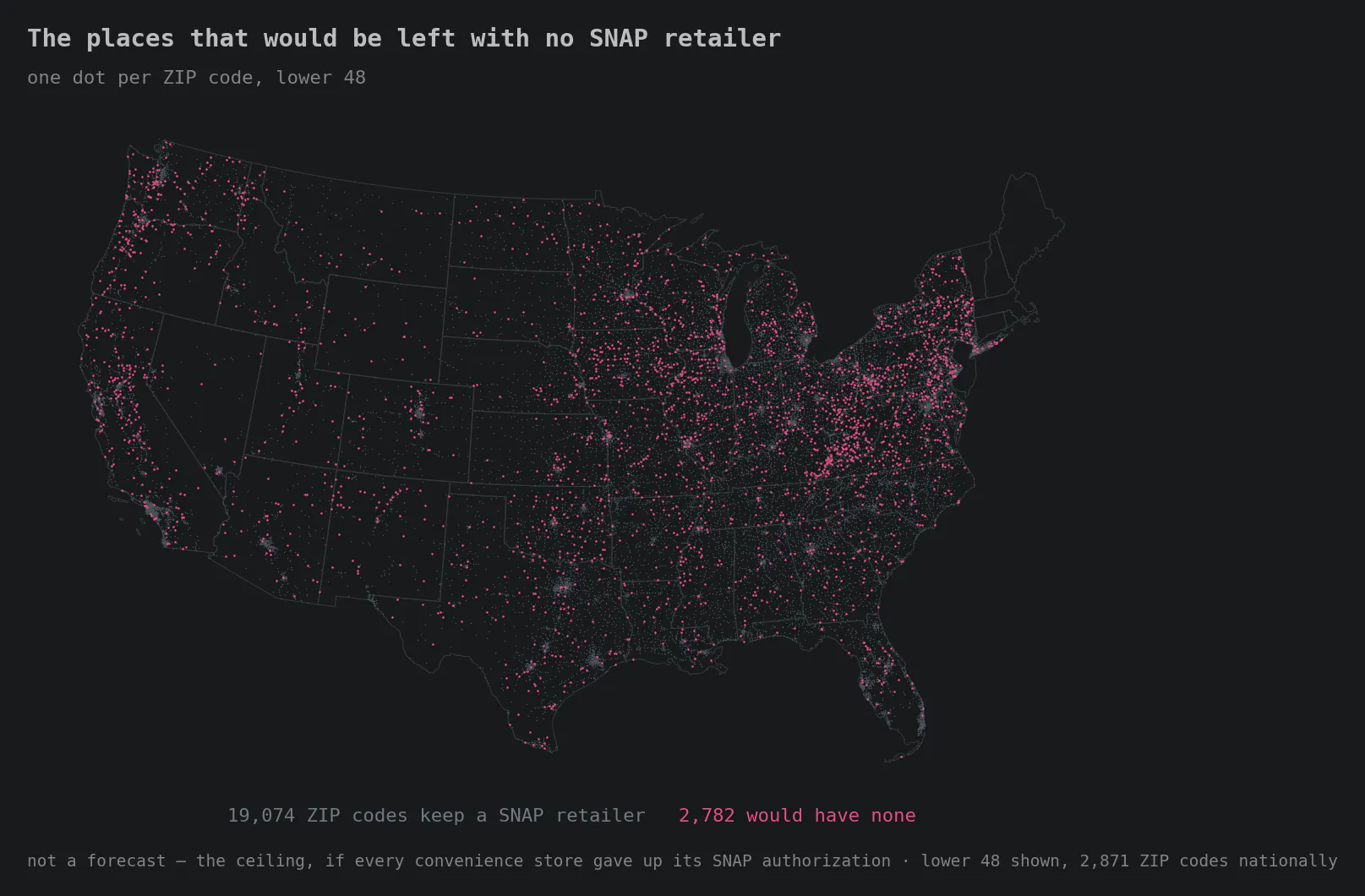
Note that the dots rarely touch large cities. Instead the risk lies in the interior and the rural East — the same geographic inequality finding we have stumbled upon throughout this entire series.
This next bar chart hammers this home directly. In ZIP codes with fewer than a thousand people, 50% would be left with no SNAP retailer at all. In ZIP codes above twenty-five thousand, 0.1% would. The median ZIP code left with no SNAP retailer holds 1,051 people; the median one that keeps at least one SNAP retailer holds 8,343.
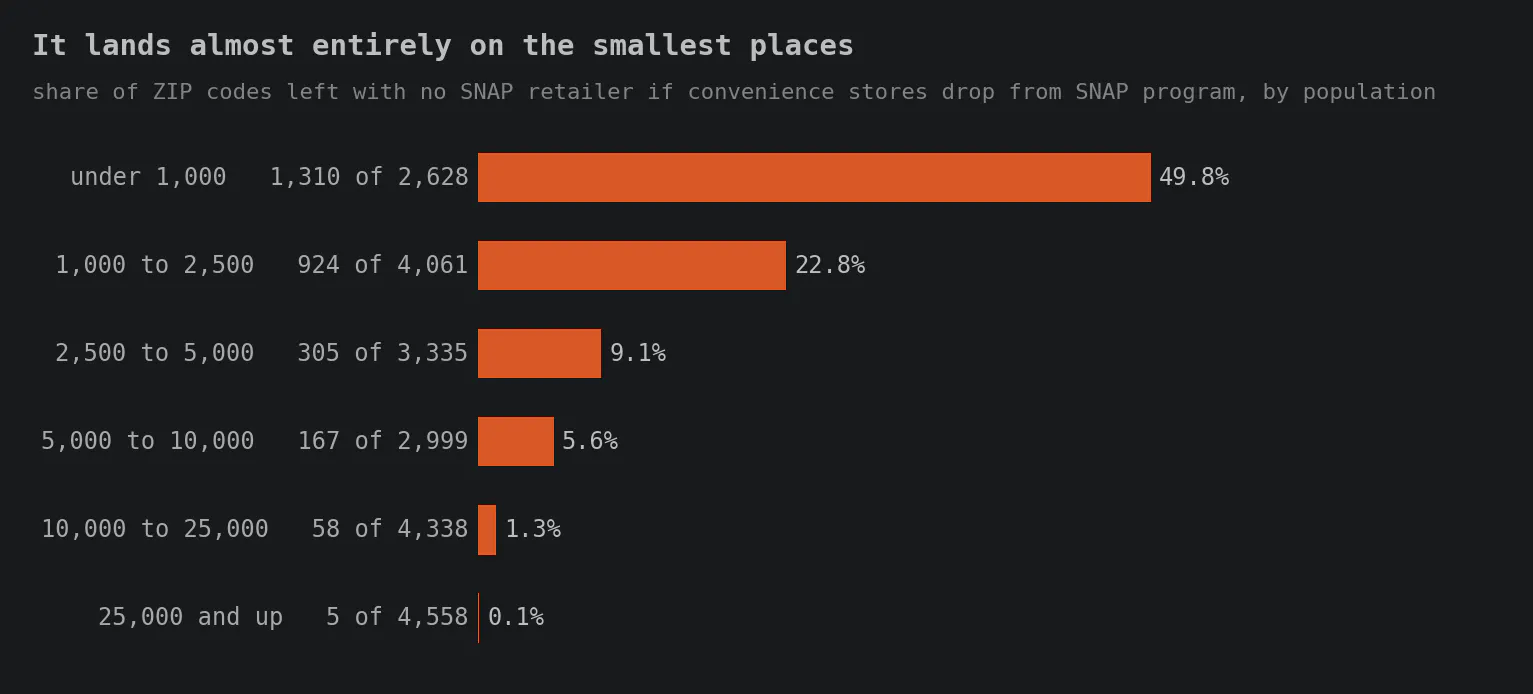
This is the point of this modeling exercise — it shows us that even if we don't end up with the worst case scenario, we are likely to end up with greater geographic inequality.
Accountability is patriotism?
No matter how much territory we cover, we keep coming back to one thing that is sorely missing — accountability.
First, government is failing our American brothers and sisters living in more remote territories. Don't blame capitalism. Capitalism is a tool — no different from a hammer, or AI. Without intervention it leads to inequality, and that is just the way of things. But it doesn't have to be. Government sets the rules of the game, and it can set them to unleash the benefits of capitalism for all. We have drifted so far from that we now have not only an abdication of the responsibility, but elected officials of both parties using their power to enrich themselves from this broken system.
But there is another question here. I wonder how many elected officials know about the ambiguity in this stocking regulation, or the risk their most vulnerable constituents face if it doesn't get ironed out in a way that keeps retailers from dropping out of SNAP. Ignorance is not an excuse for inaction. All this data is accessible at a moment's notice. It boils down to awareness, and there are only so many moments in a day. If our lawmakers are focused on what stock to trade next, that is time taken away from protecting Americans from hidden risks like this one.
So what can we do? Of course this is my own opinion, and my own frustration with a lack of accountability that is spreading across America like a plague. But we will commit to tracking this USDA database as it updates, and identifying the changes in SNAP retailers after this ruling hits, so we all have the facts on how this plays out. And we will keep calling out lack of accountability when we see it. If this resonates with you, share it with a friend. The more people that expect more from those in power, the more likely we are to collectively drive the accountability Americans so sorely need.
Limits
The 5.3 million is everyone who lives there, not everyone on SNAP. It is the 2020 census population of those ZIP codes; this file cannot see who uses the program. The map draws the lower 48, which holds 2,782 of the 2,871 ZIP codes — the rest are in Alaska and Hawaii or have no usable coordinates.
This data cannot see inside a store. Whether a given convenience store already clears the standard, or could for less than USDA's estimate, is not knowable from an authorization file; that needs shelf-level audit data such as NEMS-S. It is why this is a ceiling and not an estimate.
The worst case is arithmetic, not a forecast. It says nothing about how likely a format is to leave. The "need for access" pathway at 7 CFR 278.1 gives USDA wide discretion, and an effort to protect rural stores could hold the count near the agency's own projection of about 500. That would be a good outcome and we would report it as one.
We describe effects, not motives. USDA's stated purpose is nutrition, and nothing here claims otherwise. Note too that fewer stores does not by itself cut benefits, which are set against the Thrifty Food Plan price; any effect would run through households finding the program harder to use, which this data cannot observe. The compliance-cost and store-loss figures are USDA's own — we have not independently estimated either.
Sources: Thrifty Food Plan, 2021 (USDA FNS-916, August 2021). the pre-2014 standard, applied under section 765 of the Consolidated Appropriations Act, 2017 (P.L. 115-31) and the same provision in every later agriculture appropriations act. Updated Staple Food Stocking Standards for Retailers in the Supplemental Nutrition Assistance Program, final rule, 91 FR 25082 (May 8, 2026) (docket FNS-2025-0018, effective July 7, 2026, compliance November 4, 2026), and the proposed rule that preceded it at 90 FR 46081. Agricultural Act of 2014, Pub. L. 113-79, section 4002(a), and the 2016 rule it produced at 81 FR 90675. The rider in current law at section 726 of Division B of P.L. 119-37. Variety definition and need-for-access pathway at 7 CFR 278.1. USDA regulatory impact analysis for the final rule, docket FNS-2025-0018 document 0236 (March 19, 2026). Trade association positions from published statements by FMI and the National Grocers Association, the joint comments of NACS, NATSO and SIGMA filed November 24, 2025, and NACS on May 8, 2026 and August 10, 2026. company disclosures and trade press. "These 97 Members of Congress Reported Trades in Companies Influenced by Their Committees," The New York Times, September 13, 2022. Store-count and survival figures from SNAP Retailer Locator Historical Data, 2005–2025, published by USDA's Food and Nutrition Administration — the Food and Nutrition Service until it was renamed on June 1, 2026 — using 656,868 stores with usable coordinates. Code, pipeline and verification: Data4ThePeople/SNAP_Locations.
Support Data That Serves the Public
Data should empower people, not just institutions. Your support helps us create accessible research, visualizations, and tools that uncover economic inequality and inform better decisions.
Donate
Enjoying this post?
Tell others about it.
More articles like this
Fetching Related Posts
There are no other articles tagged with Research