
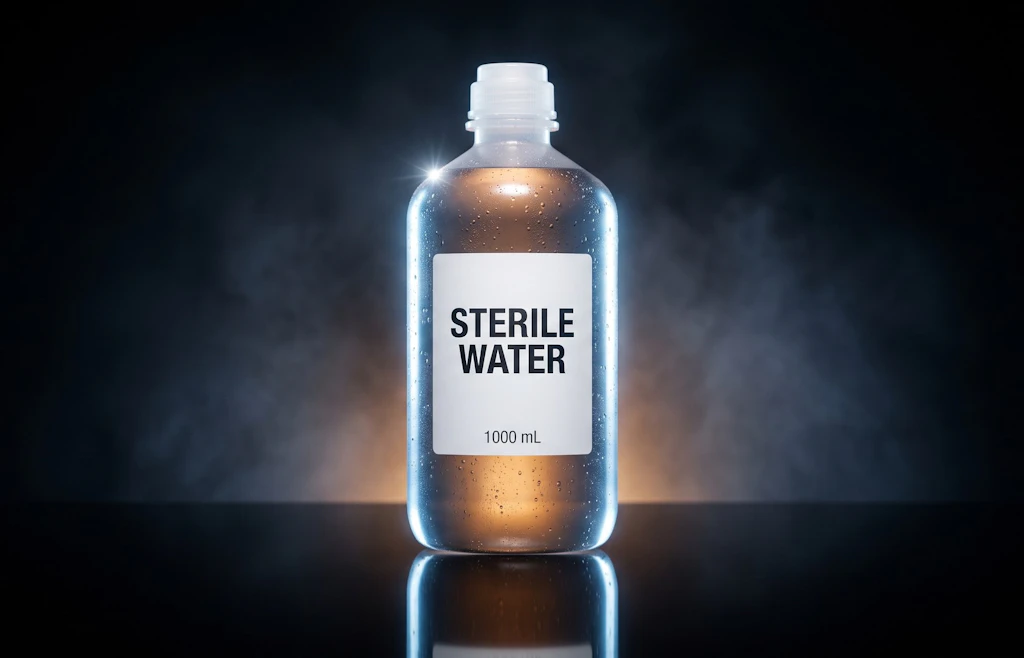
Fried Foot, and the Price of Water
Thirty years ago an ER gave me bottle after bottle of sterile water for a burn, because it was the only thing they'd give me. I finally went and looked up what it costs.

Eric Pachman
Published
September 8th 2026
Fried foot
When I was 16, I worked as a short-order cook making Philly cheesesteaks in a mall food court. Remember Steak Escape? I didn't work there. I worked at a generic knockoff of it. But you get the idea.
One of my closing jobs was to clean the filters above the fryer. They gave me no protective equipment to do it. It was the 1990s and I was 16, so it didn't occur to me to ask. I just climbed up and balanced myself on the counter next to the fryers while I scraped off the grease.
One night I couldn't reach across to the far side of the filter. So without thinking, I lifted my foot and put the tiniest amount of pressure on the cover of the fryer — turned off maybe thirty minutes earlier, but still a vat of near-boiling industrial vegetable oil.
The cover slipped. My foot went in.
I pulled it out, ripped off my shoe and my sock. The skin under the sock — which had soaked up the oil and held it against me — turned stark white and bubbled, in the exact imprint of the sock's ribbing. I'll never forget the look of my ankle. I still have the scars.
Bottle after bottle
That landed me in an ER waiting room. I remember being carried to the front desk to check in, then told to lie down on a stretcher and wait to be called back.
I waited. Anyone who has had a serious burn will tell you there is almost nothing more painful. But they didn't take me back. No painkillers. Nothing to dull it while I writhed on a stretcher, drawing stares from the other patients waiting their turn.
Nothing except sterile irrigation water.
For real. That is what they gave me. Bottle after bottle of sterile irrigation water. I'd pour one over my ankle and get about five seconds of blissful release before the pain raged back. I held out as long as I could each time before crying out for another. Bottle after bottle went over that ankle until they finally took me back and gave me something real enough to knock me out.
A couple of months later the bill came, and I remember my parents' disbelief at the price of those bottles. It was water. How could it cost so much?
I was naive then about how American health care works. I know a thing or two now — I've spent years writing and speaking about the muddied waters of drug pricing. But I never did go back and check on the sterile water. So this morning, thirty-odd years after I fried my foot, I finally did.
This is a story about water. It is also the whole of American health care pricing, in a bottle.
What hospitals charge for sterile water
First, and maybe most tellingly: this was one of the more challenging Data 4 Thought analyses. That fact is itself the finding. Asking what a bottle of water costs at hospitals around the country turned out to be harder to answer than asking how many U.S. counties have a dollar store and/or convenience store but no full grocery store. The difference is access. The USDA's data is public, relatively clean, and all in one place. Hospital pricing data is technically public, but scattered across thousands of different websites.
But we got there. From a sample of 67 hospitals across 32 states, the median list price for sterile water for irrigation is $36.83 per liter. We can buy the same bottles online, today, for between $7.25 and $10.50 per liter.
The median isn't the story, though. The variation is. One hospital in the sample lists it at $1.85 a liter. Another lists it at $404.30 — two hundred and nineteen times as much, for the same bottle.
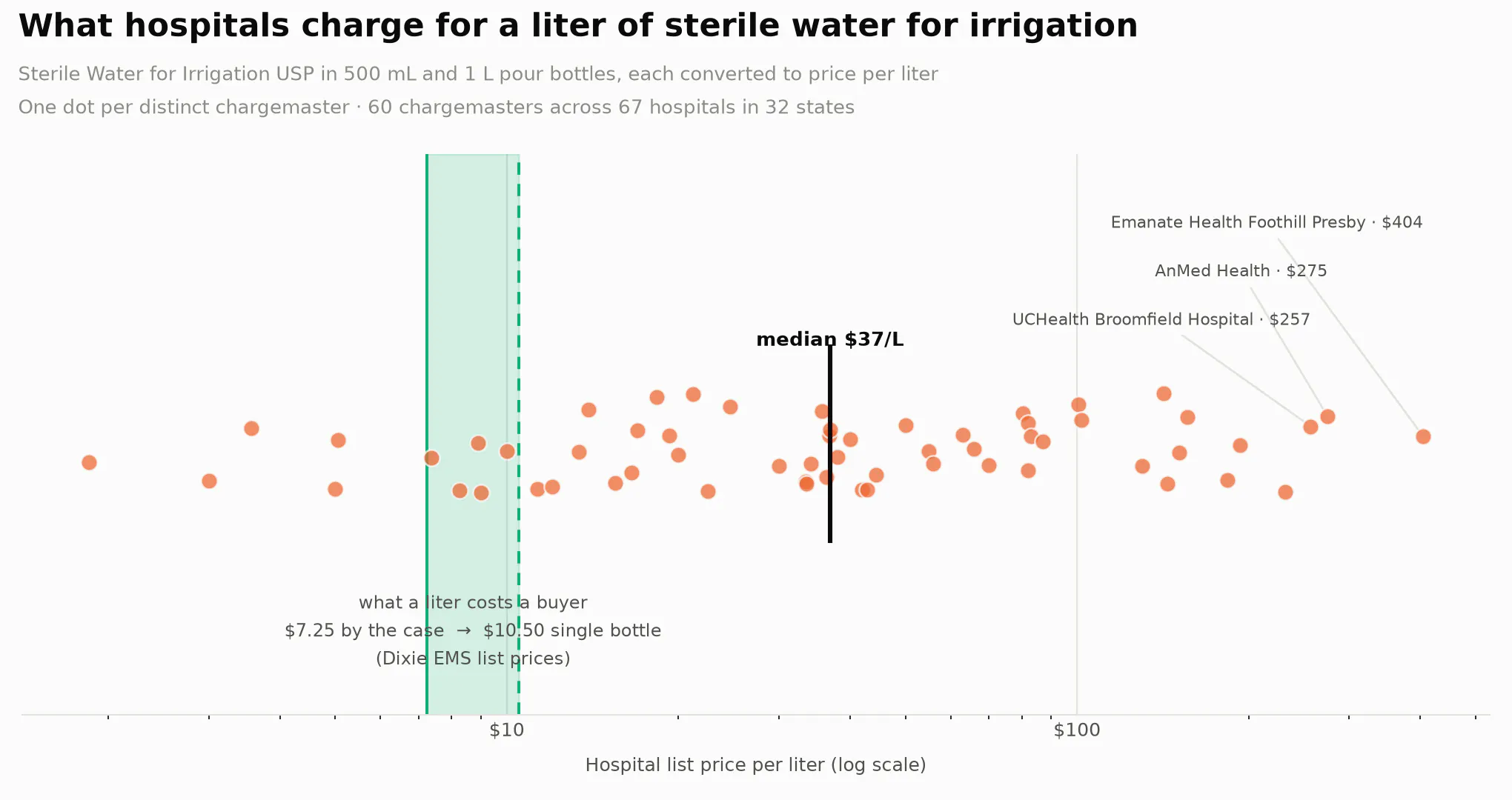
One dot per distinct chargemaster: 60 published prices drawn from 67 hospitals in 32 states. Health systems publish one chargemaster across every facility they own, so facilities sharing a price count once. Each price is for a 500 mL or 1 L pour bottle of Sterile Water for Irrigation USP, converted to price per liter. Green band is open distributor list pricing (Dixie EMS).
This dispersion is what makes American health care pricing unique. We have seen it over and over, for knee replacements and for biologic drugs administered in a hospital. The novelty here is the product.
This is water. The most abundant molecule on Earth's surface, most of what we are made of, and the one thing in that emergency room nobody had to invent, patent, or ration. And our hospitals still cannot agree on what to charge us within a factor of two hundred.
So maybe we stop trying to "fix health care," which mostly has us chasing our tails, and start with the price of the one thing everybody already understands. If we cannot explain why the same bottle is $1.85 at a hospital in Kentucky and $404 at a hospital in California, we have no business pretending the harder prices make sense.
I was sixteen, on a stretcher, pouring water on my foot because it was the only thing anyone would give me. Three decades later, the honest answer to what that water costs is: it depends which hospital they carried you into.
How we got the number
Hospitals are required to publish every standard charge in a machine-readable file. We pulled those files for a stratified national sample of 616 hospitals, found them by way of the cms-hpt.txt discovery file each hospital must post at its web root, and parsed 489 of them.
Sterile water is identified by National Drug Code, not by description. That matters: a line reading "potassium chloride in sterile water" is potassium chloride, and a line reading "9 cm H2O" is a shunt valve. Only rows whose NDC resolves in the FDA directory to a water-only product are counted, and package volume comes from the FDA's own package description rather than from the hospital's text — a bottle billed as "1 EA" is still a liter.
Prices are gross charges — list price, before any discount. We excluded chargemasters that apply one flat figure across dozens of distinct products, which is a placeholder rather than a price. Because a health system publishes one chargemaster across all of its hospitals, facilities in the same state carrying an identical price are counted once, so no single system can tilt the median. This is a sample, not a census. It describes the 67 hospitals we could verify, not every hospital in America.
Data 4 Thought · Analysis of CMS hospital price transparency files, September 2026
Support Data That Serves the Public
Data should empower people, not just institutions. Your support helps us create accessible research, visualizations, and tools that uncover economic inequality and inform better decisions.
Donate
Enjoying this post?
Tell others about it.
More articles like this
Fetching Related Posts
There are no other articles tagged with Data 4 Thought