
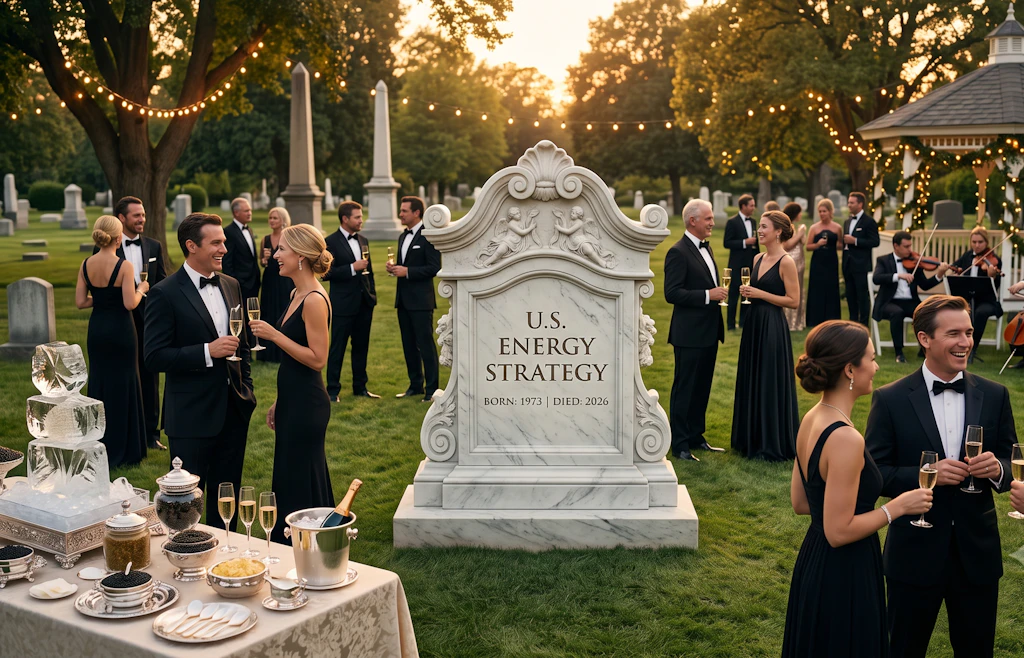
RIP: U.S. Energy Strategy
An extended version of our MarketWatch op-ed, where we cut through the complexity of oil markets to show what's really driving your gas prices.

Eric Pachman
Published
July 23rd 2026
These past couple of months, we have written and visualized a lot about energy, especially crude oil and gasoline. There's a reason why. Gasoline prices are arguably the most visible pain point for the American people. They are certainly the most volatile, with the ability to jump 30% in a span of weeks, taunting you from those unmistakable red digital numbers as you drive by.
And yet, how gasoline prices work remains largely misunderstood. And so, we wrote... again, and again, and again, and again. And we created new visualizations to help us "see"... again, and again.
But a couple of days ago, we ventured past the "four walls" of this website, partnered with author, professor, and innovation expert Michael Kinch, and wrote an opinion piece for MarketWatch.
Below you will find a slightly extended version of this op-ed, which leans a bit more into the storytelling we love so much.
As always, if you want to go straight to the data, visit our visualizations page, where you can see how U.S. oil inventories are doing (hint: not good) and check up on those pesky "crack spreads." If you don't know that term yet, it's time to add it to your vocabulary, because it's essential to follow if you care about your gas prices. We worked hard in this latest opinion piece to make terms like these easy to understand, so we can all see the reality of oil markets.
Because what happens when we ignore reality? This happens. What is going on today happens. People needlessly suffer while they are fed false narratives that exploit our collective ignorance of the truth. It's not our fault. This stuff is not easy to understand. So, we try to make it easier, so we understand, and we remember. And then maybe next time we will have the collective knowledge to not let history repeat itself. Again.
America Is Watching the Wrong Oil Number
By Eric Pachman and Michael Scott Kinch, Ph.D.
A month ago, it looked like this war was finally winding down. A ceasefire took hold in mid-June. Oil started moving through the Strait of Hormuz again, not at pre-war levels, but enough that a flood of long-stranded barrels began pouring back into a slowing world economy. The price of crude fell back to roughly where it started, and the world celebrated. But while everyone watched crude oil prices, a different oil measure, the one that arguably matters more for the prices of gas at our pumps and the goods delivered to our houses, quietly never stopped climbing.
And then the celebration ended. The ceasefire collapsed, and the United States and Iran have traded fire for days on end: American strikes on Iranian command centers and missile sites, Iranian missiles aimed at U.S. bases across the Gulf, tankers attacked at sea, and a renewed American blockade of Iranian ports. Oil prices jumped, and that other oil measure, called the "crack spread," kept climbing, hitting an all-time high just last week. Meanwhile, a new front has opened that should scare people more than it seems to. Iran's allies in Yemen have positioned missiles and drones to close the Bab el-Mandeb Strait at the mouth of the Red Sea. That is the very route Saudi Arabia has been using to pipe its oil around the closed Strait of Hormuz. The world's workaround is now a target too.
By the time you read this, some of the narrative may have shifted again. That is how fast this is moving. Events are outrunning anyone's ability to keep the story current, ours included.
So, which is it? Is this war on or off? Escalating or burning itself out? Will the next ceasefire hold any better than the last one? Is the crisis behind us or ahead of us?
Here is the uncomfortable answer: it matters far less than you would think. The war started this crisis. But whether the war ends and whether the crisis ends are two different questions, and the second one does not depend on the first nearly as much as the market seems to believe.
How can we say that? Between us, we've spent most of our careers studying complex systems and what happens when they break. One of us spent five years building refinery models for ExxonMobil. That's enough to know this story is far from over, whichever way the shooting goes.
This piece is mostly an attempt to explain why, because there's a big gap between what most people think they know about oil and how oil actually works. And that gap is being used against the American people. A government that has walked away from its job of setting America's energy strategy is quietly selling that strategy to the highest bidder. A public that doesn't know how any of this works has allowed it to happen.
Crude oil is not one thing
Start with the words "crude oil." Most people picture a single thing, the same everywhere. It isn't. "Crude oil" is a collective term for any big batch of hydrocarbons pulled from the ground as a liquid. Every deposit is a different batch, and every batch makes a different mix of products when it runs through a refinery.
Here's a way to picture it. You sit down at a restaurant and order a bowl of sliced apples. The waiter brings a fruit salad. A few apples on top, but the rest is mostly cantaloupe and honeydew. You call him back and say you ordered apples. He shrugs. "You ordered fruit. Eat it."
That's crude oil. When a chemical engineer hears the term, we think "fruit," not "apples." There's no single crude. There are endless kinds, each one different depending on where it was drilled, the same way different fruits have different flavors and nutrients. So, picture crude oil as fruit salad. Some batches are heavy on berries, some heavy on melon, but no two are the same.
Now say you run a juice factory, and apple juice is your most profitable product by far. You built the place, at huge cost, to run one kind of fruit salad, the kind loaded with apples. One day that blend stops showing up. A friend who's never run a juice factory says, who cares, just buy a different fruit salad. But you know better. The blends you can still get have way fewer apples. You can still make juice, but not the apple juice that pays the bills, and every batch you run on the wrong blend earns less than it should.
That's exactly the mismatch American refineries were built into. Our refineries, especially the giant ones on the Gulf Coast, were built over decades (a long time ago) and at a cost of tens of billions of dollars to run one kind of crude: heavy and sour, the thick, high-sulfur oil from places like Canada, Venezuela, Mexico, and the Persian Gulf. That's our apple-heavy fruit salad. Then the shale boom buried us in the opposite kind, light sweet crude that our expensive equipment doesn't optimally use. That's why we do the thing that confuses so many people: we sell our own oil and buy someone else's. It's not crazy. We sell the fruit salad we've got and buy the one our factories were built for.
Why reopening the Strait doesn't fix it
Now picture the whole world this way. Before the war, the global oil market was connected by a giant web of tankers and pipelines, built up over many years, that matched each kind of crude to the refinery best suited to handle it. The right fruit salad, shipped to the right factory, all over the planet.
Then the Strait of Hormuz closed and choked off the world's most important artery. Every careful connection in that web collapsed. Countries didn't politely wait for their usual grade. They grabbed whatever oil they could get. Barrels that would have gone to one refinery went to another that was never built for them. The matching fell apart.
Here's what the markets are getting wrong. Reopening the Strait doesn't undo that. Turning the valve back on gets oil moving again, but it doesn't rebuild the web. It takes a long time for the right crude to find the right refinery again, for tankers to reroute, for contracts to reform, for the whole delicate match to settle back into place. And every time the shooting starts again, the clock resets.
This conundrum is coming to life in two numbers. The first is that since this war started, ceasefires have come and gone, but one constant has held: America keeps draining its own oil, fast. Total crude in storage, including the Strategic Petroleum Reserve, has fallen to about 726 million barrels. That is the lowest level since 1984, and roughly 129 million barrels below where it stood the week the war began in February. The emergency reserve has taken the brunt of it: it now holds just 316 million barrels, its lowest level since April 1983, and seven of the ten largest weekly withdrawals in the history of the Strategic Petroleum Reserve happened this year. And this is not some distant worry. Storage tanks need a minimum amount of oil just to keep their pumps working; the industry calls it "tank bottoms." Last week, the government's own energy statisticians published an explainer on the term, because at one of America's most important oil hubs, prices now suggest the tanks may be scraping bottom already.
Now consider the timing. We are running the reserve down to forty-three-year lows just as hurricane season arrives; the worst storms typically form in August and September. More than half of America's refining capacity sits on the Gulf Coast, directly in the path of those storms. So does the reserve itself, stored in salt caverns along the Texas and Louisiana coast. One big storm in the wrong place could knock out the machines and the backup at the same time, and we've already spent much of the backup.
The second number is the oil measure we teased earlier, the "crack spread." That's the gap between what a refinery pays for crude and what it earns selling the gasoline and diesel it makes from it. For most of the last decade that gap ran from ten to fifteen dollars a barrel. This week it hit seventy dollars a barrel, the highest level ever recorded. Think about that: the margin for refining a barrel of oil is now worth more than what an entire barrel of crude cost the day this war began. And here is the tell. It kept climbing while crude was collapsing, and it is still climbing now that crude is rising again. It does not care which way the headline price moves. That gap is the market telling you, in dollars, that the right crude is not reaching the right refineries. The price of oil can do whatever it likes. The machines that turn it into fuel are screaming either way.
The long-term problem is worse
In the long term, our energy problem is only getting started, and the outlook is grim. The deeper issue isn't the war. It's that our government is using the public's confusion about energy to hand the country's oil strategy to people who care about the next earnings report a lot more than they care about America's energy security.
After the 1973 oil crisis, when embargoes led to gas rationing on American streets, the country did something on purpose: it banned crude oil exports. We'd felt what it cost to depend on someone else, so for forty years we kept our oil at home for our own security. Then, in 2015, the ban was lifted. Today the United States exports more oil than ever, about three million barrels a day more than just a year ago, at the very moment we're draining our own reserves to the lowest levels in a generation.
Why sell our oil when we so clearly need it here? There are really only two honest answers. Either it's the wrong kind, the light sweet crude our own refineries can't use, which is a fair reason to sell it. Or the call is being made by people chasing short-term profit over America's security. The truth is probably a bit of both, and nobody in charge is drawing the line between them. Drawing that line is the whole job of a national energy strategy, and we don't have one anymore.
The same thing is happening with natural gas, the single biggest fuel for the power plants that make our electricity. Demand for it is about to jump, driven by the enormous appetite of AI data centers, which drove about half of all new U.S. electricity demand last year. And yet we're shipping record amounts of that same gas overseas. We even subsidized the plants that chill it down for export. That trade has paid off nicely for the shareholders of the export companies. Over those same years, the price you pay for electricity at home went up nearly 40%. We're selling the fuel our own grid runs on and paying more to keep our own lights on because of it.
China didn't stop deciding
It's worth looking at how another country handled the same ten years. China treated energy as a matter of national strategy and planned in decades, not quarters. Its clean-energy spending hit about a trillion dollars in 2025, roughly four times what it spent on fossil fuels. Its solar capacity quadrupled in five years, almost matching the entire power capacity of the United States, and electric cars went from a sliver of its market to more than half. None of this is about being green. It's about a country that decided what it wanted its energy future to look like and then built it. America invented solar power in the first place. We just didn't have the patience to keep our hand on the wheel.
The war will end one day. Maybe not this month, maybe not this year, and maybe not the way anyone predicts. The Strait will open, and close, and open again. Eventually the web of tankers and pipelines will slowly, painfully stitch itself back together, and the immediate shock will pass.
But an engineer knows the shock is just the beginning. What comes after a shock is often worse than the shock itself. Think back to the spring of 2020. The scariest, most acute part of the pandemic, the lockdowns and the empty streets, was over in a matter of months. The real economic damage came later and lasted for years: snarled supply chains, empty shelves, and the worst inflation in forty years, which didn't even peak until well into 2022 and took years to wind back down. The shock was fast. The fallout was slow, and it hurt far more people for far longer.
That is what we are walking into now. The war is the shock. What follows — the drained reserves, the mismatched oil, the strained grid, and the price we all pay for it — is the fallout. And we are meeting it with the thinnest cushion in a generation.
So here is the bottom line. The American people need a long-term energy strategy that works for them, and we need it now. We don't have to copy anyone. The United States has its own unique set of resources, and the right plan will lean into the advantages that are ours alone. But we need a plan, one built for the people who live here, not for the investors who profit off it. This is a matter of national security. If we don't build it, and build it now, we are putting the American people in danger. The time to put a hand back on the wheel is now, while we still can.
Eric Pachman is founder of Data 4 the People (D4TP) and a former chemical engineer. Michael Scott Kinch, Ph.D., is a Professor at Stony Brook University.
Support Data That Serves the Public
Data should empower people, not just institutions. Your support helps us create accessible research, visualizations, and tools that uncover economic inequality and inform better decisions.
Donate
Enjoying this post?
Tell others about it.
More articles like this
Fetching Related Posts
There are no other articles tagged with News & Media