
Oil prices are in freefall. So are oil inventories.
Markets are celebrating. Your pump price isn't. Here's what the data actually shows.

Eric Pachman
Published
June 25th 2026
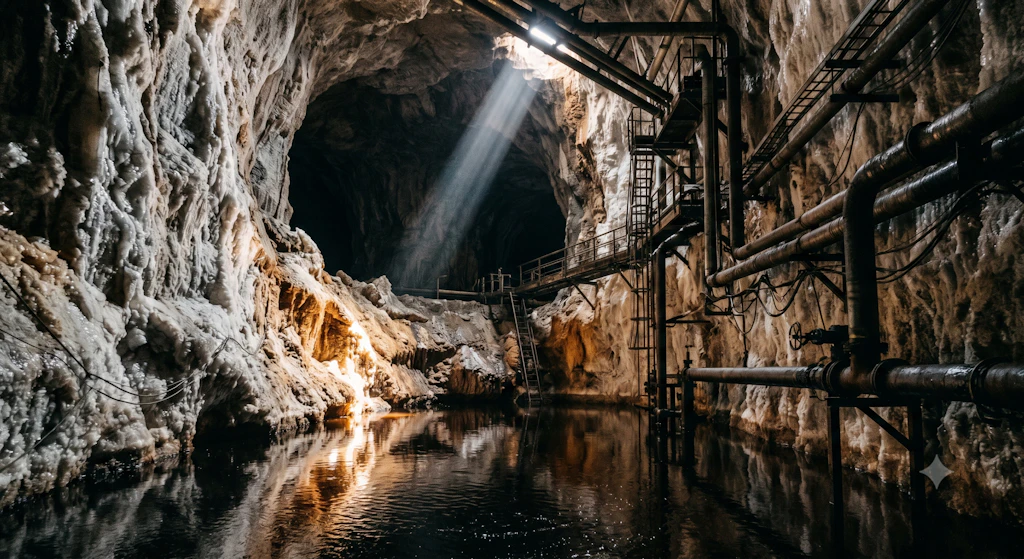
AI-generated illustration of an underground salt cavern. Created by Google Gemini. The actual SPR caverns are cylindrical, up to 2,500 feet deep, and inaccessible once filled with crude oil.
P.S. As we were writing this yesterday, President Trump ordered a DOJ investigation into oil companies for not passing crude price drops to consumers faster. We'd gently suggest he read this first to learn a thing or two about how oil markets work.
The Cliff-Notes Version
Oil prices have fallen back to where they were before the war started. Markets are celebrating the peace deal. But here is what the data is actually showing:
- U.S. oil reserves just hit their lowest level in 40 years
- This week alone we lost 15 million barrels, one of the biggest single-week drops ever recorded
- The oil that is now flowing through the Strait of Hormuz is going to China, not to us
- Your gas prices are still high because refiners are making record profits on every gallon they produce. Don't bet on that changing soon
- The emergency oil reserve we built after the 1973 gas crisis is nearly gone
- Iran may have permanently set up a tollbooth on the world's most important oil route, collecting payment in Chinese yuan, not dollars
The short version: the shooting may have stopped. The energy crisis has not. And some of what happened during this war could affect America's financial power — and maybe solvency — for a very long time.
Read on for the full picture, with data.
If you've been following along with Data 4 The People's oil inventory tracker, you already know the punchline. U.S. crude inventories just hit 743.3 million barrels total: 412.1 million barrels commercial, and a Strategic Petroleum Reserve that has now fallen to 331.2 million barrels. Overall oil inventories are approaching 1984 levels (how poetic, as much of what we are living through feels very much like 1984). Another large weekly draw. Another record low for this time of year.
But here's what makes this week's number genuinely strange: crude oil prices have collapsed. WTI is trading near $70 per barrel, essentially back to where it was the day before the war started. Markets are celebrating the peace deal, and particularly the removal of sanctions on Iranian oil, which could bring up to 2 million barrels per day of additional Iranian crude back to global markets over time, plus unlock roughly 67 million barrels of crude currently stranded in the Gulf. On paper, that's meaningful supply relief. The asteroid, apparently, has been handled.
Except it hasn't. And the data says so in three ways your pump price already knows.
The inventory draw is accelerating, not slowing
The IEA's June Oil Market Report — released last week — is one of the most alarming documents published during this entire crisis, and it was almost entirely ignored in the peace deal coverage. Global observed inventories fell 143 million barrels in May alone, at a draw rate of 4.6 mb/day. That's nearly double April's draw rate of 2.5 mb/day. The crisis was accelerating even as diplomats were shaking hands.
OECD government inventories — the strategic reserves that countries hold for exactly this kind of emergency — are now at their lowest level since December 1990. The IEA was explicit: "Despite the significant reductions in demand for crude oil and refined products, the buffers in the system continue to erode at a record pace."
But what does the U.S. picture look like?
We now have just 743.3 million barrels of total crude — a 40-year seasonal low. And this week alone we lost 15.1 million barrels — the 4th largest single-week draw in 44 years of EIA data. Four of the five largest weekly crude draws ever recorded have occurred during this crisis. The buffer is not just shrinking. It is being consumed at a pace this country has never experienced. The peace deal clearly hasn't started to refill those tanks yet. But it could stop the bleeding — or could it?
The oil that's flowing isn't coming here
Before the war, the US received just 2.5% of crude oil flows through the Strait of Hormuz. So why did our inventories draw down so severely if we barely imported Hormuz crude to begin with?
Because oil markets are global. When Hormuz closed, the countries that did depend on it came shopping in our markets.
China's seaborne crude imports fell 3.6 mb/day from February to April. India lost 760,000 barrels per day. Japan, South Korea, and others absorbed the rest of the shock. They needed replacement supply — fast. So they went to the Atlantic Basin. They went to Russia. They went to Brazil, Canada, Venezuela. And yes, they came to us.
US crude and petroleum product exports surged to near-record levels in April. We were shipping our own supply abroad at record levels — while our own commercial inventories drew down at home. We exported our groceries to the other side of town while our own shelves went bare.
Now the strait is reopening. Thirty-one tankers carrying 41 million barrels of Iranian crude have departed since the MOU was signed. Virtually all of it is headed to China. The oil is flowing again. It's just not flowing here. Asian buyers were hit hardest, they're geographically closest, and they're refilling their depleted reserves first. US inventories will be last in line.
Your pump price got the memo. Crude prices didn't.
WTI is back near $70. Pre-war levels. If that crude price drop was going to show up at your pump, it would be showing up by now.
It isn't.
The reason is the crack spread — the difference between what refiners pay for crude and what they charge for the gasoline and diesel they produce from it. Pre-war, the 3-2-1 crack spread ran around $22/barrel. As of yesterday's close it sits at $50.80.
Look at yesterday's EIA wholesale petroleum price table and let that sink in. The crack spread was up more than 10% on June 23rd alone — on the same day that crude oil (WTI) fell by 5%.
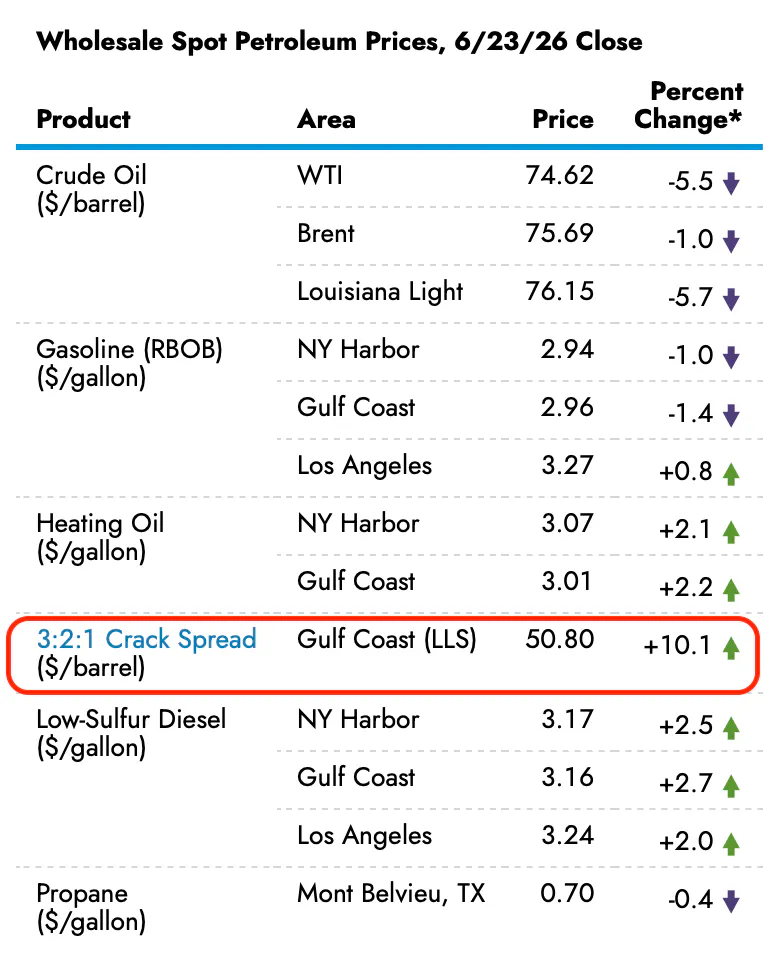
Source: EIA
That $29 gap translates to roughly 69 cents per gallon you're paying above what the crude price alone would suggest. Refiners are not passing the crude price collapse through to you — because their own margins are still historically elevated, product inventories remain tight, and the physical supply chain hasn't normalized even as futures markets celebrate.
There is one silver lining buried in this data, though it comes with a catch. With crack spreads at $53, refiners are making extraordinary profits on every barrel they process. So they are running their facilities flat out, at 96.1% of operable capacity last week, well above the typical ceiling of 95% that refineries rarely exceed even in peak seasons, converting as much crude as they can get into gasoline and diesel. That is actually keeping product inventories building and partially cushioning pump prices right now. But here is the catch: when crude flows normalize and crack spreads compress back toward their pre-war levels, that incentive disappears. Refinery utilization drops. Product output falls. The cushion evaporates, potentially right at the moment everyone assumes the crisis is over.
There's one more reason not to expect relief at the pump anytime soon. Even if global demand softens and our record crude exports slow down, the oil we produce here isn't necessarily the oil our biggest refineries need. The giant Gulf Coast refineries at Port Arthur, Beaumont, and Galveston Bay were built decades ago to process heavy, sour crude — the kind that comes from Canada, Mexico, Saudi Arabia, and Iraq. American shale production is predominantly light, sweet crude — a different animal entirely. So even in a world where WTI falls to $60 and US production is running at record levels, your Gulf Coast refiner may still prefer to import the specific grades of crude it was designed to run — because running domestic light sweet crude through a complex refinery built for heavy sour means underutilizing expensive equipment, producing a suboptimal product mix, and leaving margin on the table. They can run it. They just don't want to. Energy independence is real in aggregate. At the refinery gate, it's considerably more complicated.
The pipes don't care about the peace deal
Even if everything goes perfectly from here — mines cleared, tankers flowing, refineries ramping back up — the IEA projects it takes until early 2027 for production and trade patterns to return to pre-war levels. Goldman Sachs, the most optimistic major forecaster, says Gulf exports return to normal by end of July. Even in that best case, US inventories are last to recover.
There is a historical footnote to all of this that deserves a moment of reflection. The Strategic Petroleum Reserve was born directly from the trauma of the 1973 Arab oil embargo — when OPEC cut off US oil supply and prices quadrupled in a matter of months, the equivalent in today's dollars of going from $14 to $80 a barrel. That single shock triggered gas lines, rationing, double-digit inflation, and a recession that scarred a generation. Congress passed the Energy Policy and Conservation Act in 1975 and we began filling those underground salt caverns in Texas and Louisiana with emergency crude. The whole point was to make sure it never happened again.
Yesterday — even as oil prices were declining 4% on peace deal optimism — the SPR hit its lowest level since 1983. We built that buffer over fifty years. The Biden administration burned through a significant portion of it in 2022, releasing 180 million barrels to fight post-Ukraine energy prices. This crisis has consumed much of the buffer that was left. And at 331.2 million barrels, we are approaching what energy analysts estimate is the practical minimum operating level of the reserve — roughly 300 million barrels — below which the salt cavern physics make extraction increasingly difficult. We are not just low. We are nearing the floor. The 1973 embargo started from a period of cheap, complacent oil — and quadrupled prices in a matter of months. We were in exactly that same complacent place on February 27, 2026. History didn't just rhyme. It found the same opening.
The foundation of American borrowing power may have just been undermined
There is one more risk worth naming — one that connects directly to something you feel every April 15th.
You've probably heard that the US is carrying about $36 trillion in national debt. And you've probably wondered — how does that actually work? How does the world's largest debtor keep borrowing at relatively low interest rates without the whole thing collapsing? The answer, in large part, is something called the petrodollar. Since the 1970s, global oil has been priced and settled in US dollars. That means every country on earth — China, India, Japan, Germany, everyone — needs to hold dollars to buy oil. That structural global demand for dollars is what allows the US Treasury to keep selling debt to the world at rates it otherwise couldn't sustain. It's the silent subsidy that makes our deficit arithmetic work.
Now look at what Iran just did. Economists and analysts have been warning about this for months. Diana Choyleva, Chief Economist at Enodo Economics, put it plainly: "The decline of the petrodollar in the Gulf is not a matter of if it will happen, but when — and that when is approaching faster than most believe." Iran has now institutionalized yuan-denominated settlement at the world's most important oil chokepoint, formalizing that arrangement with Oman as a permanent co-administrator. Every barrel that flows through Hormuz under an Iranian toll regime, settled in yuan rather than dollars, is one less barrel creating structural demand for US currency. It doesn't end the petrodollar tomorrow. But it chips away at the foundation that makes our $36 trillion debt manageable. The peace deal didn't fix this. It may have locked it in.
The shooting may have stopped for now. But the concessions embedded in this deal — a permanent Iranian toll authority over the world's most critical oil chokepoint, yuan-denominated settlement baked into its architecture, and Oman as co-administrator — could shift the balance of global economic power for generations to come.
So why does any of this matter?
Fair question. None of us can reopen the Strait of Hormuz, rebuild the SPR, fix our unsustainable debt situation, or stop Iran from collecting yuan-denominated tolls. The outcome of this crisis will be what it will be. And we now have to live with it.
But that's not really why we do this.
Data 4 The People exists because we believe that an informed public makes better decisions and demands better decisions from the people who govern them. The SPR wasn't built because oil experts understood energy security. It was built because ordinary Americans sat in gas lines in 1973 and demanded their government never let that happen again. They understood the problem viscerally, and they acted.
We are, right now, watching history rhyme. The same complacency. The same depleted buffers. The same assumption that someone else is handling it.
If we can build a habit of reading the data — not the headlines, not the political spin, but the actual numbers — maybe the next time a crisis like this begins to take shape, enough people will see it coming early enough to demand action before the asteroid is right above us.
That's why we go into the detail. Not because you can fix it today. Not because we take any pleasure in depressing you. Because understanding it now is how we avoid repeating it fifty years from now.
Support Data That Serves the Public
Data should empower people, not just institutions. Your support helps us create accessible research, visualizations, and tools that uncover economic inequality and inform better decisions.
Donate
Enjoying this post?
Tell others about it.
More articles like this
Fetching Related Posts
There are no other articles tagged with Research