

The fastest growing industry in America - and what it tells us
Mental health practitioner job growth outpaces all other industries in America

Eric Pachman
Published
May 21st 2026
Exponential Growth. Flat Paychecks.
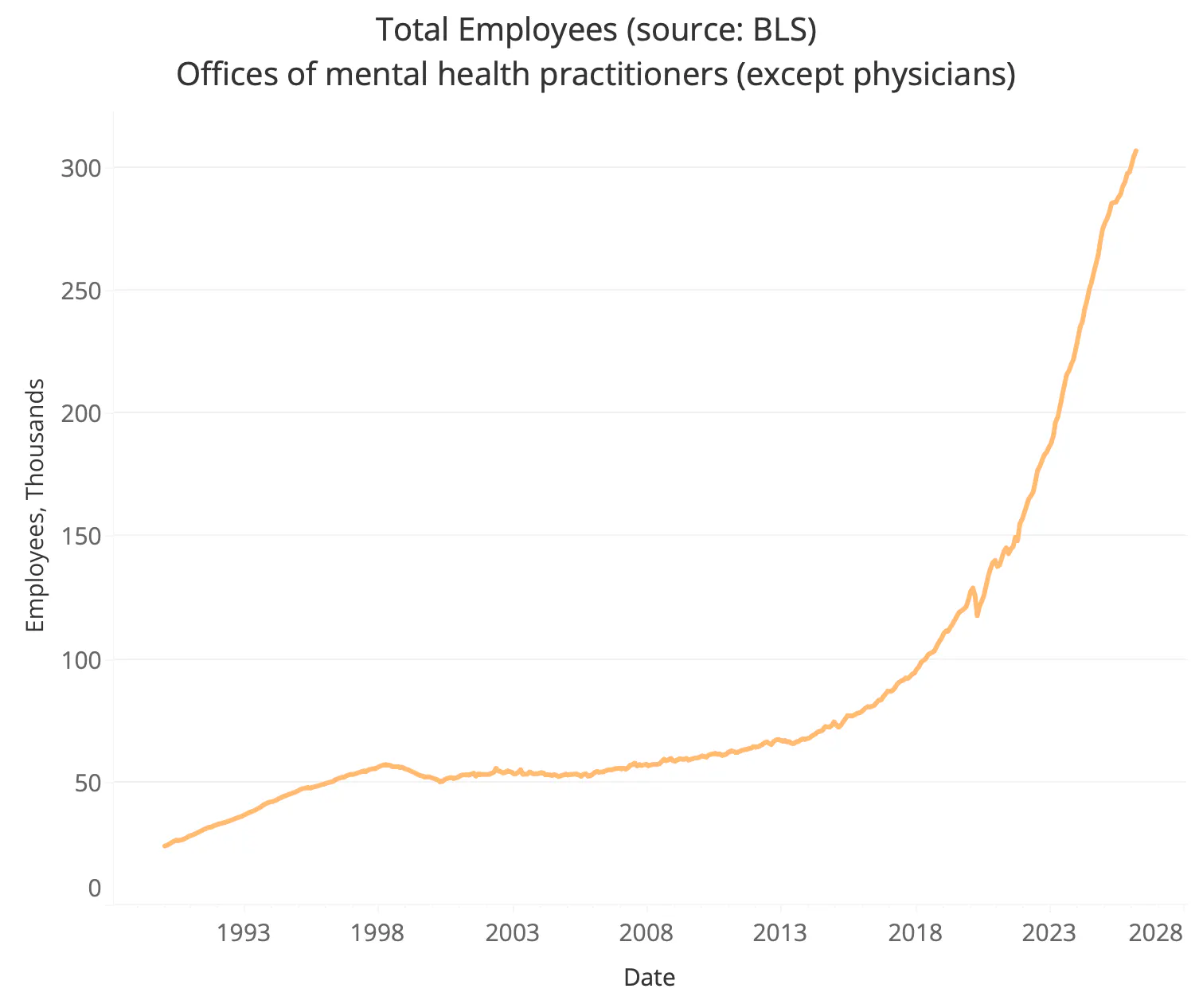
This morning I'm thinking about mental health. With everything going on in this country, the topic is never far from my mind. And apparently, based on this chart, I'm not alone.
Source: BLS
Of the nearly 700 industries tracked under the North American Industry Classification System (NAICS), you're looking at the one that had the largest percentage growth over the last decade - Offices of Mental Health Practitioners (a.k.a. therapists).
There's a lot to unpack here. But the point of Data 4 Thought posts isn't to fully unpack. It's to engage. To present you with TRUE FACTS and hopefully get you thinking. Every chart I offer is a starting point - the basis for your own research, which hopefully leads to more nuanced, less polarized opinions.
So here are some guiding questions.
Is this trend good or bad? (Trick question - there is no good or bad. There just is.)
What caused the spike? Therapy becoming less taboo? Social media handing all of us impossible benchmarks for happiness? The smartphone takeover? COVID and Telehealth? All of the above?
What can we learn from this industry? Part of this genuinely excites me - our medical system doesn't reward preventative care. It pays big bucks to treat you after you've overdosed, had a heart attack, needed medication, or been diagnosed with cancer. And yet here's this chart - the exception to the rule. Preventative treatment that's actually happening despite the design of the healthcare system, not because of it.
But then I think... how bad is America's mental health crisis, really? If structural incentives are actively working against therapy adoption and we're still seeing exponential growth - how much more would we see if we actually paid therapists what they're worth?
Consider the math. Becoming a licensed mental health counselor requires a bachelor's degree, then a master's degree, then 3,000+ hours of supervised clinical work, then a licensing exam. We're talking 6-8 years of education and training. The average graduate enters the profession carrying $79,500 in student loan debt - 113% above the national average for all borrowers. And what do they earn for all of that? A median salary under $60k. After adjusting for inflation, that's essentially flat since 2020.
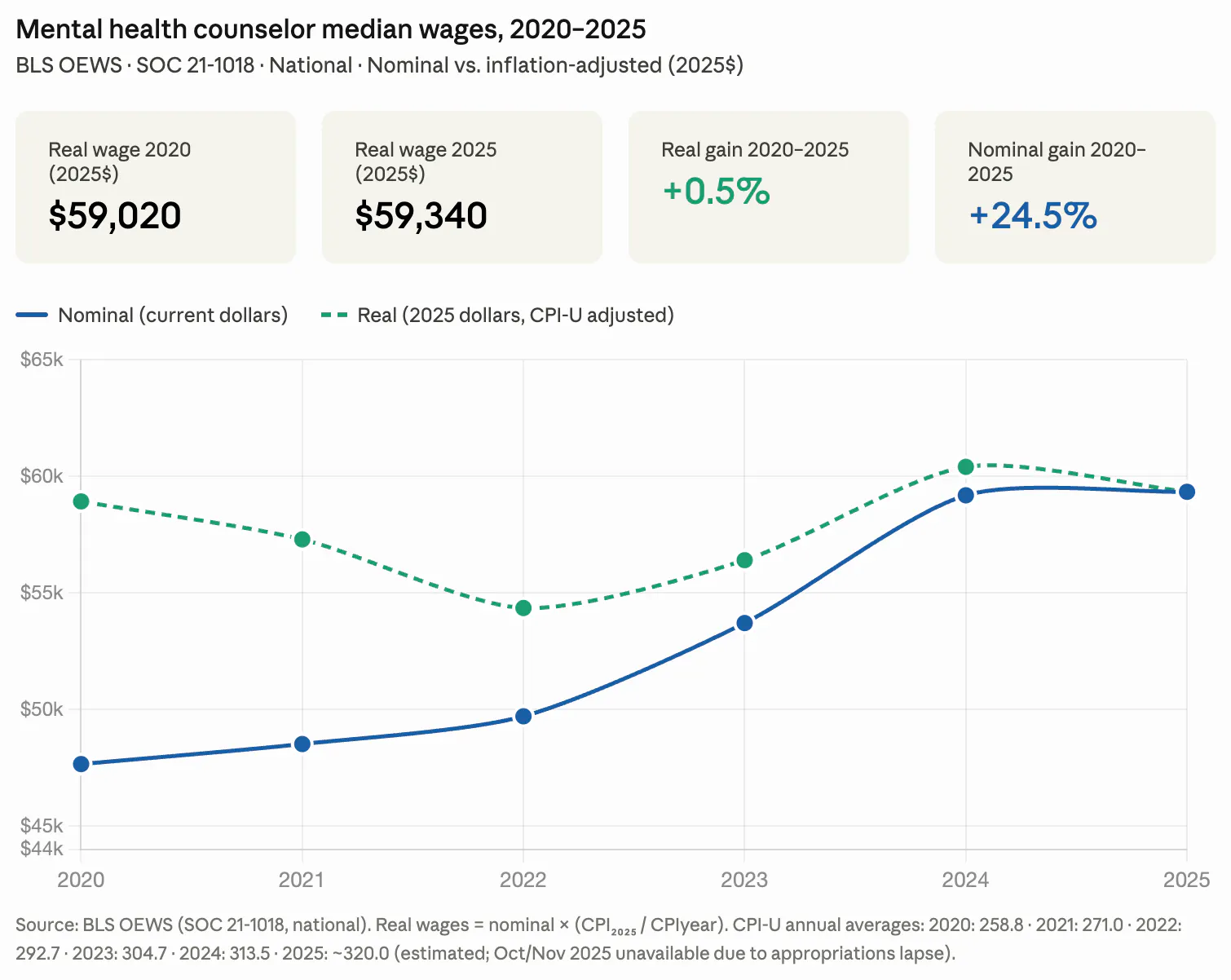
They start their careers already owing more than a full year's gross salary. The economic incentive simply isn't there. Which means the therapists showing up for America's mental health crisis every single day must be doing it because they genuinely love it. That's either beautiful or alarming. Maybe both.
Lots of thoughts for a Thursday morning. But thinking in America is atrophying. So we may as well get as much practice as we can.
Support Data That Serves the Public
Data should empower people, not just institutions. Your support helps us create accessible research, visualizations, and tools that uncover economic inequality and inform better decisions.
Donate
Enjoying this post?
Tell others about it.
More articles like this
Fetching Related Posts
There are no other articles tagged with Data 4 Thought