
Accountability Is Patriotism: Did JobsOhio Achieve Its Vision?
For more than a decade, Ohio has tried to transform its economy through a private nonprofit funded by liquor profits. No one ever set a benchmark to measure whether it worked. So we did.

Eric Pachman
Published
July 1st 2026
In 2011, Ohio tried something no state had tried before. It took the core mission of the agency responsible for growing the economy, the Department of Development, stripped that work out, and handed it to a private nonprofit it created from scratch. The new entity, JobsOhio, was funded not by taxes but by the profits from the state's liquor sales, and it was built to do one thing: create transformative job growth. Governor John Kasich, signing it into law, called it "the vehicle for the transformation for our economy."
The promise Ohioans were sold was speed. Freed from public bureaucracy, JobsOhio could "work at the speed of business" rather than the speed of government, moving fast enough to win deals other states would lose. The open question was the price. What did Ohio give up to get that speed? The first hints came early. In 2013, after Auditor Dave Yost subpoenaed JobsOhio's records, the legislature passed a bill in less than a week, with no public debate, barring him from auditing the roughly $100 million a year in liquor profits that fund the organization, and House Democrats moved to subject it to state audits, ethics, and public-records law through a proposed JobsOhio Accountability Act. Those efforts failed, and similar questions have kept surfacing since. Each raised the same one: in buying the speed of business, did Ohio give up the accountability that is supposed to come with it?
This is the question that manifested this project idea.
We cannot measure transformation directly, because the word is too vague and qualitative to pin to a number. But to us it carries a clear implication. Transformation means more than keeping pace. It means leading. We also cannot audit JobsOhio's headline claim that Ohio rose from 49th to 20th in the nation, because no methodology behind that number was ever published, and a number you cannot reconstruct is a number you cannot check.
What we can do is the thing that, as far as we can tell, no one has done. We looked back across the twelve years, took the 103 industries JobsOhio targeted, and benchmarked Ohio's job growth in each one against the same industry in every other state and in its five border neighbors. We did it using public data, buried in the download files of the Bureau of Labor Statistics website, that has been available the whole time. The guiding question has an answer. This is our attempt to give it one, and we have published every step of our methodology so that anyone can check our work or recreate it themselves.
Before we get to what we found, it is worth stepping back. When an organization spends a billion plus dollars chasing a goal, there is a normal way to tell whether it worked. Let us understand that baseline first.
Corporate America's accountability to its shareholders
A CEO who wants to make a large investment, a new product launch, an expansion into a new market, does not simply spend the money and later announce it went well. Before the money moves, management has to win approval from a board that does not report to the CEO, justifying the spend against targets the board will hold it to. The results come back measured against those targets, and if the returns do not show up, the people who put up the money can act, up to and including replacing the management team. That discipline is not red tape bolted onto business. It is part of what moving at the speed of business means. The speed and the accountability arrive together.
Strip that scene down and the accountability in it has three properties, and all three have to be present at once.
- The measure is set in advance. Before the money moves, everyone agrees on what success will look like and how it will be counted. You cannot pass a test whose questions are written after you have seen your own score, which is why the target comes first, not last.
- The measure is judged by someone independent. The board is not the executive. The investors do not work for the person asking for the money. Whoever decides whether the bet paid off has no stake in the answer being yes. An organization that judges its own performance is not being held accountable; it is grading its own test.
- The measure is disclosed. The result is put where the people who funded it can see it, check it, and disagree with it if they want. Disclosure is what turns a private opinion into a public fact. You do not have to accept someone's verdict on their own work, but if they show you the test, the data, and the scoring, you can judge for yourself.
Set in advance, judged independently, disclosed. That is not an exotic standard reserved for Fortune 500 boards. It is the ordinary discipline attached to serious money everywhere in the private economy, and it is exactly the discipline a fast-moving company cannot escape.
None of this is about punishment. A benchmark is not a trap laid for the executive who falls short. It is closer to the opposite. When everyone has agreed in advance on what success looks like, falling behind becomes information instead of embarrassment. You can see it early, name it honestly, and change course while there is still time. A measure you can track against is what lets an organization admit a strategy is not working and pivot, rather than plow forward for years on a path that was quietly failing the whole time. JobsOhio was built for the speed of business. The question is whether it kept the accountability that comes with it.
What JobsOhio measures, and what it doesn't
JobsOhio was created in 2011 but had no independent funding until early 2013, when its affiliate acquired the rights to Ohio's wholesale liquor franchise, paying the state about $1.5 billion financed through bonds, for a lease running through 2038. Those liquor profits are its sole funding source. We are not here to judge why Ohio built it this way. What matters for this report is the effect: the structure gave JobsOhio the speed it desired.
It also had a consequence. Money routed through a private nonprofit does not get examined the way ordinary public spending does. JobsOhio is not subject to the public-records law or the standard state audit that apply to public agencies. This has put real distance between the public and the program's results.
To be clear, JobsOhio does measure things, and measures some of them well. Its books are clean. An annual compliance review by the Ohio Auditor has returned zero material findings for thirteen years running, and its financial statements are audited and posted publicly. When it funds a company, it attaches targets to that deal, jobs to be created, payroll to be added, and a later review checks whether the company hit them. It also commissioned a third-party study estimating that its projects generated about $16.6 billion in state tax revenue, roughly $17 for every dollar it invested. This is not an organization that reports nothing.
But look closely at what all of it measures. The audits confirm the money was spent as documented. The deal targets track whether individual companies kept their promises. The tax-revenue study estimates the ripple effects of JobsOhio's own projects. Even the national-sounding rankings are built from its own deal flow: it boasts of ranking top five nationally for jobs created, projects, capital investment, and payroll, but each of those just counts what JobsOhio itself did. Every measure looks inward, at its own activity and its own deals. Not one tests the thing it set as its standard: how Ohio's targeted industries performed against the same industries in other states. You cannot lead the nation without a comparison to the nation, and that comparison is the one measurement JobsOhio never made.
It does point to a number that sounds like one. By the widely cited McKinsey account, Ohio ranked 49th among states in target-sector job growth in 2010 and rose to 20th by 2022. It is a clean and encouraging arc, and it may well be accurate. We cannot say, because we could not find the method behind it, and we looked hard. Any researcher publishing a finding is expected to attach the methodology behind it, or point to where it lives, so others can check the work. The data sources, the growth measure, the industries included, the peer set, the treatment of suppressed data: none of it is attached to this number anywhere we could find.
We checked the places it should be. It was not in the McKinsey writeup that reports it. It was not on JobsOhio's own website. It was not in its annual reports. In every case the number is stated and never derived. Even the 2018 assessment JobsOhio calls "independent" turns out, on inspection, to be a forward-looking strategy review built around questions about future investments, not a published benchmark of the national-leadership claim. We are not saying the work was never done. We are saying that after looking everywhere a reader would reasonably look, we could not find it, and neither can the public it was meant to persuade.
Give the program every benefit of the doubt, and this is still where you end up. The structure was ... unconventional, and hard to audit. The deal-level metrics are real but answer a smaller question. The one ranking that speaks to the actual promise comes with no method anyone can check. Tellingly, even McKinsey, the source of that ranking, urged JobsOhio to "measure success against the needs of Ohioans" rather than against other economic-development shops. Nothing here proves bad faith from anyone. It only proves that no one, in twelve years, was ever required to look back and benchmark Ohio's job-growth performance against the rest of the country, to see whether its unconventional methods actually delivered the transformation Ohio was promised.
So we built the test
Because the only account on offer was JobsOhio's own, we built the benchmark it never built for itself.
We used a single public dataset, the Bureau of Labor Statistics Quarterly Census of Employment and Wages, a near-complete count of jobs drawn from unemployment-insurance records. For each industry JobsOhio named, we measured how Ohio's employment grew from 2013 to 2025, and compared it to how the same industry grew across other states over the same window. If transformation means leadership, the test is whether Ohio's targeted industries led, and that is the comparison we ran. The full method is in a companion page. Nothing about it is proprietary, and anyone can rebuild it. Here is what it shows.
On the industries JobsOhio chose to grow, Ohio is, at best, a median state. Across every defensible way of drawing the comparison, it ranks between 25th and 31st out of 50 states.
Not a national leader. After twelve years, Ohio is middle of the pack at best.
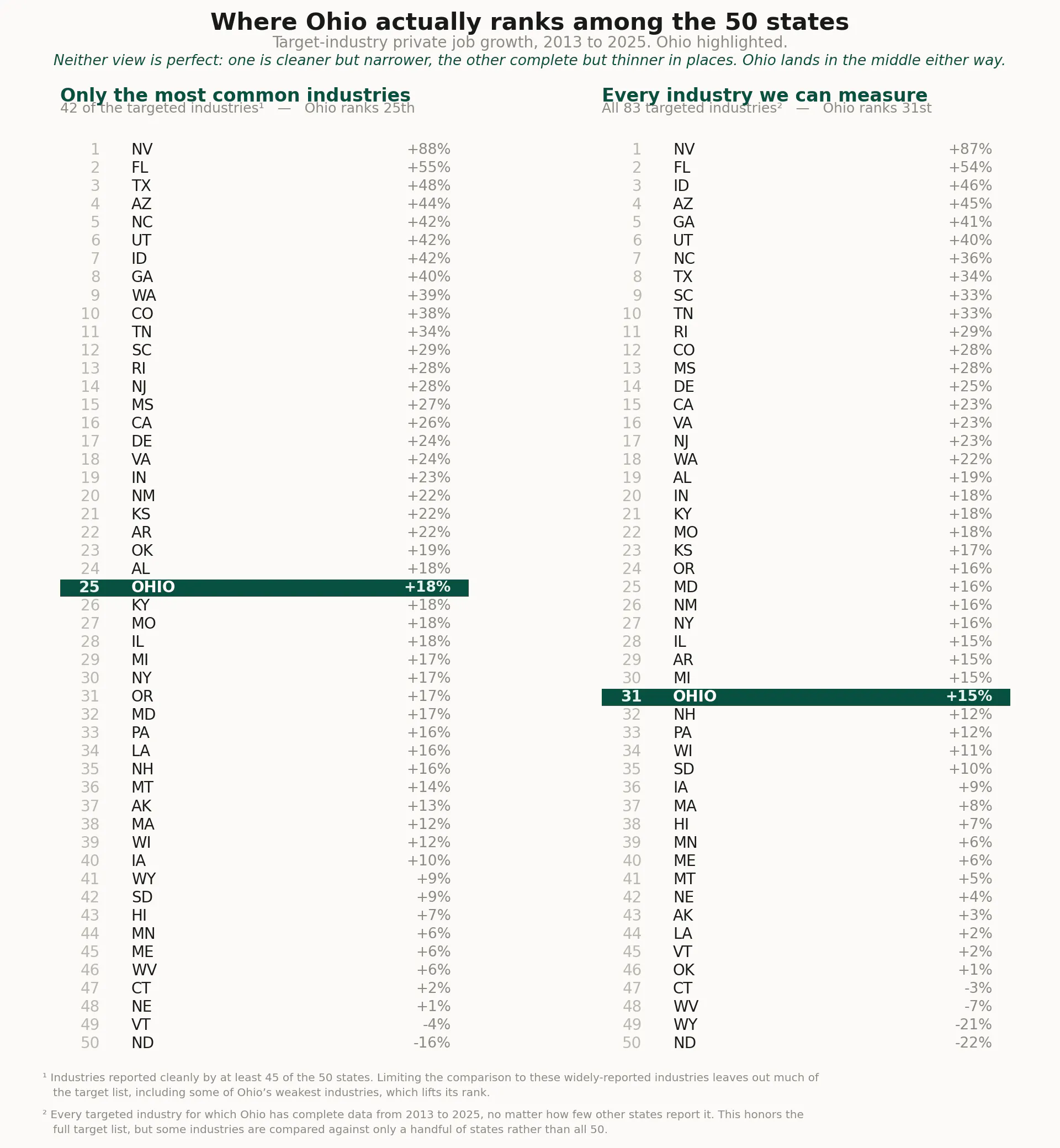
Each panel ranks all 50 states. Ohio is highlighted. The two views use different sets of industries, which is why some states move between them, but Ohio lands in the middle of the pack in both.
There is one way to make Ohio look better, and it is worth understanding because it is the whole story in miniature. Restrict the comparison to only the industries large enough to appear in every state, and Ohio climbs toward 22nd. But this cuts the comparison down to just 13 of the 103 targeted industries, about an eighth of the list, which undermines the whole exercise. Those 13 are the biggest, most universal industries, exactly the ones where Ohio's scale helps most, and they leave out most of the target list. As we explain in the methodology, we spent considerable time weighing tradeoffs like this one to land on what we believe is the most defensible version of the study. Widen the lens to a representative share of the industries JobsOhio actually named, and Ohio settles back into that 25th-to-31st band and stays there.
One industry makes the pattern concrete. Motor Vehicle Manufacturing is on JobsOhio's target list, and it is one of the program's worst results. Ohio fell from about 20,700 jobs in 2013 to about 19,000 in 2025, down roughly 8 percent, while the median state in that same industry grew 95 percent. It is the worst gap on the entire list, and because so few states report it cleanly, it is also one of the first results to vanish when the comparison is narrowed. The industries that flatter Ohio survive that narrowing. Its conspicuous failures do not.
We are careful about what this does and does not prove. It does not prove JobsOhio caused Ohio to fall short. Many forces move employment in any industry, and the program cannot be credited or blamed for all of them. What it establishes is narrower and harder to wave away. On the program's own chosen yardstick, the industries it prioritized did not keep pace with the same industries elsewhere.
You do not have to take any of this on our word. The full analysis is below, every sector, every industry, every state. Click into any sector to see the individual industries inside it, and compare Ohio against the national benchmark and its border states yourself.
Why this is the part that should bother you
Sit with what just happened. To answer a basic question about a public program, leading the nation or not, we had to pull twelve years of federal employment records, define a fair comparison, and run the test that the program declined to run on itself. A decade and a billion plus dollars in, a couple of analysts with public data did the measuring that should have been built into the program on day one.
That is the biggest failure here, and it is larger than any single job number. JobsOhio could have defined this benchmark for itself in 2013, published it, and reported against it every year since. It would not have been hard. The data is free and the math is arithmetic. The reason no one did it is not that it was difficult. It is that no one was ever required to.
JobsOhio is a large and visible example, but it is an example of the disease, not the disease itself. The disease is the level of accountability we have quietly agreed to expect from the people who spend public money, which is to say almost none. The same voters who would fire a CEO for grading his own exam will re-elect officials who were never given one.
The person who said this most plainly is the one who tried to look. When former Governor Kasich recently criticized JobsOhio for "mission drift," Ohio Attorney General Dave Yost, who as state auditor had fought to examine JobsOhio's books, answered him directly: "You will find the one responsible in the mirror, Governor. As Auditor of State, I worried about just such things. You ignored a subpoena and twisted every arm in the legislature to pass a law to stop me from auditing JobsOhio." The official charged with checking the books was, by design, kept from checking them.
We have seen what that opacity hides, up close. In 2018, that same Dave Yost audited Ohio's Medicaid drug program and found $224.8 million in spread pricing that middlemen had quietly pulled out of public money in a single year. The lesson then is the lesson now. You cannot fix what you are not allowed to see, and you cannot judge what was never measured. Transparency comes first, or everything built on top of it stands on shaky ground.
It does not have to be this way, and the fix is neither complicated nor partisan. When government makes a large investment, the measure of success should be set before the money is spent, by someone other than the people spending it, and disclosed so the public can see the reasoning and weigh it. You do not have to agree with how success is measured. You just need a measure you can see, so you can judge the results for yourself. That is the entire difference between a result you can check and a claim you have to take on faith.
After all this work, we still do not know whether JobsOhio worked. That is not an accusation. It is the plain state of things twelve years on, and it is the problem in a single sentence. A program that wanted to be trusted should have made itself checkable. Ohioans who want accountability for how their money is spent should refuse to accept anything less.
Asking for the receipts is not an attack on government. It is the opposite. It is what you do when you believe government can be worth trusting and you hold it accountable to its promises. That expectation, held firmly and applied to everyone who spends our money, is not cynicism. It is protecting America. It is patriotism.
Support Data That Serves the Public
Data should empower people, not just institutions. Your support helps us create accessible research, visualizations, and tools that uncover economic inequality and inform better decisions.
Donate
Enjoying this post?
Tell others about it.
More articles like this
Fetching Related Posts
There are no other articles tagged with Research