
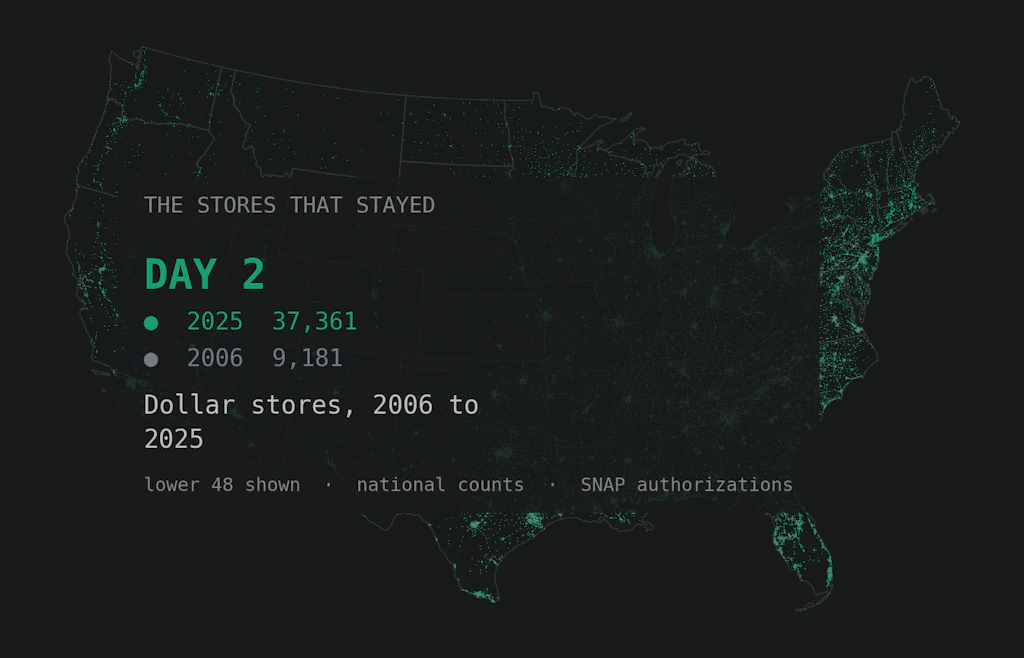
Dollar store domination
Small grocers couldn't make the small-box store work. Dollar store chains did — growing faster and lasting longer than any other format in SNAP. Whether that is a problem or a lifeline depends on where you live.

Eric Pachman
Published
August 20th 2026
SNAP-authorized retailers, 2006–2025. USDA Food and Nutrition Service authorization records. 37,361 dollar stores authorized at the end of 2025, against 63,497 grocery stores of every size.
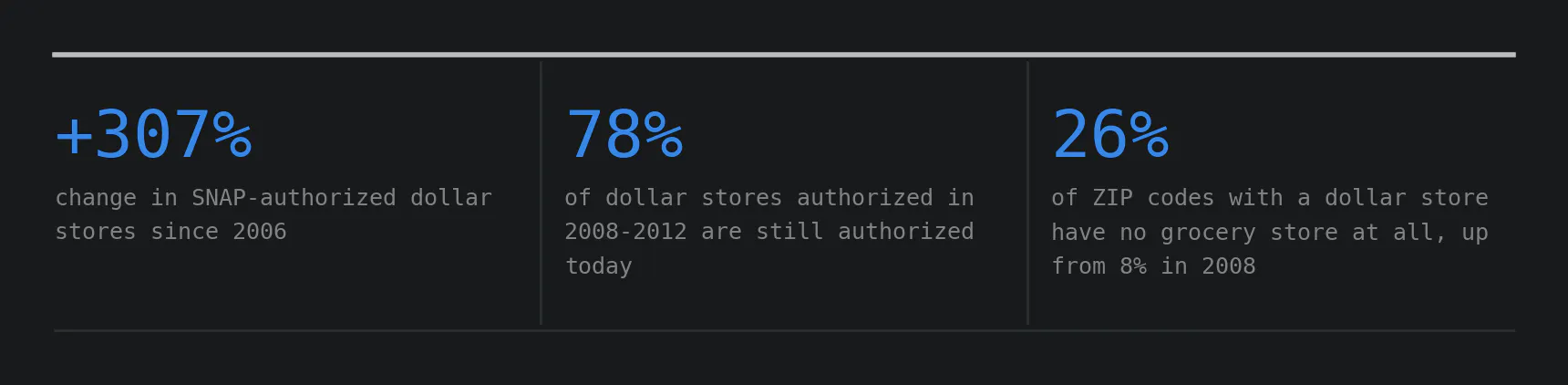
+307% change in SNAP-authorized dollar stores since 2006. 78% of dollar stores authorized in 2008–2012 are still authorized today. 26% of ZIP codes with a dollar store have no grocery of any size, up from 8% in 2008.
Yesterday's piece ended on a question. Small grocery is a small format that could not make the numbers work. The dollar store is a small format too — same small box, narrow range, few staff. It did the opposite.
They grew rapidly
Dollar stores went from 9,181 SNAP-authorized stores in 2006 to 37,361 in 2025. That is a +307% change, while no grocery format managed even a tenth of that. One caution before reading it as store growth: at the start of the window not every dollar store took SNAP, so part of the early climb is existing stores joining the program rather than new stores opening. The Limits section at the end sizes that gap.
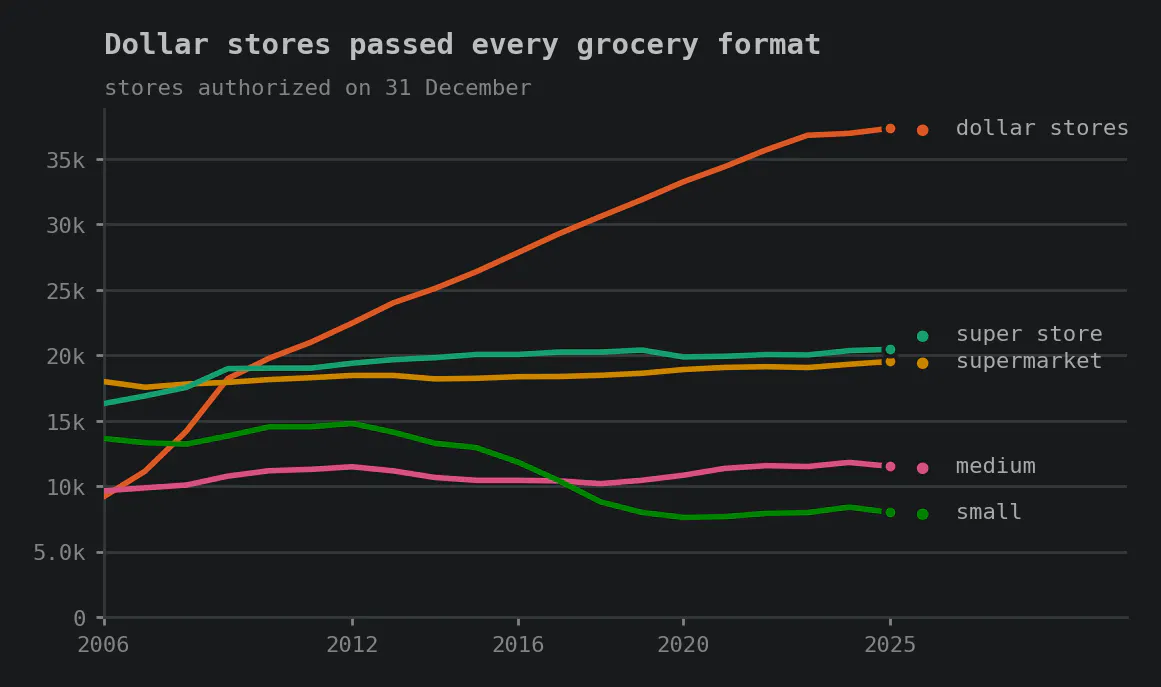
They are now the second most common kind of SNAP retailer in the country, behind only convenience stores. There are 37,361 of them against 63,497 grocery stores of every size combined.
They kept their authorizations
But dollar stores didn't just have growth — they had growth and longevity. Take every retailer that joined SNAP between 2008 and 2012, and ask how many are still in the program at the end of 2025. No other format touches the dollar store.
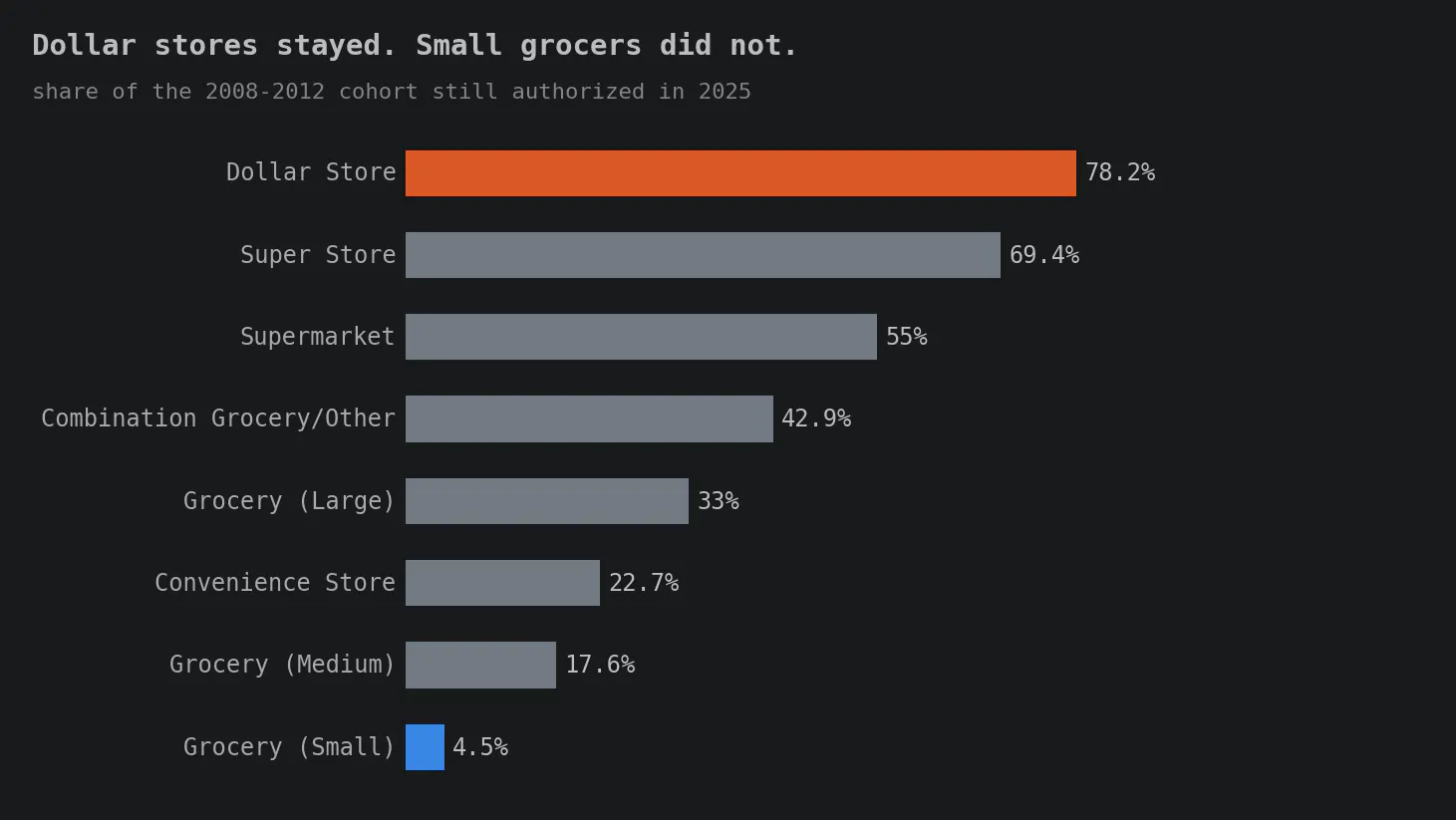
78% of dollar stores are still authorized. Meanwhile, just 4.5% of small grocers are. A dollar store from those years is 17.2× more likely to still be in the program. Even more impressive, dollar stores outlasted the super stores — the supercenters with more scale in a single store than any other format — which kept 69% of theirs.
The growth in dollar store concentration
You have likely heard the saying that there are three things that matter in real estate: location, location, and location. Location matters just as much in data analysis — a national total says little about anyone's lived experience.
So we asked the location question that piqued our curiosity: how has the number of ZIP codes with a dollar store but no grocery store changed over the history of the data? The answer is in the chart below:
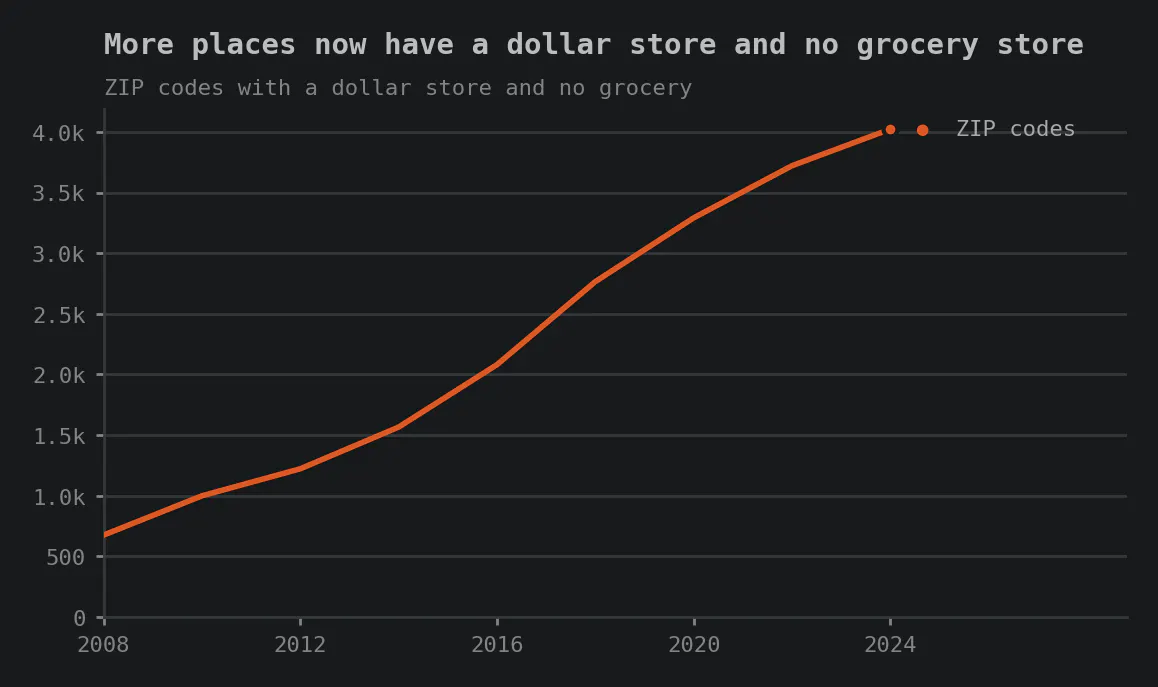
In 2008, there were just 675 ZIP codes with a dollar store and no grocer. By 2024 that had risen to 4,024. Put another way: of all the ZIP codes that have a dollar store, the share with no grocer went from 8% to 26%. That means if you live in one of these ZIP codes, cannot travel beyond it, and are on SNAP, you are buying your food at a dollar store or a convenience store.
We initially made the mistake of reading this as a bad thing. But good and bad are relative concepts. Included in those 4,024 ZIP codes are towns that in 2008 had no SNAP-authorized grocer and no dollar store — some had nothing but a gas-station convenience store that took SNAP. For a town like that, the dollar store opening is a very good thing, providing considerably more food options than a gas station carries.
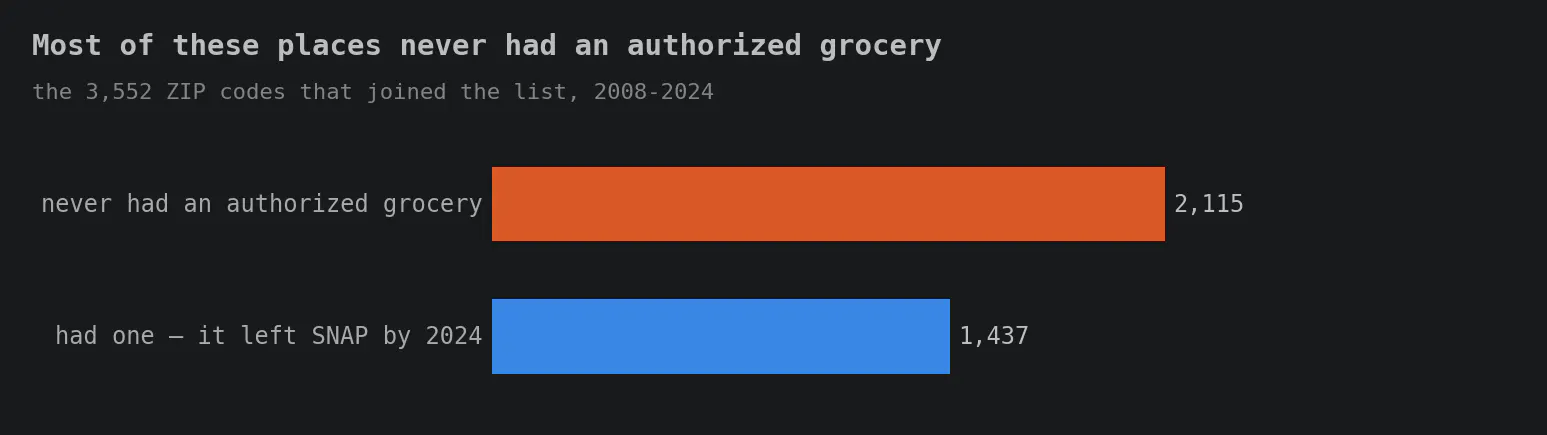
So we did the math. The list is not one-way: of the 675 ZIP codes on it in 2008, 203 left it by 2024 — nearly always because a grocery became authorized there — while 3,552 joined, which nets out to the 4,024. Of the 3,552 that joined, 60% never had a grocer that accepted SNAP to begin with, while 40% had one at some point and it left the program:
The mix differs by state. Here is the walk across from 2008 to 2024 for the ten states that added the most ZIP codes with a dollar store and no grocery store. Each starts with the ZIP codes in this group in 2008, deducts those that fell out of it, then adds the two kinds of additions: new dollar stores in ZIP codes that never had a grocery store that took SNAP, and ZIP codes that once had a grocery store that took SNAP and no longer do.
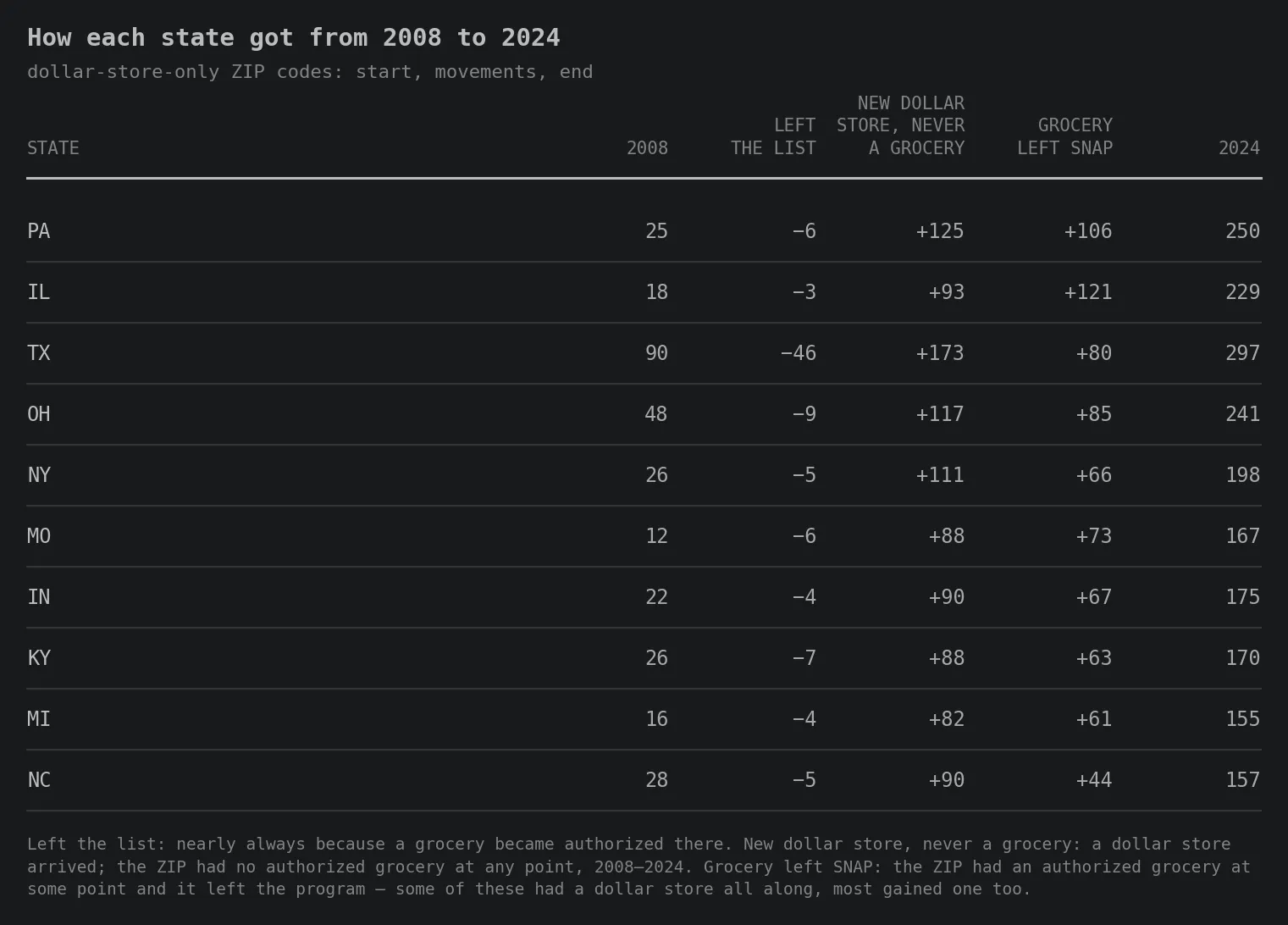
Take Pennsylvania, the top row. It started 2008 with 25 ZIP codes that had a dollar store and no authorized grocer. Six of those left the list — almost always the good way, a grocery store becoming authorized there. Then 125 ZIP codes joined when a dollar store opened somewhere that never had an authorized grocer, and 106 more joined where a grocery left SNAP. Net it out and Pennsylvania ends 2024 at 250.
Texas leans hardest toward arrival: 173 of its new ZIP codes never had an authorized grocery, against 80 where a grocery left SNAP. Illinois leans the other way — it is the only state on the list where the grocers that left SNAP outnumbered the dollar stores that arrived.
What it adds up to
Dollar stores "have their cake and eat it too."
They are small where small wins: a box that has a better chance of being profitable in a town of a few thousand people, where a supermarket cannot. And they are big where big wins: a chain that works out how to clear USDA's stocking bar once, then spreads the cost of doing it across twenty thousand stores.
Consider these two characteristics and the growth of this store format stops being surprising.
However, it begs the question: why is the SNAP authorization bar currently low enough for a small dollar store to clear? Partly because someone else fought to keep it there. The 2016 stocking rule would have raised it sharply. It was rolled back in May 2017 — by the convenience store industry, lobbying hard for its members. From what we can tell, dollar stores never publicly led that campaign. They just got the benefit.
Which is where we go next: the country's 117,055 convenience stores, the single largest group in this data, and how they have thrived without anything like the chain concentration dollar stores enjoy. Only 35% of them belong to a chain at all.
Tomorrow: the convenience store.
Limits
Nothing here measures floor space, sales, or what is on the shelves. A dollar store and a supermarket each count as one record.
How closely do authorization counts track actual stores? At the end of the window, almost exactly.Nearly all dollar stores belong to a handful of public chains that tell their investors how many stores they run, which allows a check no other format offers:
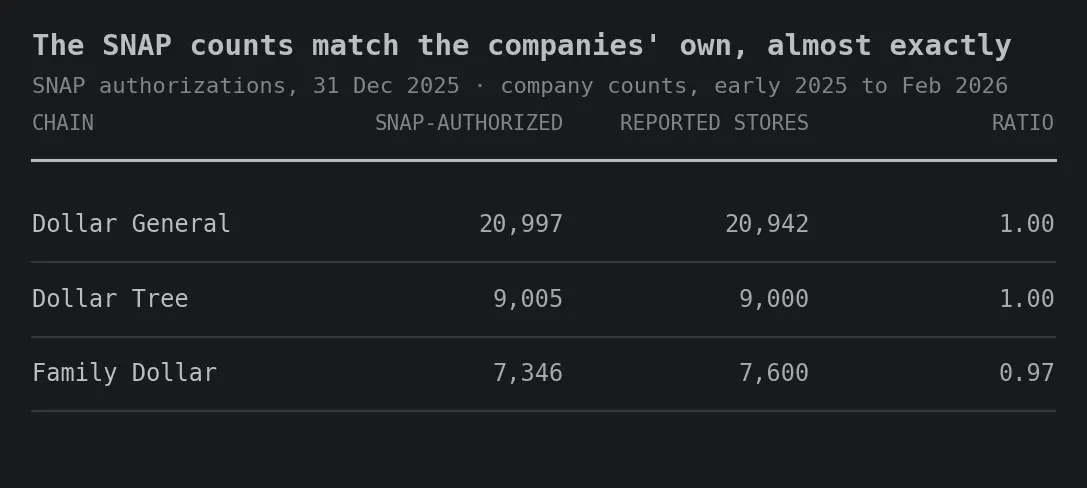
Essentially every Dollar General and Dollar Tree in the country takes SNAP. We cannot say authorizations and stores are the same thing — a closed store can linger in the file until USDA catches up — but at the end of 2025 the two clearly move together.
They did not at the start of the window. In 2006, Dollar General was already essentially all in: 8,206 of its 8,229 reported stores were authorized. Family Dollar and Dollar Tree were not — Family Dollar ran about 6,000 stores that year with just 130 authorized, and Dollar Tree about 2,914 with 595.
Both joined the program over the years that followed. So the +307% is growth in authorized dollar stores; the growth in dollar stores themselves is closer to a doubling. The direction and the ranking of the story stand either way, but the two numbers are not interchangeable.
For independent stores there is no such check. An ended authorization may mean the shop closed or may mean it stopped taking EBT. 6.0% of small grocers lost their authorization and later regained it, median gap 58 days — those were open the whole time.
Store-level SNAP spending is not public. A 2019 Supreme Court case put those figures under a FOIA exemption, so we can see where authorized stores are but never how much any one of them takes in.
In the ZIP code split, "a grocery left SNAP" means exactly that — its authorization ended. The store itself may still operate without SNAP. And ZIP codes are places, not people: many of the ZIP codes that gained their first authorized store are lightly populated, so counts of places do not translate directly into counts of shoppers.
Company store counts are from early 2025 to early 2026 and are compared against authorizations at the end of 2025, so the ratios are close, not exact.
Source: USDA FNS SNAP Retailer Locator Historical Data, 2005–2025, covering retailers authorized at any point in the window. Analysis uses 656,868 stores with usable coordinates. A store counts as active in a year if an authorization covered 31 December. Company store counts from Dollar General and Dollar Tree investor releases; Family Dollar via trade press; 2006 store counts from each company's fiscal 2006 Form 10-K. The 2017 rollback is Section 765 of P.L. 115-31. Code, pipeline and verification: Data4ThePeople/SNAP_Locations.
Support Data That Serves the Public
Data should empower people, not just institutions. Your support helps us create accessible research, visualizations, and tools that uncover economic inequality and inform better decisions.
Donate
Enjoying this post?
Tell others about it.
More articles like this
Fetching Related Posts
There are no other articles tagged with Data 4 Thought