
The help desk for people who really need help
Dayton has one of the oldest ombudsman offices in the country, and nearly 30 years of records kept by hand. The number one thing the office currently investigates is child care.

Eric Pachman
Published
September 21st 2026
Are you familiar with what an ombudsman does?
If you are like me, you may be familiar with the term, but if pressed on exactly what it does, crickets.
There's no shame in that. It's not our fault. I went looking for the numbers, because I wanted to open this piece with them. How many ombudsman offices did this country have? How many are left? What share of us still live somewhere with one? I could not find the answers. Hawaii opened the first office in 1967. A few cities followed in 1970 and 1971, Dayton among them. After that the trail goes cold. The U.S. Ombudsman Association, the professional association these offices belong to, says the number of new ones is small. I found no published count of how many have closed, and no figure for how many people still have one nearby.
That absence is worth sitting with. We count a lot of things in this country. This does not appear to be one of them. An office set up to help people who struggle to be heard has itself gone unmeasured, which, to me, speaks volumes about America.
So what does an ombudsman office do? Think of your ombudsman office (if you have one) as the concierge desk for citizens. You know Marriott Bonvoy? Maybe you have gold or platinum status there. And if you do, whenever you have an issue with your reservation, you can call a friendly human being and they will make your problem go away. That's what the ombudsman does. Except they aren't there for people with status dealing with relatively frivolous issues like room upgrades. They are instead fielding calls from people who can't figure out the labyrinth of recertification requirements to keep SNAP benefits, or people who qualify for child care subsidies but can't figure out how to get them, or people whose power has gotten shut off, are living in the dark, and can't get their utility company to talk to them.
One difference from the concierge desk. The ombudsman is neutral. They are not by definition on your side, they are on the side of a fair process, and when they look into a complaint and find the agency did nothing wrong, they say so. In Dayton that happens about four times in ten.
In short, the ombudsman's office is the help desk for people who really need help. And the fact that these offices live in obscurity is likely because these people who are really struggling to navigate the complexity of social benefits programs also live in obscurity.
But the offices that exist toil away to help people each and every day. It turns out I have connections to Dayton's ombudsman office, so I have learned much about its inspirational work over the past few weeks. Dayton opened its office in 1971, one of the first cities and counties in the country to do it. And more importantly for me, it has nearly 30 years of data on the calls it has received, meticulously documented by hand as if it knew one day technology would catch up to its processes, and give it the ability to tell the stories of the Dayton community.
And so, with permission from the office, I analyzed their data. And what I found was a slap in the face. Why? Because I have posted more than 80 times on Data 4 The People in the past nine months, and none have been on the #1 thing the office currently investigates: access to child care.
Meanwhile, as I was working on this, Child Care Aware of America put out its 2025 price report. In Ohio, infant care in a center runs $13,780 a year before any subsidy. That is 40 percent of what a typical single parent in this state takes home. No wonder families need subsidies, and no wonder so many of them end up at the ombudsman's door.
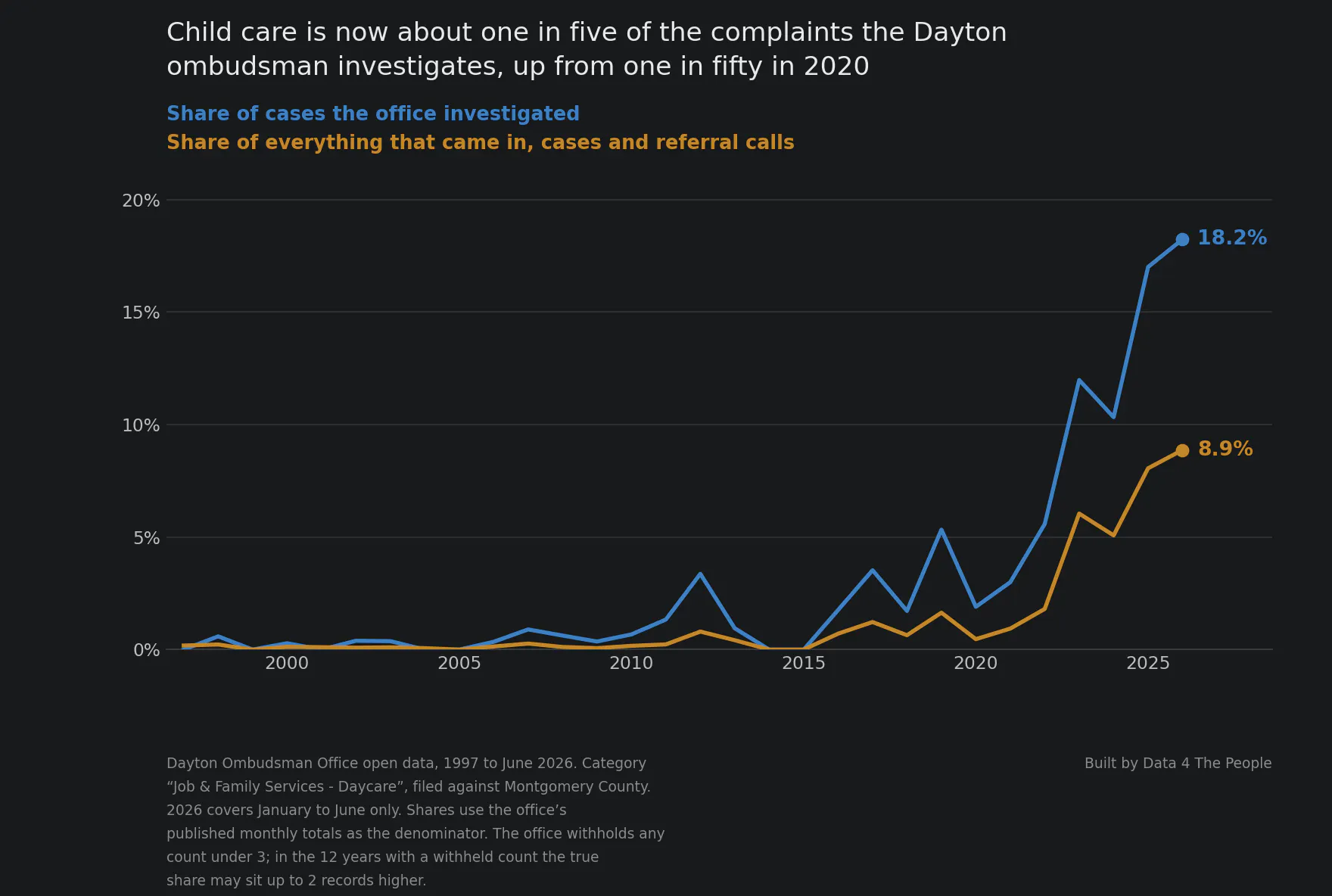
Dayton Ombudsman Office records, 1997 to June 2026, shared with permission. 2026 covers January to June only.
Now, to be clear, these are usually not calls complaining about a provider. Rather, these are calls trying to understand how to qualify for subsidies offered by the state. You see, back in 2023 child care subsidies were actually expanded in Ohio. That's a good thing on paper. But when you dig into it, the expansion was very small. It wasn't designed to get to all the people that could technically now qualify. But what it did do (in my view) was likely give people hope that they could qualify. And so, my best reconstruction of what happened was that the Montgomery County Department of Job and Family Services (JFS) was likely inundated with calls. I can't verify this since I don't have their data. But I do have the ombudsman's data. People reach that office after the official process has failed them, so a rise in calls is a sign that the process for getting answers about eligibility isn't working as designed.
This is quite concerning given what is now coming. Last year, the One Big Beautiful Bill (OBBB) was passed, clamping down on all sorts of social benefits (SNAP, Medicaid, and by extension child care, which in Ohio you can qualify for through SNAP or work requirements). The way this bill clamps down on benefits is by making the recertification and work requirement process much more strict. Think about the logical outcome. Process gets more complicated. People can't follow it. People call JFS to ask what to do. If JFS doesn't have the bandwidth to address the issues (their budget for running these programs went up in 2024, and was flat the year after) then the queue grows. Unresolved problems increase. People lose their benefits not because they don't qualify, but because they can't figure out the maze of new requirements and paperwork.
And who is able to offer assistance to these people? The ombudsman.
To be fair, the child care data I showed above is a small quantity of data. Though old, our ombudsman's office is small, likely because people don't know it exists. But as the OBBB fully takes hold, and the complications it causes cascade through state departments that are beyond stretched thin, that will likely change.
Where this comes from
The numbers come from the Dayton Ombudsman Office's own records, January 1997 through June 2026, shared with permission. The office hides any count under three, so that no one can be picked out of a small group. A blank in their files means unknown. It does not mean zero. Everything else I used is below.
On what an ombudsman is, and the three kinds:
- Ombuds offices overview and comparison chart, American Bar Association
- Standards for the Establishment and Operation of Ombuds Offices, American Bar Association
- Governmental Ombudsman Standards, United States Ombudsman Association
On the history, and on how few of these offices there are:
- The history of ombudsman offices, for Hawaii opening the first one in 1967
- Jamestown, New York city code, for the office it adopted in January 1970
- Seattle-King County ombudsman records, for the office created there in 1970
- About the Dayton office, for its founding in 1971 and its long-term care program
- Dayton's ombudsman marks 55 years, Dayton Daily News
- Municipal government ombudsman, United States Ombudsman Association
On what child care costs:
- The price of child care in 2025, Child Care Aware of America
- Affordability analysis, state tables, Child Care Aware of America, for Ohio's $13,780 infant center price and the single-parent income comparison, both from its January 2025 survey of state networks
On child care in Ohio:
- How Ohio's publicly funded child care measures up, Policy Matters Ohio, for the 2023 change from 142 to 145 percent of the federal poverty level
- Eligibility and income guidelines, Hamilton County Job and Family Services, for what a family has to do to qualify
- Impacts of the state budget on Ohio Job and Family Services, Center for Community Solutions, for what counties get to run these programs
On the One Big Beautiful Bill:
Support Data That Serves the Public
Data should empower people, not just institutions. Your support helps us create accessible research, visualizations, and tools that uncover economic inequality and inform better decisions.
Donate
Enjoying this post?
Tell others about it.
More articles like this
Fetching Related Posts
There are no other articles tagged with Data 4 Thought