
Accountability Is Patriotism: From the Spreadsheet to the Shelf
The government priced a healthy diet to the penny, then locked it in a spreadsheet no shopper opens.

Eric Pachman
Published
June 30th 2026
Accountability is Patriotism
From the Spreadsheet to the Shelf
A week or so ago, we pulled the government's grocery list and read it.
In our last piece, we went looking for the spreadsheet that decides how much a family on food assistance gets to eat. It's called the Thrifty Food Plan, and it isn't a guideline — it's the number. Federal law says the cost of one specific basket sets the maximum SNAP benefit. We rebuilt that basket from the bottom up, re-pricing all 1,342 foods line by line, and landed within about a percent of the government's own figure: roughly $229 a week for a family of four.
But arriving at the right total only told us the receipt was real. It didn't tell us the basket was buyable. That meant looking past the sum to the line items — all 1,342 of them.
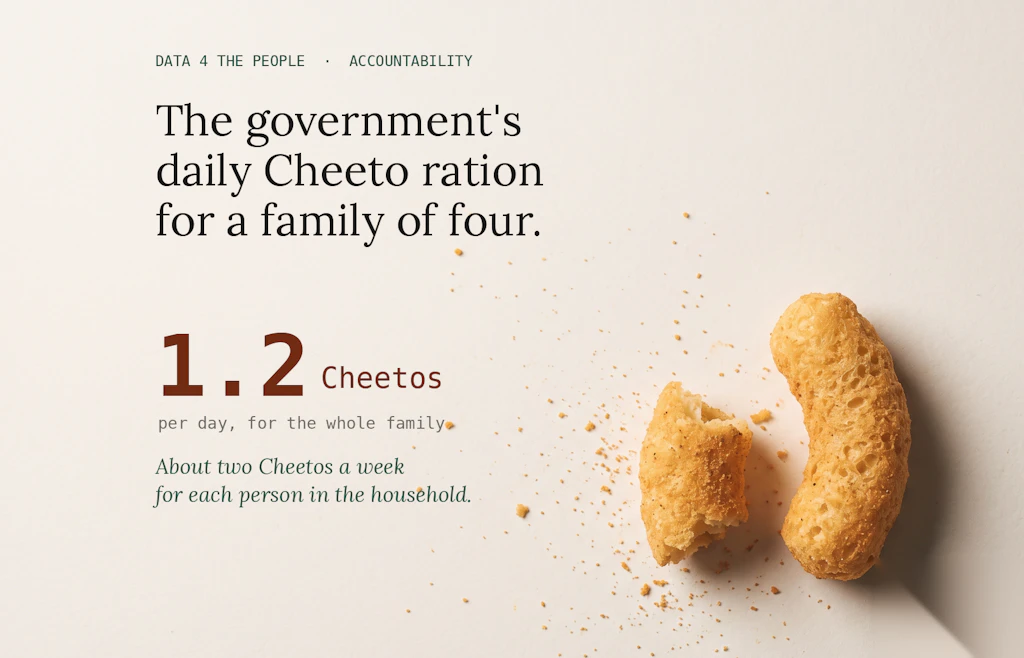
Every dot is a food the USDA's economists decided a SNAP family should buy each week. The first thing you notice is the sheer count. But the real problem is the size of the items. Zoom in and the plan stops describing groceries and starts describing fractions: 0.18 ounces of a nutrition bar a week — a tenth of a single bar; 0.39 ounces of queso fresco, when the smallest round on the shelf is ten ounces; four-tenths of an ounce of Cheetos. Dozens of line items land at ten, eleven, twelve cents a week — sums that correspond to no package a store will sell you.
This is the artifact of how the plan is built. In a spreadsheet you can put 0.18 ounces of anything in a cell. You can't put it in a cart. The plan quietly assumes you'll buy the whole bag — then ration it across months. One 8.5-ounce bag of Cheetos, at the budgeted rate, is a five-month supply for a family of four.
So the cart is the first finding: the basket is built out of quantities that don't exist in retail.
Move past the phantom aisle, and the story turns — unexpectedly — hopeful.
Those thousand-plus fractional line items clutter the list, but they barely touch the bill. More than 80% of the weekly spend is concentrated in about 100 items, and the top 45 alone account for the lion's share. The plan has a long tail of phantoms, but its real cost lives in a short, ordinary list — bread, milk, eggs, chicken, apples, potatoes.
So we studied those top 45 and asked two plain questions. If you had a Walmart Supercenter near you: could you buy these foods for roughly the price the USDA's math implies? And do package sizes even exist to buy the quantities prescribed?
The answer, to our surprise, was overwhelmingly yes on both.
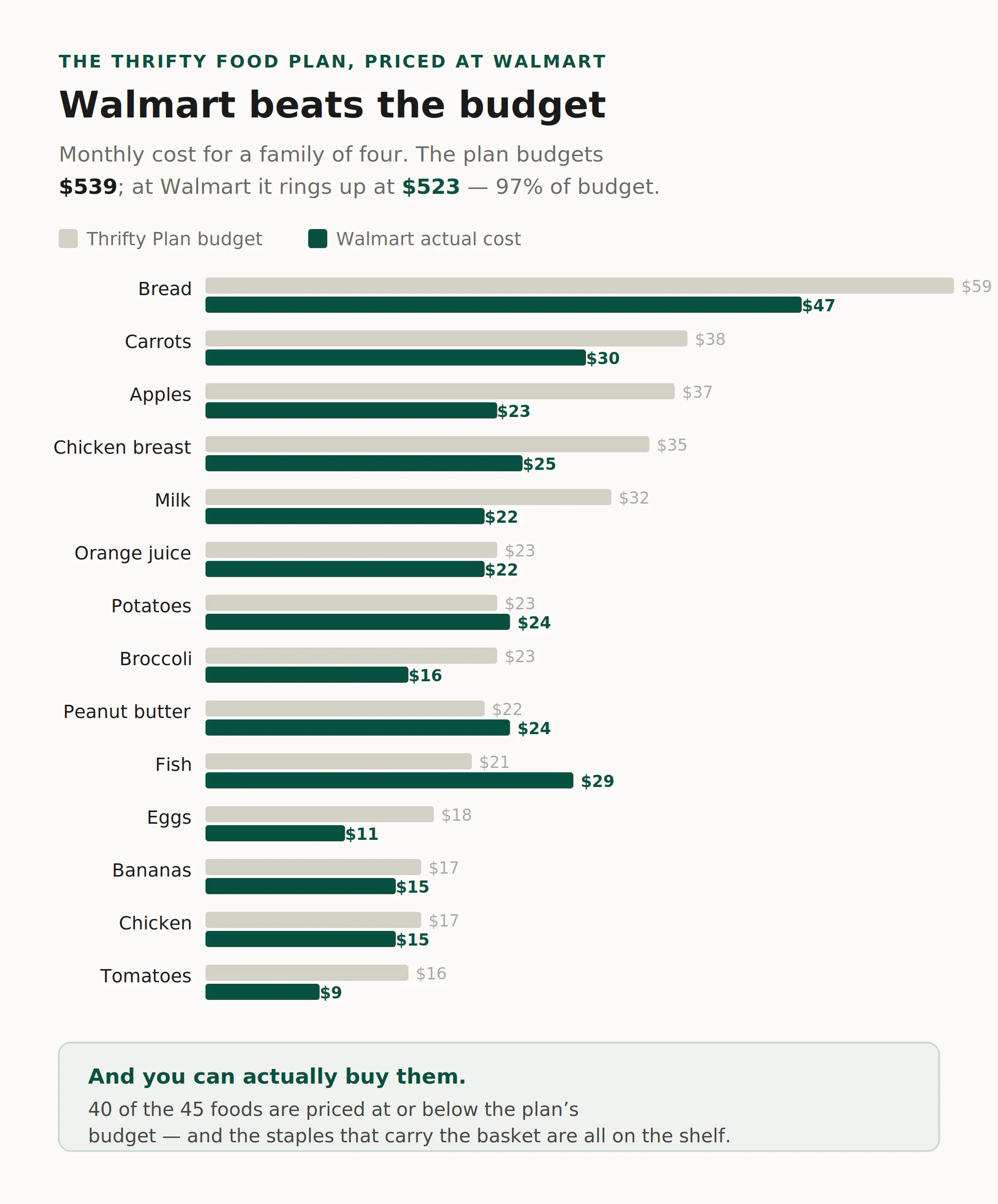
Priced at Walmart, the basket comes in under the government's number. The full monthly basket the USDA pegs at $539 rings up at about $523 — roughly 97% of budget, with 40 of the 45 items at or under their implied target price. Only five cost more — dry pinto beans, dry black beans, pork loin, soy milk, and queso fresco — and they fail by a hair. Together their overage is $8.50 of the $124.43 weekly basket, about seven percent. Even the losers barely lose.
For a family standing in a full-service Supercenter, with the whole list in front of them, the part of the Thrifty Food Plan that matters — the buyable core, not the fractional tail — basically works. The math holds. The food is there.
Which is exactly what makes the next part land. This is only true if you can get to a store like this.
It works at a Walmart Supercenter. Tens of millions of Americans don't shop at one.
For a family in a rural county, or a city neighborhood a bus transfer from a full grocery store, the nearest place that takes SNAP is often a dollar store. There are now roughly 20,000 Dollar Generals — more store locations than any other retailer in America — and in thousands of communities, the standard-format store isn't agrocery option. It's the only one.
So we ran the same 45-item basket through that shelf.
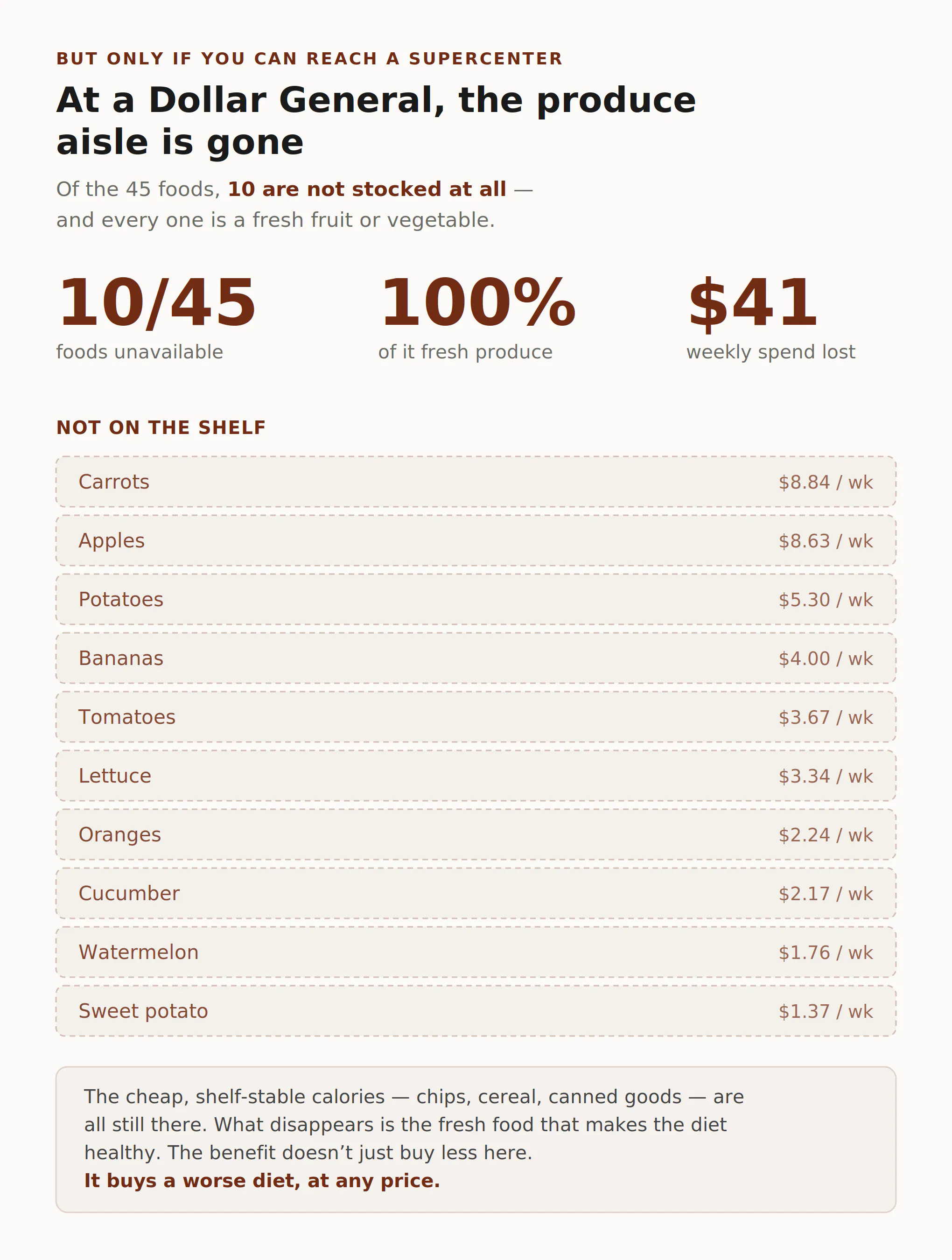
Ten of the forty-five foods simply aren't there. And it isn't a random ten — it's every fresh fruit and vegetable in the basket, without exception: the apples, bananas, carrots, potatoes, tomatoes, lettuce, oranges, cucumbers, watermelon, sweet potatoes. A standard Dollar General stocks shelf-stable cans, frozen goods, packaged snacks, limited dairy. The produce section doesn't shrink. It never existed.
And this isn't the cheap tail disappearing — it's the healthy core. Those ten fresh items are $41.32 of the weekly spend. A third of the basket. The chips, cereal, canned corn, and peanut butter survive. The fresh food the USDA's nutritionists built the whole plan around is the exact part that's gone.
So the optimistic finding comes with a condition. The benefit is a flat number, blind to whether a full grocery store is within reach — which means the math can be right and the food still absent.
This problem can be fixed — if the will is there.
We went in expecting to expose a number that doesn't work, and instead found one that mostly does. It is genuinely possible to buy the core essentials of the Thrifty Food Plan on what SNAP allocates — but only on one condition: a fairly priced, fully stocked grocery store is within reach. Where one exists, the government's math generally works. Where it doesn't, the same benefit buys a fundamentally worse diet.
The government can't conjure a grocery store into every neighborhood overnight. But there's a smaller, more solvable gap it did once at least attempt to solve — and just walked away from. For more than thirty years, SNAP-Ed taught recipients exactly the skills a tight budget demands — how to stretch food dollars, compare quantity and quality at the shelf, turn limited means into nutritious meals. In 2022 it reached about 1.8 million people through 29,000 partners at over 300,000 sites, on less than half a billion dollars a year. In 2025, the One Big Beautiful Bill Act zeroed it out entirely. The same law cut roughly $186 billion from SNAP itself and delivered the largest Medicaid cut in the program's history. As we documented with Barron's earlier this month, Medicaid-funded care work has quietly become one of the last reliable engines of job growth in much of the country. So one law thinned the food benefit, killed the program that taught people how to shop it, and pulled funding from the care economy that employs the same communities — communities whose health is shaped, year over year, by exactly the food access this whole piece is about. The cuts compound, and they land on the same kitchen tables.
But even SNAP-Ed taught only general shopping skills. It was never wired to the Thrifty Food Plan itself — the specific basket that sets the benefit. The government did the analytical part: it figured out, food by food, what a healthy diet costs at the lowest price — then locked that work inside a spreadsheet no shopper will ever open.
So here's the question worth asking: how do you take the intelligence in that spreadsheet and bring it into the shopping experience itself? None of it requires inventing anything. Picture a pre-built thrifty basket a family could order in one tap, instead of reverse-engineering 1,342 line items in the aisle; SNAP dollars that flag the most nutrient-dense option at the moment of choice. And for the places a full store doesn't reach — dollar stores supplemented by food co-ops, local farmers given a reason to feed their own communities. Different tools, one idea: stop treating the benefit as a check mailed into a void, and start treating it as a system someone is accountable for — measured by whether food reaches the table.
Let's be honest about the bar: this is far easier than building artificial intelligence, which the country is pouring hundreds of billions into right now. We are not short on capability. We are short on the accountability to carry the government's own homework the last mile — from the spreadsheet to the shelf.
Despite the thousand-plus things in it you can't actually buy, the Thrifty number still has real value. We can make the system behind it honest too — if someone is finally held to account for it.
A note on prices and method. The Thrifty Food Plan budget figures throughout reflect USDA's 2021 market basket scaled to May 2026 — the latest available CPI month — using item-level Consumer Price Index adjustments, not a price USDA published in May 2026. Walmart prices were observed directly in late June 2026 and modeled as whole minimum packages sufficient to cover one month; a handful relied on proxy items or required manual unit corrections. Of the 45 core foods, the five priced above budget are all medium-confidence estimates, and several reflect a cooked-weight-versus-dry-package mismatch that overstates the retail cost — so "40 of 45 at or under budget" is a conservative count. The dollar-store comparison models availability from standard Dollar General store formats rather than a physical store audit. The roughly one-month gap between the budget and retail price dates does not materially affect the comparison. Click here for a more detailed methodology.
Support Data That Serves the Public
Data should empower people, not just institutions. Your support helps us create accessible research, visualizations, and tools that uncover economic inequality and inform better decisions.
Donate
Enjoying this post?
Tell others about it.
More articles like this
Fetching Related Posts
There are no other articles tagged with Data 4 Thought