
Accountability Is Patriotism: Child Poverty on Native Land
A child born on Native land is far more likely to grow up in poverty than a child born almost anywhere else in America.

Eric Pachman
Published
June 29th 2026
Accountability is Patriotism
Failing the First Americans' Children
This coming Saturday, America celebrates its 250th birthday. In the run-up to that milestone we've been thinking about what patriotism actually means, and we keep landing on one ingredient that seems to have atrophied over time: accountability.
So this week's Data 4 Thought posts share a single theme. Accountability is patriotism. Five posts, five different topics, each one fixable with a little more accountability, capped by a bonus opinion piece on July 4th.
We hope the series helps us all think past the fireworks and the cookouts to a harder question: what can we, as a people, do better as we move beyond 250?
A note on what follows. Data 4 Thought usually keeps its authors out of the frame. We report what the numbers say, in plain language, and let you draw your own conclusions. This piece breaks that rule on purpose.
The research here is the same as always: fact-based, sourced, and reproducible. The numbers on Native-land child poverty are not our opinion, and they are not up for debate. We want that foundation to be undeniable.
But this week's theme is accountability, and accountability is hard to feel in the abstract. So once the data is on the table, I'm going to step out from behind it and tell you what it makes me feel. That part is opinion. It's my interpretation, shaped by my own views and biases, and you are free to read the same numbers and feel something entirely different. That's the point. We can disagree about what to do, as long as we start from the same shared truth about what is.
So: the facts first, undeniable. Then my views, which are only mine.
The first Americans
This first post is about the first Americans: the Indigenous people who were already here when the rest of us arrived on these shores chasing the freedom we celebrate, and take for granted, this week.
I should say plainly that I'm an outsider to this. I'm not Native, and I won't pretend to speak for anyone who is. What I can do is what we always do here, which is let the data speak, name the places it points to, and be honest about what it stirs up.
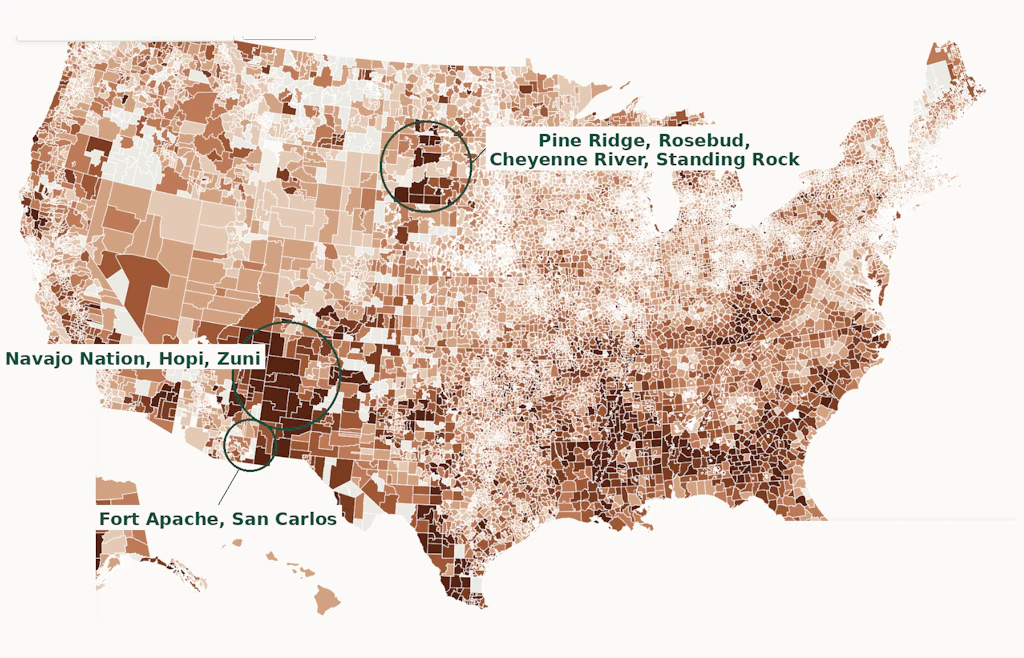
A few weeks ago we published an interactive map of child poverty by school district. Some of the densest red clusters on that map, it turned out, sat on federally recognized reservation land.
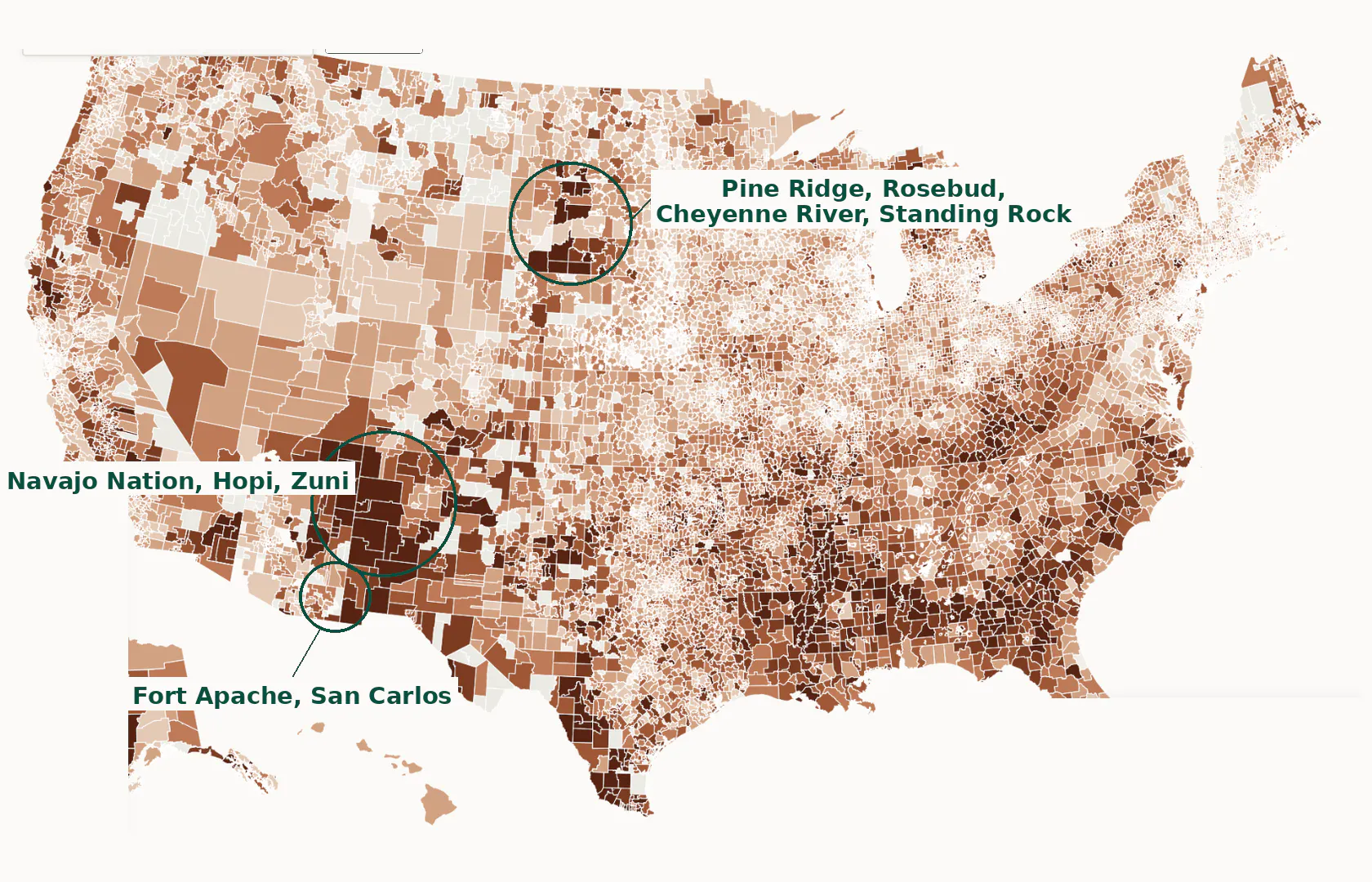
This post is our attempt to drill into that pattern and answer a plain question: are Native children more likely to grow up in poverty than the rest of us immigrants?
We use "the rest of us immigrants" deliberately here. Nearly every American family came to this country from somewhere else. Native Americans are the exception, and that exception is the whole point.
The data answers the question clearly. We found 144 school districts whose land falls at least 75% within Native land, which we define as federally recognized reservations and Alaska Native areas. Those 144 districts have a median child poverty rate of 22.4% and a weighted-average rate of 25.6%. Both are far higher than non-Native-land school districts, which sit at a 12.4% median and a 14.6% weighted average. Native-land child poverty runs close to double the rest of the country.
The hardest-hit districts have names worth saying out loud. On the Standing Rock, Cheyenne River, and Pine Ridge reservations in the Dakotas, and across the Navajo Nation in the Southwest, child poverty in some districts runs past 35%, 45%, even 50%. These are not abstractions. They are specific nations on specific land.
How to read the chart
The chart puts the two groups side by side so you can see not just the averages but the full spread.
On the left, each of the 144 Native-land districts is a single dot, arranged in a beeswarm: dots stack outward where many districts share the same poverty rate, so the width of the swarm at any height tells you how common that rate is. Hover any dot to see the district, its state, its child poverty rate, and which nation's land it sits on. The dots near the top are places like Dupree, on the Cheyenne River Reservation, and McLaughlin, on Standing Rock, where more than half of children live in poverty. On the right, the 12,983 other districts are too many to show as individual dots, so they appear as a filled shape whose width tracks how many districts fall at each rate, with the sparse high-poverty outliers still drawn as points.
Each side also has a summary box laid over it. Line up all the districts from the lowest poverty rate to the highest, and the box covers the middle half of them, the 25 percent above the midpoint and the 25 percent below. The line across the box is the median, the district right in the middle. So the box tells you where most districts sit, and the higher the box, the higher the poverty rate in the typical district in that group.
The takeaway is in the vertical shift of the box. Granted, the two groups overlap. Plenty of Native-land districts land in the same range as ordinary districts, and a few districts elsewhere have higher child poverty rates. But the whole distribution on the left is pulled upward. You can see it in the box and the median line, which sit far higher than they do on the right.
The most telling statistic of all is this: the median Native-land school district has higher child poverty than 86% of non-Native-land school districts. Put simply: a child born on Native land is far more likely to grow up in poverty than a child born almost anywhere else in America.
What the data makes me feel
This is the part that's opinion. The numbers above are fixed. What I do with them is mine, and yours to argue with.
I can't speak for you. I can only tell you what this chart does to me.
There's sadness in it, and frustration. But mostly there's anger at the hypocrisy of it: that the most native-born of our native-born children face a harder path to prosperity than the rest of us who came here from somewhere else. And there's guilt. I didn't cause this. But go back far enough and someone who looks like me did. And I ignored it until now.
But we're all busy, consumed by our own problems, and there's no reason to feel guilty for this. We are wired to fill our stress container to the brim, and stress feels just as dire whether the crisis is getting your daughter to her gymnastics meet on time or figuring out what the family eats tonight because the account is empty and payday is a week away.
However, data can put our problems in proportion. What are my problems, set against a child growing up in one of these districts? Can I make their problem my problem, even a little? Can I be accountable to them, when the land on which I write this post was theirs first?
So whose job is it to look out for these children? Who is accountable for giving them the same shot at a good life the rest of us expect for our children? Part of the answer is you and me: we are accountable for telling this story to the people we elect, and then holding these leaders accountable to fix this problem. That's not the opposite of celebrating America this week. It's the most patriotic thing we could do.
Support Data That Serves the Public
Data should empower people, not just institutions. Your support helps us create accessible research, visualizations, and tools that uncover economic inequality and inform better decisions.
Donate
Enjoying this post?
Tell others about it.
More articles like this
Fetching Related Posts
There are no other articles tagged with Data 4 Thought